InfoMiner Intelligence Platform: Detect Risks and Threats Faster, Broader and Deeper
InfoMiner monitors external intelligence, risk signals and potential threats around the clock for decision makers and intelligence, risk, research and mission-critical teams in government, finance and large enterprises. Fast, broad and deep capabilities support critical decisions. Marketing customers are not our core market.
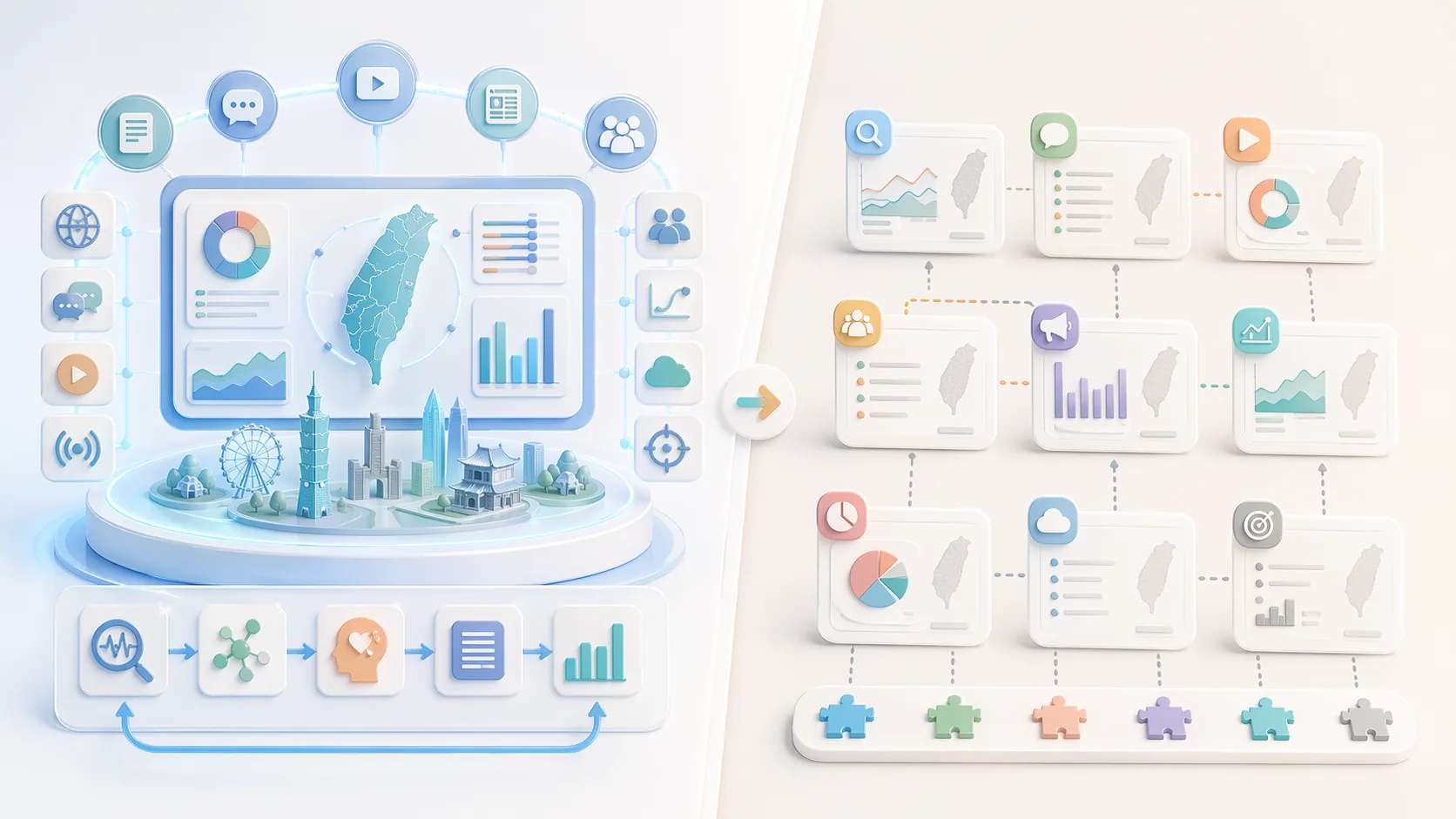
A clear market boundary: marketing customers are not our focus
Taiwan already has several mature platforms for brand, PR, social media and consumer insight teams. InfoMiner takes a different path: helping organizations obtain critical intelligence earlier, identify risk signals, anticipate potential threats and move assessments into the decision process.
This is not a ranking by feature count, scale or age. Each platform has customer segments and missions where it excels. InfoMiner has a clear market position centered on intelligence, risk and threat missions for government, finance and enterprises.
Intelligence, risk, and threats form one decision chain
Intelligence is not a large pile of news, posts, and reports. It is the continuous collection of mission-relevant external information and the verification of relationships among sources, timing, entities, and events, so an organization can understand how its external environment is changing. Information becomes usable intelligence only when it can be searched, compared, traced, and incorporated into a workflow.
Risk is where external change intersects with an organization’s own exposure. The same development can have very different implications for a government agency, financial institution, or enterprise. A platform must therefore do more than count mentions: it should help users determine whether an event affects policy, reputation, compliance, supply chains, operations, or customer trust.
Threats are events, actors, narratives, or propagation paths that may cause real-world impact. Here, threats are not limited to cybersecurity incidents; they also include the spread of false or misleading information, cross-border events, supply-chain disruptions, major controversies, and other external forces that may affect organizational stability. InfoMiner turns fragmented signals into threat indicators that teams can prioritize, track, and assess.
A complete workflow must therefore acquire intelligence first, identify risk next, and finally assess threats and their potential impact. This is also the clearest market distinction between InfoMiner and marketing applications centered on brand exposure, campaign performance, or consumer response.
Each platform serves a different core mission
The first selection question is not which tool has the most features. It is who will use it and what decision it must support. The following summarizes where each platform's clearest strengths fit.
Public-opinion analytics, social listening, and intelligence platforms may use similar public data, but product design differs by whom the platform serves. Marketing and brand teams focus on campaign response, audience profiles, and changes in attention. Teams accountable for risk and threats place greater emphasis on source completeness, alert speed, historical context, cross-border information, data integration, and deployment control.
| Platform | Core strengths | Best-suited missions and teams |
|---|---|---|
| InfoMiner | External intelligence integration, risk-signal monitoring, potential-threat alerting, long-term event context, data integration and on-premises deployment. | Decision makers and intelligence, risk, research and mission-critical teams in government, finance and large enterprises. |
| OpView | Mature Taiwanese online public-opinion data and analytics, with public-sector experience. | PR, research or public-affairs teams that need to understand Taiwanese public opinion, media response and social discussion. |
| KEYPO | Traditional Chinese corpora, the BIG10 domain language model, AI Agents and automated reporting. | Enterprise or content teams that value Chinese-language analysis, issue tracking and report production. |
| QSearch | Social-platform data, flexible trend analysis and brand workflows. | Daily monitoring and performance analysis for brand, social, campaign and marketing teams. |
| i-Buzz / QuickseeK | Industry and consumer research, cross-regional Chinese-language data and data APIs. | Market research, consumer insight, brand and cross-regional data teams. |
The table scrolls horizontally; swipe to see the full content.
InfoMiner's core strengths: fast, broad and deep
The value of an intelligence platform is not more charts. It is seeing risk earlier, understanding the information environment more completely and assessing potential threats more deeply at critical moments. InfoMiner connects all three in one intelligence workflow.
| Intelligence capability | How InfoMiner delivers it | Decision value |
|---|---|---|
| Fast | The current platform uses a 5-minute update and alert cycle, delivering new signals for configured topics by LINE or email. Actual service levels depend on the purchased plan and data sources. | Shorten the time from an event appearing to organizational detection and assessment, giving decision makers an earlier view before risk expands. |
| Broad | Cover more than 500,000 channels across news, forums, social media, television and video. LargitData data services can add cross-border sources such as Weibo, Xiaohongshu and Douyin, with API integration into existing systems. | View the same event across media, regions and languages without limiting the picture to one platform or market. |
| Deep | Depending on the plan and source licensing, data can extend back more than 10 years. InfoMiner combines propagation paths, topic networks, OCR, ASR, generative AI summaries and event assessment, and can use QubicX and RAGi for internal knowledge integration and on-premises deployment. | Place a single signal in the context of long-term trends, propagation structures and organizational knowledge to create a traceable basis for assessment. |
The table scrolls horizontally; swipe to see the full content.
Fast: Begin assessment before a signal becomes an incident
Intelligence speed is not simply how often a page refreshes. It is the total time from the appearance of a critical signal, through system detection and delivery to the responsible person, to the start of organizational assessment. InfoMiner currently supports five-minute updates and alerts, allowing new developments in monitored topics to enter on-call, risk-management, or decision workflows through LINE or email. Actual service levels depend on the purchased plan and data sources.
Broad: Prevent intelligence blind spots caused by a single source
Major events rarely remain on a single platform. They may first appear on social media or a forum, move into news and video, and then spread across regions and languages. InfoMiner covers more than 500,000 channels across news, forums, social media, television, and video. Cross-border data services and APIs can be added so users can examine gaps and connections among sources from a single mission perspective.
Deep: Assess real-time signals in their long-term context
Looking only at current attention can mistake short-term fluctuations for long-term trends and overlook earlier appearances of the same narrative, account, or propagation structure. Depending on the plan and source licensing, InfoMiner can look back more than ten years and combine propagation paths, topic networks, OCR, ASR, generative AI, and internal knowledge to help analysts explain where an event began, how it evolved, and which existing risks it relates to.
From external intelligence to risk alerting and threat assessment
InfoMiner turns public information into intelligence that can enter an organization's decision process. Teams can start with risk-signal monitoring, move through anomaly detection, cross-source comparison, propagation analysis and historical review, then deliver threat assessments to decision, risk or research functions.
- Intelligence:Continuously track specified topics, people, organizations, events and external change.
- Risks:Identify risk signals such as unusual volume, critical content and escalating events.
- Understand:Reconstruct event context across news, social media, forums, video and cross-border sources.
- Threats:Use propagation paths, long-term data, AI summaries and internal knowledge to assess potential impact.
- Deliver:Deliver intelligence into existing workflows through reports, alerts, APIs or on-premises environments.
InfoMiner serves teams accountable for risks and threats
When users are accountable for policy, financial risk, enterprise operations, supply chains, major events or public issues, they need more than mention counts. They need trustworthy, traceable and continuously operating intelligence infrastructure.
Government and public governance: Track events and societal risk
Government and public-governance teams need to know whether an issue is intensifying across platforms, which narratives are spreading, and whether a local discussion is becoming a cross-regional public risk. InfoMiner brings real-time monitoring, historical trends, and propagation context together so case officers, researchers, and decision-makers can maintain a shared, continuous view instead of conducting fragmented searches separately.
Financial services and risk management: Connect external signals to organizational exposure
External risks facing financial institutions may involve corporate reputation, regulatory developments, customer trust, industry events, and market change. An intelligence platform organizes fragmented signals by topic, entity, and time, then uses alerts, historical comparison, and data integration to feed them into existing risk-control workflows for professional review and action.
Large enterprises and mission-critical teams: Build sustainable intelligence capabilities
Large enterprises must monitor markets, competitors, supply chains, overseas operations, and emerging events at the same time. When data sources, monitored topics, and user departments multiply, one-off searches and manually prepared reports are difficult to sustain. Through cross-border sources, APIs, permissioned workflows, and QubicX and RAGi for internal-knowledge integration and on-premises deployment, InfoMiner helps organizations retain intelligence capabilities within their own processes and environments.
| Use case | Key question | InfoMiner capabilities |
|---|---|---|
| Government and public governance | Is the event escalating, spreading across platforms or creating a new public risk? | Real-time alerts, cross-source tracking, event context and long-term trends. |
| Finance and risk management | Could external signals affect reputation, compliance, customer trust or operational stability? | Multi-source risk monitoring, historical comparison, alerts and data integration. |
| Large enterprises and mission-critical operations | How will markets, supply chains, competitors and unexpected events affect the next decision? | Cross-border intelligence, propagation assessment, internal and external knowledge integration, and on-premises deployment. |
| Research and analysis units | How can verifiable trends, relationships and changes be found in large volumes of data? | Long-term data, topic networks, multimodal analysis and traceable sources. |
How to choose: start with the decision you serve
If the core work is brand campaigns, social media operations, consumer insight or marketing performance, QSearch, i-Buzz, QuickseeK and relevant OpView or KEYPO plans all offer mature capabilities. If the core work is external intelligence, risk monitoring, threat alerting, cross-border data or on-premises integration for government, finance or large enterprises, InfoMiner is the platform built for that mission.
The most effective evaluation uses a real mission: test whether required sources are covered, how quickly critical signals arrive, whether history restores context, whether analysis is traceable, and whether intelligence can enter the organization's existing decision process.
Further information
- InfoMiner:Product overview、Government procurement contract、QubicX、Developer Portal
- OpView:Public-sector solution、API
- KEYPO:keypo.tw
- QSearch:Platform features
- i-Buzz / QuickseeK:i-Buzz API、QuickseeK