QubicX vs. Other On-Premise AI Solutions: Complete Enterprise On-Premise Deployment Comparison Guide
With the proliferation of generative AI, more Taiwan enterprises are evaluating on-premise AI deployment options. Solutions range from in-house DIY (integrating Ollama + vLLM), NVIDIA AI Enterprise, Microsoft Azure Arc AI, to all-in-one platforms like QubicX, each with distinct use cases and trade-offs. This guide provides a comprehensive comparison across six dimensions: deployment complexity, LLM support breadth, RAG integration, maintenance workload, local Taiwan support, and cost.
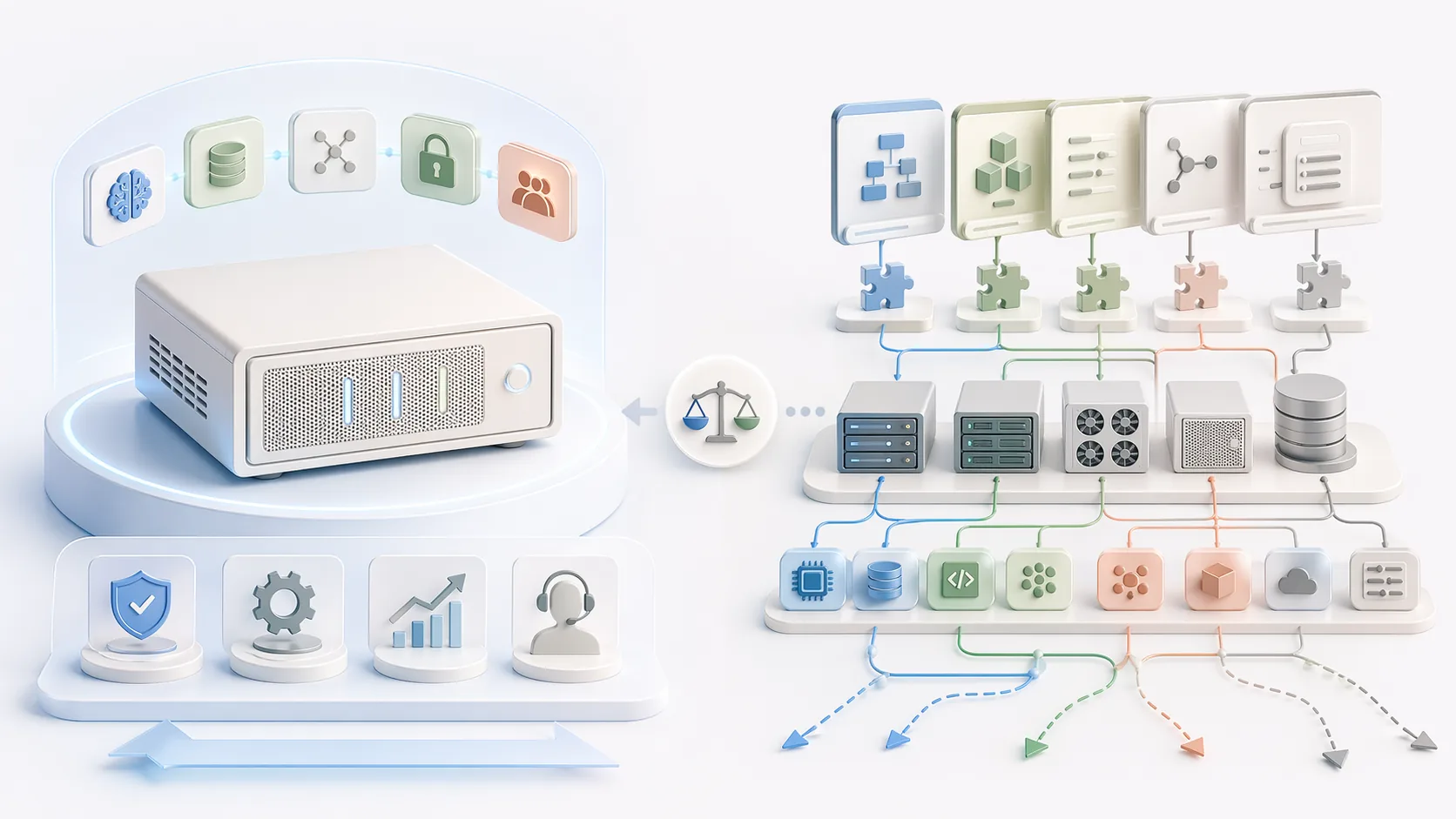
Feature Comparison Table
| Assessment Dimensions | QubicX | In-House DIY Solution (Ollama + vLLM) | NVIDIA AI Enterprise | Azure Arc AI |
|---|---|---|---|---|
| Product Positioning | All-in-one enterprise on-premise AI platform, including hardware, software, and services | Self-integrated open-source tools, fully customized | GPU-optimized software stack tailored for NVIDIA hardware | Cloud-to-edge extension, hybrid cloud management platform |
| Deployment Complexity | Low: Vendor assists with installation and initial setup; actual timeline depends on hardware delivery and security review progress | High: Requires AI engineers to design architecture and integrations | Medium: Requires NVIDIA hardware with moderate configuration complexity | Medium: Requires Azure account with involved hybrid cloud setup |
| LLM Support Breadth | Mainstream open-source models (Llama, Mistral, etc.), optimized for Traditional Chinese | Supports virtually all open-source models, offering maximum flexibility | NVIDIA NIM supports a broad range of LLMs, including commercial and open-source models | Supports Azure AI service models, including OpenAI and select open-source models |
| RAG Integration | Built-in RAG engine supporting document upload, vectorization, and semantic retrieval | Requires manual integration of LangChain/LlamaIndex and vector databases | Provides RAG components, but requires manual integration and configuration | Integrates with Azure AI Search, but requires cloud connectivity |
| User Interface | Enterprise Web management console, operable by non-technical staff | Primarily CLI-based, requiring custom UI development | Technical management backend requiring specialized NVIDIA expertise | Managed via Azure Portal, comprehensive UI primarily in English |
| Maintenance Workload | Low: Vendor provides maintenance services and SLAs | High: All updates, patches, and tuning must be handled internally | Medium: NVIDIA provides technical support, requiring internal enterprise IT coordination | Low to Medium: Microsoft cloud services management, with hybrid architecture complexity |
| Local Taiwan Support | Local Taiwan technical team offering Traditional Chinese service and rapid response | Primarily open-source community support (mostly in English); verify commercial support options with each project's official website | NVIDIA partners exist in Taiwan, though support depth varies by vendor | Microsoft has locations and partners in Taiwan with stable support quality |
| Domestic Data Residency | Full on-premise deployment: computing and data executed entirely within corporate intranet without external transmission | Fully on-premise, depending on your custom-designed architecture | Runs on on-premise hardware; verify license activation and update mechanisms with official NVIDIA terms | Hybrid cloud architecture where management control plane involves Azure cloud services; verify data and management traffic paths with official Microsoft architecture documentation and your deployment configuration |
| Traditional Chinese Optimization | Specially optimized for Traditional Chinese NLP with strong comprehension of Taiwan context | Depends on chosen models; platform layer includes no Chinese fine-tuning and requires manual handling | Official documentation does not specify dedicated Traditional Chinese tuning; Chinese performance depends on selected models | Chinese performance depends on selected Azure AI models; we recommend benchmarking with your own corpora |
| Cost Structure | Hardware + software licensing + service fees in an integrated turnkey quote | Zero software license fees, but hardware and engineering labor must be factored in; long-term maintenance hours should be included | Requires NVIDIA hardware and enterprise software licensing; contact NVIDIA or authorized partners for pricing | Hybrid cloud pricing structure: on-premise hardware plus Azure subscription fees; refer to Microsoft official pricing pages |
This comparison was compiled in July 2026 based on official public documentation, open-source project repositories, and product descriptions. Features, licensing models, and package contents may change across updates; refer to each vendor's latest official announcements. If any description diverges from current reality, please contact us for correction.
Overview of Major Enterprise On-Premise AI Deployment Solutions
Enterprises face diverse options when evaluating on-premise AI, each suitable for specific scenarios. In-house DIY approaches (integrating open-source tools like Ollama, vLLM, and LangChain) give engineers maximum technical freedom to support nearly any model and deployment topology; the trade-off is requiring a dedicated AI engineering team to architect systems, integrate components, and handle long-term maintenance.
NVIDIA AI Enterprise is a commercial software suite optimized for NVIDIA GPUs, featuring NIM (NVIDIA Inference Microservices), NeMo training frameworks, and enterprise support. For enterprises with substantial NVIDIA GPU investments, it extends the value of existing hardware; however, the software stack is deeply coupled with the NVIDIA ecosystem. Contact NVIDIA for official licensing pricing.
Microsoft Azure Arc AI extends Azure AI services to on-premise infrastructure, ideal for organizations deeply embedded in the Microsoft ecosystem. A hybrid cloud architecture allows workloads to run locally while managed via cloud; however, operations remain reliant on Azure's cloud control plane, which may raise concerns for strict data-never-leaves-premise policies.
QubicX offers an alternative approach: a turnkey solution covering hardware selection, software platforms, and operational services for enterprise on-premise AI, backed by full Chinese-language support from a local Taiwan team.
QubicX's Core Advantages and Positioning
QubicX is designed so enterprise IT departments can run on-premise AI successfully without needing to become AI infrastructure specialists. The platform integrates LLM inference engines, enterprise knowledge bases (RAG), user management interfaces, API gateways, and monitoring systems under a unified Web console.
QubicX is tuned specifically for Traditional Chinese, with preloaded models and retrieval configurations validated primarily against documents in Taiwanese contexts; actual response quality varies by document structure and query style, so testing internal data during PoCs is recommended. The built-in RAG engine supports parsing, chunking, and semantic retrieval for Chinese documents, enabling business users to build enterprise knowledge bases directly by uploading Traditional Chinese files without requiring engineer intervention each time.
From a security perspective, QubicX uses on-premise deployment, executing all data computing within the corporate intranet while providing RBAC permission controls, operational audit logs, and data encryption. For regulated organizations such as financial institutions and government agencies, we assist compliance and security reviews with architecture documentation and control checklists; verifying compliance with specific statutory requirements and internal policies remains the responsibility of your legal and security teams based on data types and deployment environments.
Comparative Analysis with In-House DIY Solutions
The most common starting point for DIY solutions is Ollama paired with Open WebUI, allowing engineers to run LLMs locally within hours as a rapid path to validating on-premise AI feasibility. However, a substantial engineering gap exists between a personal testbed and an enterprise production environment.
To bring a DIY solution to enterprise-ready production requires additional work: multi-user authentication and RBAC systems, RAG knowledge base integration (selecting and deploying vector databases, implementing embedding pipelines), monitoring and alert mechanisms, high-availability architecture (load balancing, failover), security audit logging, and comprehensive backup and disaster recovery plans. Combined, these tasks typically demand months of effort from an experienced AI engineering team.
The advantage of DIY lies in technical flexibility and zero licensing fees. If your organization boasts ample AI engineering talent and requires highly customized architectures, building in-house is a viable choice. But for enterprises whose core business is not AI engineering, the total cost of ownership (engineering labor + maintenance) of a DIY approach often exceeds QubicX licensing costs.
Comparison with NVIDIA AI Enterprise
NVIDIA AI Enterprise is a commercial software suite designed for enterprises with existing NVIDIA GPU infrastructure. NIM microservices provide optimized LLM inference containers delivering peak performance on NVIDIA GPUs; NeMo Guardrails provides safety guardrails; NeMo Retriever supplies RAG components. For organizations with large-scale inference workloads and existing NVIDIA hardware, NVIDIA AI Enterprise is worth evaluating for hardware performance; actual concurrent capacity must be benchmarked against specific models, quantization schemes, and GPU configurations.
However, NVIDIA AI Enterprise is positioned as an AI infrastructure platform rather than an out-of-the-box enterprise AI application. Enterprises must still assemble knowledge base management, user interfaces, and business workflow integrations themselves. Furthermore, obtain official license pricing from NVIDIA or authorized partners, and note how tightly the software stack couples with NVIDIA's ecosystem, which affects future procurement flexibility.
QubicX does not lock into a single GPU vendor, allowing configurations with NVIDIA or AMD GPUs based on enterprise budgets and requirements for greater procurement flexibility. For local support in Taiwan, LargitData directly provides Traditional Chinese technical services under a single contact point with clear accountability; for other solutions, we advise requesting written terms regarding local support channels and service level agreements prior to contracting.
Deployment Complexity and Maintenance Cost Comparison
Deployment complexity and ongoing maintenance are crucial factors frequently underestimated during vendor selection. QubicX offers on-site installation services where technical engineers handle hardware setup, OS tuning, software installation, and initial configuration, while enterprise IT teams primarily coordinate network and security policies. Initial deployment timelines vary based on hardware delivery, server room readiness, network provisioning, and security review cycles; we recommend scheduling prerequisite tasks at project kickoff.
Deployment timelines for DIY solutions depend heavily on engineers' AI infrastructure experience. Teams new to LLM deployment often spend considerable time merely evaluating options (which vector database, which embedding model, vLLM vs. alternative inference frameworks). Transitioning from proof-of-concept to a stable production environment requires integration, stress testing, and security audits; project duration should be assessed based on team expertise and project scope rather than generalized with a single number.
Regarding maintenance costs, QubicX includes Service Level Agreements (SLAs) with regular system health checks and version updates, requiring enterprises only to maintain the underlying hardware environment. In contrast, DIY solutions require continuous tracking of open-source component updates (breaking changes, vulnerability patches) and resolving compatibility issues across integrations—a substantial burden for resource-constrained IT departments.
Selection Recommendations for Taiwan Enterprises
Based on enterprise scale, IT capabilities, and core requirements, here are specific selection recommendations:
- Choose QubicX: If enterprise IT teams lack AI infrastructure expertise, wish to shorten the evaluation-to-launch timeline, value Traditional Chinese fine-tuning and local support, or belong to regulated sectors like finance and government with strict data residency requirements. QubicX unifies hardware, software, and operational services under a single window, reducing DIY engineering overhead and eliminating ambiguous accountability.
- Consider In-House DIY Solutions: If you have in-house engineering talent skilled in AI infrastructure, require highly customized architectures, prefer investing engineering hours over paying software licenses, or need to support many niche models and workflows. Building in-house offers maximum flexibility, but organizations must honestly weigh long-term maintenance costs and handover risks.
- Consider NVIDIA AI Enterprise: If you have already procured substantial NVIDIA A100/H100 GPUs, employ AI infrastructure engineers, primarily seek to maximize GPU inference performance, and possess sufficient budget for NVIDIA licensing fees.
- Consider Azure Arc AI: If your organization is deeply integrated into the Microsoft 365 / Azure ecosystem, familiar with Microsoft hybrid cloud architectures, and has no compliance concerns regarding certain data flows traversing Azure cloud services.
A recommended progressive path is initiating proof-of-concept testing with Ollama to confirm the value of on-premise AI in your use cases, then evaluating QubicX for production deployment. This approach minimizes initial investment while building hands-on insights into user requirements, document formats, and hardware workloads during the PoC phase, providing solid empirical grounding for formal rollouts.