Supply Chain Security Review Guide: Supplier Risk Assessment and Continuous Monitoring
A Supply Chain Security Review refers to a systematic assessment and continuous monitoring in which an enterprise evaluates its suppliers, contractors, and counterparties for country risk, compliance risk, financial stability, and cyber security risk, in order to ensure the resilience and compliance of the supply chain. As geopolitical tensions rise, export controls tighten, and awareness of critical infrastructure protection grows, supply chain security review has become indispensable for manufacturing, technology, high-tech manufacturing, and government procurement. This article fully explains the definition of supply chain security review, its risk dimensions, review process, and continuous monitoring mechanisms, and describes how LargitData supports enterprises in building supply chain risk management capabilities with InfoMiner and RAGi.
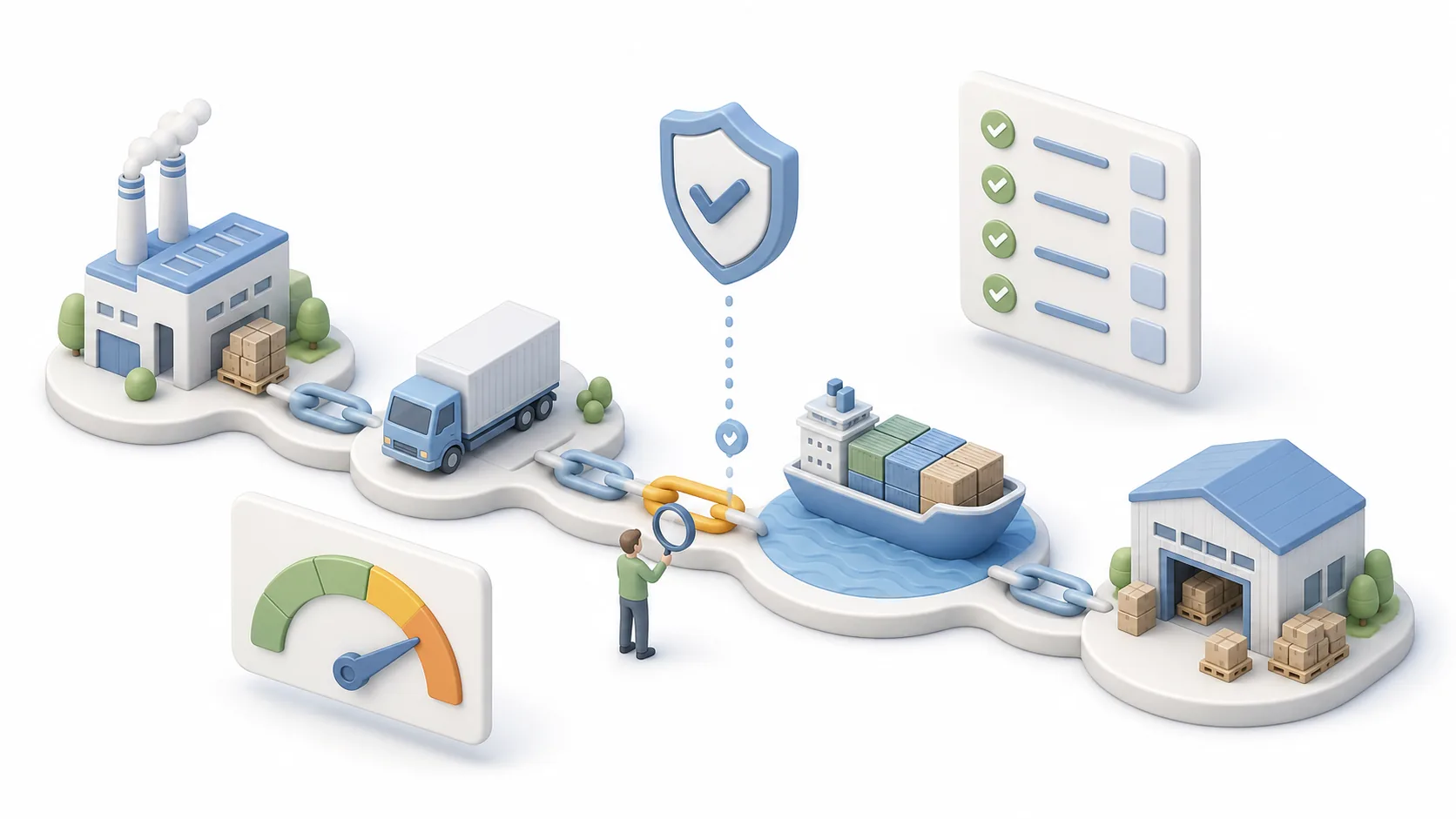
The Definition and Importance of Supply Chain Security Review
The core objective of a supply chain security review is to continuously identify and reduce, before and after a supplier enters the supply chain, risks that could disrupt operations, violate regulations, or damage reputation. Traditional supplier evaluation focuses mostly on price, quality, and delivery, but in an environment of rising geopolitical and cyber security risk, enterprises must additionally incorporate dimensions such as country risk, sanctions compliance, cyber resilience, and beneficial owners. Once any link in the supply chain involves a sanctioned entity, a security vulnerability, or a financial crisis, it can cause cascading impacts on overall operations.
For Taiwan's manufacturing and technology sectors, supply chain security review is especially critical. Global export controls and technology control policies change rapidly, and a supplier's country and end use can directly affect whether an enterprise can legally ship. Institutionalizing supply chain security review enables enterprises to quickly inventory affected supply nodes when policies change, reducing operational and compliance risk.
The Key Risk Dimensions of the Supply Chain
- Country risk: assessing the geopolitical stability, export controls, and trade policy of the supplier's home country.
- Sanctions compliance: screening against public sanctions lists such as OFAC, EU, and UN to avoid dealings with sanctioned entities.
- Beneficial owner identification: penetrating the ownership structure to confirm the supplier's ultimate controlling party and related risks.
- Financial stability: assessing the supplier's financial soundness and the risk of bankruptcy or financial crisis.
- Adverse media and litigation: detecting disputes, penalties, and legal disputes involving the supplier.
- Cyber security and data protection: assessing the supplier's cyber resilience and data-handling compliance.
- Critical infrastructure compliance: meeting supply chain security requirements for highly regulated industries and critical infrastructure.
- ESG and labor risk: reviewing the supplier's environmental, social responsibility, and labor conditions.
- Concentration risk: identifying structural risk from over-reliance on a single supplier or a single country.
Use Cases
- Onboarding review by manufacturing and technology firms before adopting new suppliers.
- Supply chain security compliance reviews for highly regulated industries and critical infrastructure units.
- Qualification and risk review of bidding suppliers in government procurement.
- Assessment of suppliers' country and end use in export control scenarios.
- Periodic review of existing suppliers and real-time review triggered by anomalous events.
The Supply Chain Security Review Process
A thorough supply chain security review generally comprises four stages. The first stage is onboarding review: before a supplier enters the supply chain, complete identity verification, sanctions screening, country risk assessment, and beneficial owner identification. The second stage is risk grading: based on the review results, classify suppliers into high, medium, and low risk levels, applying stricter controls and more frequent reviews to high-risk parties. The third stage is continuous monitoring: maintain long-term observation of key suppliers, with real-time alerts when sanctions lists are updated or when significant adverse media or financial anomalies occur. The fourth stage is response and exit: when risk exceeds acceptable limits, initiate alternative supplier assessment and exit procedures.
Continuous Monitoring and Sanctions Screening
Supply chain risk is not static. A one-time admission review cannot capture how a supplier's risk profile may change in the future, which is why continuous monitoring is key to supply chain security. By automatically cross-referencing public sanctions lists such as OFAC, EU, and UN lists, and continuously monitoring negative news, litigation, and changes in country-level policy, a company can receive an early warning the moment a risk emerges and take countermeasures sooner. Sanctions lists are updated frequently, and automated matching can shorten the gap between "the list changing" and "the company becoming aware of it," reducing response time more effectively than periodic manual checks. However, no mechanism can guarantee there will be absolutely no blind spots, and a few inherent limitations should be acknowledged when designing such a system: there is a time lag between when each list is published and when it is synchronized, and the underlying data sources themselves may be delayed or incomplete; name matching is affected by transliteration differences, abbreviations, Traditional/Simplified Chinese variants, and entities sharing the same name, matching too loosely produces a flood of false positives, while matching too strictly can miss real matches; relationships held through multi-layered equity structures or proxy arrangements often don't appear directly on the lists and require separate look-through checks; and if retrospective scanning of historical transactions is not included in scope, previously established business relationships may be overlooked. A practical approach, therefore, is to clearly define the scope of matching and the list of data sources, set a re-scan frequency triggered by list updates, establish a manual review and escalation procedure for false positives and ambiguous cases, and log the time, data source version, and rationale for every match, so that coverage and exception handling can both be reviewed.
Deployment Options and Data Governance Compliance
A supply chain security review platform can be deployed either in the cloud or on-premise, depending on requirements. For general manufacturing and technology enterprises, a cloud solution deploys quickly and has low operating costs; for highly sensitive industries, critical infrastructure, and government clients, on-premise deployment keeps data processing and model inference within the internal network, meeting data sovereignty and confidentiality requirements. Review data should be limited to sources that are public and lawfully obtainable, with access control, audit trails, and a data retention policy in place so that review results are traceable and verifiable. It's worth noting that data being "publicly available" does not mean it may be "freely collected, reproduced, stored, or used across borders": the same piece of public data may be treated differently under the law depending on whether it's used for a one-time credit check versus long-term profiling and monitoring; platform terms of service may also restrict automated scraping and reuse. We therefore recommend reviewing, source by source and use by use: what usage the source's authorization or terms permit; whether the collected content includes personal data of natural persons (such as the names of responsible parties or board members), which would require a separate lawful basis; how the retention period and deletion mechanism are set; and whether cross-border transfer is involved. Determinations of applicability under the Personal Data Protection Act and GDPR should be confirmed case by case by legal counsel based on the data type, processing purpose, and the company's role; the actual scope of applicability and operational requirements should still be based on the latest announcements from the competent authority and your company's legal determination. The relevant provisions can be found atLaws & Regulations Database of the Republic of China (Taiwan)for reference.
Further Reading
FAQ
Want to build supply chain risk management capabilities?
Contact the LargitData expert team to learn how InfoMiner and RAGi can help you conduct supplier risk assessment, sanctions screening, and continuous monitoring.
Contact Us Book a Demo