AI Agent vs. RPA: A complete comparison of old and new automation technologies — how should enterprises choose?
RPA (Robotic Process Automation) has been the primary tool for enterprise digital transformation over the past decade, and AI Agents are now redefining the boundaries of process automation under the banner of “intelligent automation.” For many Taiwanese enterprises, the key question is: does existing RPA investment need to be retired? Is AI Agent really superior to RPA? Through a comprehensive technical comparison, cost analysis, and migration strategy, this article helps IT leaders and digital transformation officers make the selection decision that best fits their situation.
RPA technology fundamentals and current state
RPA (Robotic Process Automation) is an automation technology that uses software robots to mimic human operations on a computer interface. RPA robots can record and repeatedly execute fixed operational workflows, such as logging into systems, copying and pasting data, filling out forms, and downloading reports, without needing to modify backend systems or develop API interfaces. Common RPA platforms on the market include UiPath, Automation Anywhere, SS&C Blue Prism, and Microsoft Power Automate.
RPA's core advantage lies in being “non-invasive”: it operates at the UI layer of existing systems, requires no backend development resources, has a relatively low adoption barrier, and can automate large volumes of repetitive work in a short time. Over the past decade, RPA has been one of the most widely adopted tools for enterprise process automation, with particularly high penetration in form- and report-centric units such as finance, HR, and shared service centers; however, actual adoption rates vary widely across companies, so it's best to rely on public surveys or peer interviews within your own industry rather than applying a single market adoption figure.
However, RPA also has clear limitations. RPA robots are “rule-driven”: they can only execute pre-configured fixed workflows, and even a small change to an application's interface, such as a button moving, a field name being renamed, or a pop-up window gaining an extra confirmation step, can cause the robot to fail and require manual reconfiguration. More importantly, RPA itself has no “understanding capability”: it cannot interpret the content of unstructured documents, cannot make flexible decisions when facing exceptions, and cannot handle tasks that require contextual understanding. In practice, the most common pain point in RPA projects is maintenance burden: how often business processes and system interfaces change tends to determine how often robots need to be readjusted, and this cost is often underestimated during the adoption evaluation stage.
Core Differentiators of AI Agents
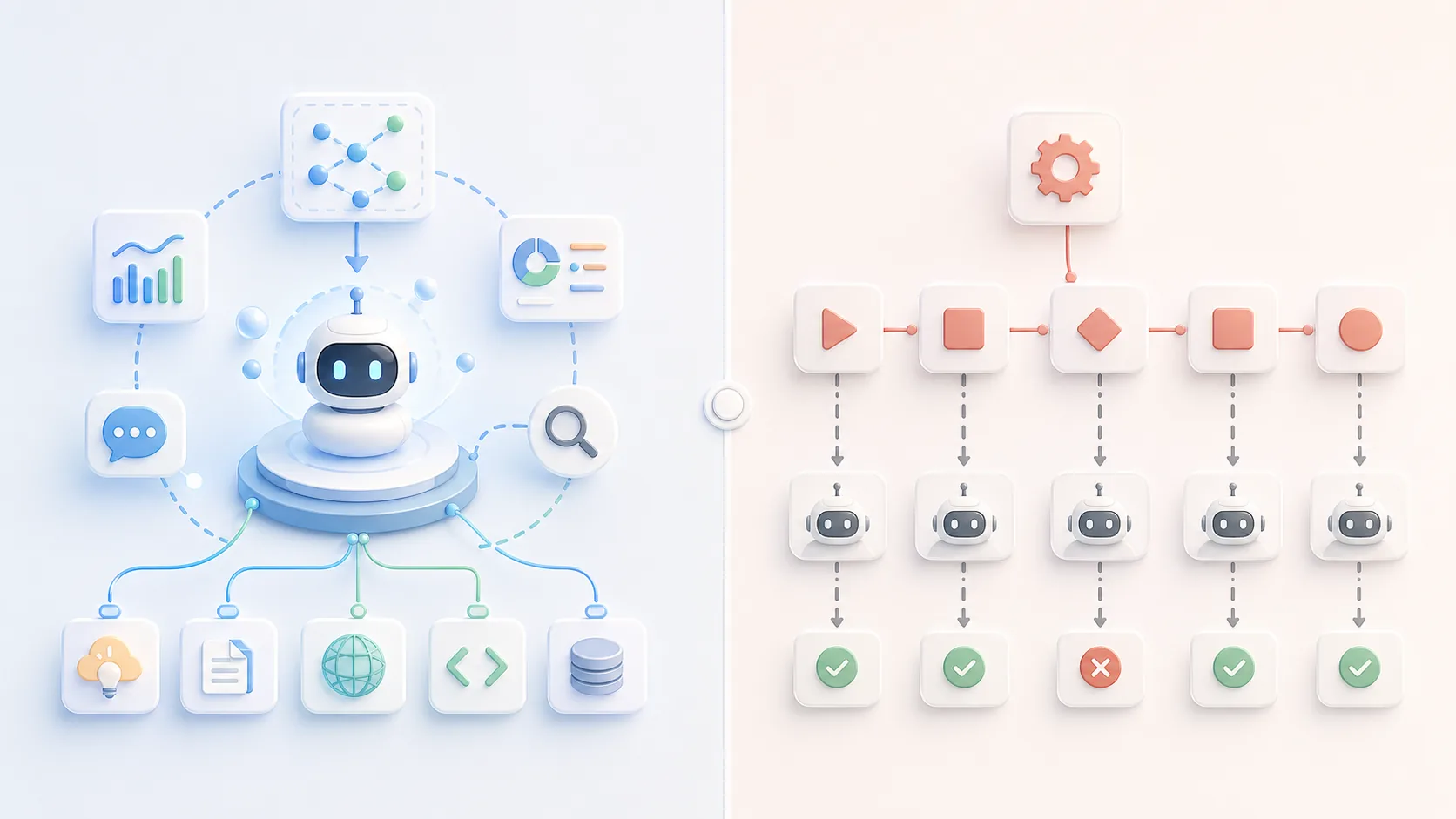
The design philosophy of AI Agent is fundamentally different from RPA. RPA is a “rule executor,” while AI Agent is a “goal achiever.” An instruction given to RPA is “click button A, copy field B, paste it into system C”; an instruction given to AI Agent is “handle all of today's pending expense approval requests for me.” The Agent autonomously understands the task goal, plans execution steps, handles various exceptions along the way, and reports the results once the task is complete.
The core technical breakthrough of AI Agent shows up in three areas. The first is understanding unstructured data: AI Agent can read and comprehend unstructured information such as PDFs, scanned documents, email content, and contract clauses, an area that RPA can barely touch. The second is contextual understanding and exception handling: when a process encounters an unexpected situation (for example, a customer inquiry spanning multiple departments, or a contract containing a special clause), AI Agent can understand the context and make a reasonable judgment, whereas RPA can only stop and wait for human intervention. The third is natural language interaction: users can assign tasks to AI Agent in natural language without following a fixed input format, greatly lowering the barrier to use.
Feature and capability comparison table
| Dimension | RPA (traditional robotic process automation) | AI Agent (intelligent autonomous agent) |
|---|---|---|
| Execution logic | Rule-driven (fixed If-Then workflow) | Goal-driven (autonomously plans multi-step execution paths) |
| Data handling | Structured data only (fixed fields, tables) | Structured + unstructured (PDF, email, images, voice) |
| Exception handling | Stops on any exception; requires manual intervention | Reasons autonomously to handle exceptions, escalating to a human when necessary |
| System interface changes | Sensitive to layout changes; interface adjustments often require reconfiguration | When integrated via a stable API, it is generally less directly affected by UI changes; however, it can still be affected by API version, permission, and data structure changes |
| Learning and optimization | No learning capability; rules are fixed | Can continuously improve performance through memory and feedback |
| Adoption complexity | Low to medium (UI recording, no API required) | Medium to high (requires API integration and prompt engineering) |
| Initial Implementation Cost | Relatively low (primarily UI recording) | Relatively high (depends on the complexity of API integration and evaluation setup) |
| Main drivers of long-term maintenance | How frequently the target system's interface and processes change | API contract changes, model version updates, prompt and knowledge base maintenance, output quality audits |
| Task complexity ceiling | Lower (suited to tasks with fixed steps and minimal judgment) | Higher (can handle tasks that require reasoning and judgment, but output needs a verification mechanism) |
| Result predictability | High: the same input produces the same action, with a clear audit trail | Lower: the same input may produce different phrasing or paths, requiring designed evaluations, retained reasoning logs, and manual review checkpoints |
| Applicable departments | Highly repetitive-work departments such as finance, HR, and data entry | Almost any knowledge-work department (customer service, research, compliance, IT) |
Note: the table above is a directional comparison of technical characteristics, not a fixed specification. Actual implementation effort, maintenance burden, and success rate can vary significantly depending on process complexity, whether the system has an API, data quality, and governance maturity; it's best to rely on the actual results of a pilot on your own process.
Which processes suit RPA, and which suit AI Agent
The first criterion for selection is not how new the technology is, but the “decision density” of the process itself. If every step of a process from start to finish can be written as an explicit rule, with a fixed input format and very few exceptions, then it's RPA's sweet spot: downloading and converting reports on a daily schedule, moving data from fixed fields in system A to system B, batch-creating accounts, or converting statement formats. Using an Agent for this kind of task is actually wasteful, adding uncertainty without gaining any judgment in return.
Conversely, if part of a process requires “understanding the content to know what to do next,” that's where AI Agent comes into its own: judging the category and urgency of a complaint from an email and its attachments, reading a contract to find where it deviates from standard clauses, consolidating quotes from multiple suppliers in inconsistent formats, or turning an unstructured application description into structured fields. The test is simple: if you're writing an SOP for a new hire and find it full of conditions like “it depends” or “if the customer mentions X, then…,” that part of the process usually exceeds what RPA can handle.
The middle ground is best handled by splitting the process. Most enterprise processes are neither pure rule nor pure judgment, but a “rule–judgment–rule” sandwich structure. A practical approach is to hand the judgment-requiring segment to an Agent, while the fetching and writing before and after it are handled by RPA or direct API calls, with a clearly defined data format at the boundary (for example, requiring the Agent to output a fixed JSON schema) so that the downstream steps remain predictable, mechanical operations.
The two technologies also fail in completely different ways, which deserves more attention during evaluation than any feature list. RPA's typical failure mode is a “brittle break”: a system update, a browser update, or one extra step in a pop-up window can bring the robot to a complete halt; the upside is that the failure is obvious, and you'll know right away. AI Agent's typical failure mode is “quietly getting it wrong”: it still produces output that looks reasonable, but it may cite the wrong passage, misread a digit in an amount, or drift from the original goal partway through a multi-step task; and because the same input doesn't necessarily produce the same output, after-the-fact auditing and reproduction are both harder than with RPA. As a result, deploying an Agent must go hand in hand with building output format validation, rule-based checks on key fields, complete execution and reasoning logs, and human confirmation checkpoints for high-risk actions (payments, external communications, data deletion).
When evaluating vendors, it's best to focus questions on verifiable items: how is success defined for this process, and who signs off on it? When it fails, how does the system know it has failed, does it stop or keep going? Does every run have a complete, inspectable trail (which tools were called, what data was read, what the judgment was based on)? When the model or platform version is updated, how is the existing process regression-tested? How are permissions segmented, and is the range of data the Agent can touch bounded by least privilege? And when a process needs to change, who is responsible, IT, the business unit, or the vendor, and how long does it take? The answers to these questions predict the actual post-adoption experience far better than any comparison table.
Cost and adoption complexity
Cost comparisons need to distinguish between “initial implementation cost” and “total cost of ownership (TCO).” RPA's initial implementation cost is typically lower than AI Agent's, since UI recording doesn't require backend API development, allowing faster rollout; however, RPA's long-term maintenance cost is often underestimated. Maintenance effort mainly comes from changes to the target system's interface and processes: every ERP upgrade, web front-end adjustment, or form field addition or change can require the robot to be re-recorded and regression-tested. There's no universal figure for this; it depends on the number of robots, how many systems are involved, and how often those systems are updated each year. To estimate it, you need to go back and check your own change logs and tickets, not apply someone else's average.
AI Agent's initial implementation cost mainly comes from API integration engineering, prompt and tool design, and the often-overlooked work of building evaluation and audit mechanisms. For enterprises with a good existing API ecosystem, integration cost can be kept within a reasonable range; for enterprises with legacy systems and no APIs, upfront investment will be higher. The Agent's operating cost then shifts elsewhere: model inference fees grow with usage, output quality needs to be re-verified after a model or platform version update, and someone needs to continuously maintain the knowledge base and prompts. In other words, it isn't necessarily cheaper, it trades the cost of “fixing interfaces” for the cost of “watching quality.”
Rather than citing someone else's payback period, it's better to run your own simple three-year projection. At minimum, include the following: the build-out person-months and external fees for each option; the estimated number of changes per year multiplied by the processing time per change; the Agent's inference volume and unit price; the proportion of exception cases that still need manual handling and the associated labor cost; and the fixed investment in auditing, regression testing, and training. Once you fill these in, you'll usually find that the tipping point depends heavily on two variables: how many times a year the target system is updated, and how much of the process genuinely requires judgment. The former being high favors AI Agent over RPA; the latter being low makes Agent less worthwhile. It's far more practical to pilot one or two representative processes first and extrapolate the results to others than to plan for the whole company from the outset.
The path from RPA to AI Agent
For enterprises that already have RPA investments, upgrading to AI Agent doesn't require “tearing everything down and starting over.” A practical migration strategy proceeds in three phases. The first phase is “identifying pain points”: review the maintenance logs of existing RPA robots to find the processes with the highest maintenance costs, the most frequent failures, or those requiring heavy manual intervention because they can't handle exceptions, these are the top priority candidates for replacement by AI Agent.
The second phase is “parallel construction”: for the selected processes, keep the RPA robot running while building the AI Agent alongside it, first running the AI Agent in “assist mode” (where the Agent makes a recommendation and a human confirms before it's executed), accumulating one to three months of performance data, and once the Agent's accuracy and stability meet the bar, switching to fully automatic mode and decommissioning the RPA robot.
The third phase is “expanding applications”: once AI Agent has successfully replaced the highest-maintenance-cost RPA processes, go further and explore scenarios RPA was never able to cover, such as procurement contract review that requires understanding unstructured documents, performance analysis that requires consolidating data across systems, or self-service HR support for employees that requires natural language interaction. Automating these scenarios will bring the enterprise productivity gains far beyond what the RPA era achieved.
Best practices for hybrid architecture
In many enterprise scenarios, RPA and AI Agent aren't an either-or choice but complementary technologies that can work together. A typical hybrid architecture has the AI Agent act as the “brain,” responsible for understanding, planning, and decision-making, while RPA robots act as the “hands and feet,” responsible for operating legacy systems that cannot expose an API. For example, an AI Agent analyzes an incoming procurement request, determines whether it complies with procurement policy, calculates the optimal supplier, and then calls an RPA robot to complete the purchase order entry in a legacy ERP system (which has no API support).
This hybrid architecture is often proposed in manufacturing scenarios, because some enterprises' Manufacturing Execution Systems (MES) or ERP are still on relatively old versions, or offer an API with only limited functionality, and a full upgrade carries significant cost and downtime risk. In such cases, combining AI Agent with RPA lets an enterprise capture partial automation benefits without replacing its core systems; whether it's applicable, however, still needs to be confirmed against that system's interface stability and change frequency, otherwise you're merely pushing the fragile point further down the line.
When choosing a hybrid architecture, enterprises should establish clear principles for dividing work: systems reachable via API should always be integrated directly by AI Agent, while legacy systems that can only be operated through the UI remain the responsibility of RPA. At the same time, ensure that AI Agent can monitor the execution status of RPA robots, so that when RPA fails, it can automatically escalate an alert or switch to a backup process, maintaining the reliability of the overall automation workflow.
Designing the boundary is the key to whether a hybrid architecture succeeds or fails. In practice, it's best to define the interface between Agent and RPA as an explicit data contract: the Agent is only responsible for outputting structured fields (for example, supplier code, amount, accounting category, confidence score), and RPA is only responsible for filling in the data according to those fields, neither side guesses at the other's behavior. The contract should include required-field checks and value-range checks; any output that fails validation never proceeds to the write stage and instead is routed to a manual queue. It's also worth adding a double rule of confidence threshold and amount threshold: cases with low confidence or high amounts are always routed for manual confirmation, letting the proportion of automation expand gradually as real-world results accumulate, rather than opening everything up at once.
Observability needs to be designed in as well. At minimum, log the input source of every run, which tools and parameters the Agent called, the structured output it produced, whether validation passed, and who ultimately approved it, and retain records sufficient to reproduce that decision. This trail is the only way to trace a process back to its root cause when something goes wrong, and it's also the requirement most commonly raised by internal audit and information security teams; adding it only after go-live is usually far more costly.
Further Reading
- What Is an AI Agent? Principles, Architecture, and Complete Analysis of 2026 Enterprise Applications
- The Complete Guide to AI Agent Enterprise Use Cases: 10 Real-World Implementations and ROI Analysis
- LLM Agent vs. traditional AI: the essential differences between old and new AI systems, and an enterprise upgrade guide
FAQ
Want to assess whether AI Agent is a good fit to replace your RPA?
Contact LargitData's solution consultants. We offer a free automation process assessment consultation to help you find the most cost-effective path to upgrading from RPA.
Free Consultation on Automation Upgrade Solutions