What Is an AI Agent? Principles, Architecture, and Complete Analysis of 2026 Enterprise Applications
AI Agent (artificial intelligence agent) is the most pivotal technology breakthrough in enterprise AI applications for 2025-2026. Unlike traditional AI, which can only "passively answer questions," an AI Agent can autonomously set goals, plan action steps, call external tools, and continuously adjust its strategy based on results until it completes complex tasks. This article provides an in-depth analysis of the technical definition of AI Agents, their four core components, mainstream frameworks (ReAct, AutoGen, LangGraph), their relationship with large language models, and enterprise deployment scenarios — the most complete introductory guide to understanding AI Agents.
AI Agent Definition and Core Concepts
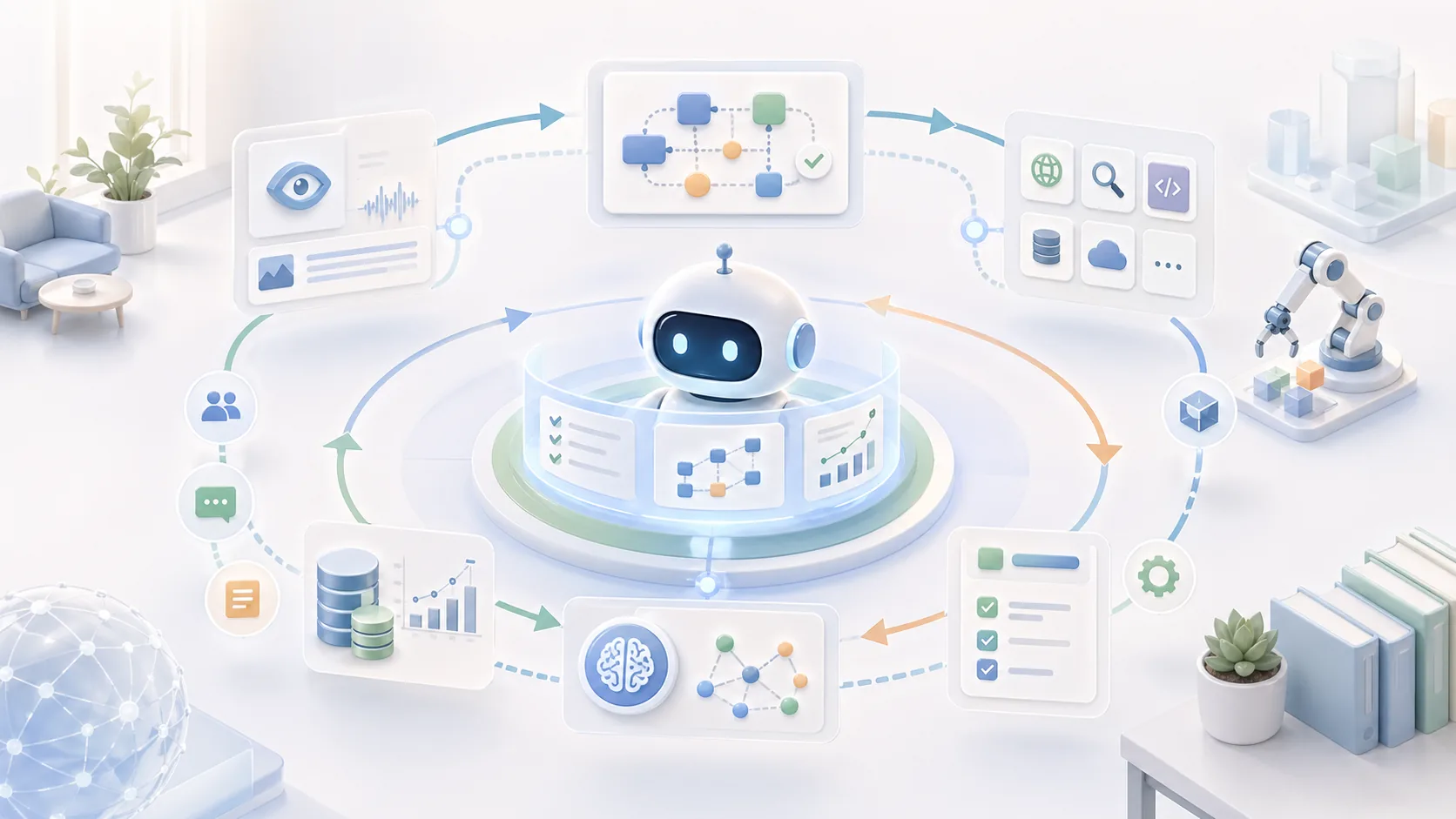
The literal meaning of "AI Agent" is "AI representative." In the technical field, an "agent" broadly refers to an autonomous entity that can perceive its environment, make decisions, and take action to achieve a goal. An AI Agent combines the reasoning capability of a large language model (LLM) with the execution capability of external tools, evolving AI systems from "question-answering machines" into "capable employees."
Traditional AI models, such as early chatbots or classification models, take an input and produce a fixed-format output in a single, passive pass. An AI Agent works very differently: it receives a high-level goal (for example, "analyze this quarter's competitor activity and compile it into a report"), autonomously breaks that goal down into multiple subtasks, decides which tools to use (web search, database queries, code execution, API calls), and adjusts its next steps based on the results of each action — repeating this loop until the final goal is achieved. This "goal-oriented, autonomous loop" capability is the most essential characteristic of an AI Agent.
Looking at the timeline: ChatGPT introduced its plugin mechanism in 2023, OpenAI added function calling to the GPT-4 series in 2024, and starting in 2025 multiple major vendors rolled out agent-oriented platforms and products one after another — turning "letting a model autonomously call tools to complete multi-step tasks" from a research topic into a generally available product feature. Naming, feature scope, and availability vary frequently across platforms, so evaluations should always reference the current version of the official documentation. For Taiwanese enterprises, the practical significance of this evolution is that AI moves from being a single-point Q&A tool to an execution unit that can be embedded into business processes — though the actual outcome still depends on whether the process itself is structured and whether the system exposes a callable interface.
The four core components of an AI Agent
A complete AI Agent system is built from four core components. Understanding these four elements helps enterprises evaluate and deploy AI Agent solutions.
Perception: understanding external information
Perception is an AI Agent's ability to receive and understand external information. Modern AI Agents can understand not only text instructions but also process multimodal information such as images, documents, web pages, database query results, and API responses. The stronger the perception capability, the richer the range of tasks an Agent can handle. For example, an Agent with visual perception can read tabular data from scanned documents, while one with voice perception can directly understand spoken instructions or meeting recordings.
Reasoning: planning and decision-making
Reasoning is the "brain" of an AI Agent, typically handled by a large language model (such as GPT-5.6, Claude Sonnet 5, or Gemini 3 Pro) acting as the core reasoning engine. After receiving a goal, the Agent uses the LLM's reasoning capability to analyze the problem, formulate a plan, choose among multiple courses of action, and re-evaluate progress after each step is executed. Chain-of-Thought (CoT) and ReAct (Reasoning + Acting) are common, widely cited reasoning patterns that let AI "think while doing"; how much they actually improve the completion rate of complex tasks depends on the task type, tool quality, and prompt design, and should be measured against a purpose-built evaluation set.
Action: calling tools to execute tasks
Action is an AI Agent's ability to interact with the outside world. Through tool use / function calling mechanisms, an Agent can call a wide range of external tools: web search engines, database queries, spreadsheet operations, code execution environments (code interpreters), REST APIs, email sending, calendar management, and more. The richness of available tools directly determines the boundary of what tasks an Agent can complete. When deploying AI Agents, enterprises typically need to expose internal systems (ERP, CRM, knowledge bases, etc.) to the Agent as APIs.
Memory: accumulating knowledge across tasks
Memory allows an AI Agent to go beyond a single conversation, retaining and drawing on past experience. Memory is divided into short-term memory (context retained within a single conversation or task execution) and long-term memory (knowledge stored in a vector database or structured database that can be queried across tasks). An Agent with long-term memory can "recognize" user preferences, accumulate domain knowledge, and avoid repeating mistakes — becoming more capable over time.
A look at mainstream AI Agent frameworks
Several mainstream technical frameworks have already emerged in the AI Agent space, and enterprises need to understand each framework's design philosophy and suitable use cases when making a selection.
ReAct (Reasoning + Acting) is one of the common, widely cited reasoning/action patterns, originating from a 2022 paper by Yao et al. At each step, the Agent first generates a "Thought" — analyzing the current situation and deciding on the next action — then executes an "Action," observes the result (an "Observation"), and moves into the next round of thinking. This "think-act-observe" loop makes the Agent's decision-making process transparent and explainable, and makes debugging easier for engineers, which is why it is often used as a reference for the underlying loop design of other frameworks.
LangGraph is the agent orchestration framework within the LangChain ecosystem. It defines an Agent's workflow as a "state graph," supporting conditional branches, loops, and parallel execution, making it well suited to enterprise applications that require precise control over Agent behavior. AutoGen (open-sourced by Microsoft) focuses on multi-agent collaboration scenarios, allowing multiple AI Agents to communicate with one another and divide up work to complete complex tasks. CrewAI offers a "role-play" style Agent framework, where different Agents take on different functional roles (such as researcher, writer, and reviewer), each performing its own duties to complete a task together.
For enterprise-grade applications, factors to consider when choosing an Agent framework include: the framework's maturity and community activity, its level of support for Chinese, the feasibility of on-premise deployment, the ease of integration with the enterprise's existing systems, and the vendor's long-term support capability. LargitData's RAGi platform provides Agent workflow orchestration and tool integration capabilities, and can be deployed in the cloud or on-premise; the actual frameworks, models, and integration scope supported may change with each version — please consult the product documentation or confirm during your deployment evaluation.
The relationship between AI Agents and LLMs
A large language model (LLM) is the "brain" of an AI Agent, but an AI Agent is not the same thing as the LLM itself. An LLM is a powerful but passive tool: it can answer questions, generate text, and reason, but it needs a human to give it explicit instructions each time before it can act. An AI Agent, by contrast, is a "system architecture that runs an LLM," giving the LLM the ability to plan proactively, use tools, and execute across multiple steps.
A vivid analogy: an LLM is an extremely knowledgeable brain, but a brain without a body. An AI Agent equips that brain with eyes (perception), hands and feet (action tools), and memory (a long-term memory store), enabling it to truly act in the digital world. In an enterprise AI Agent system, the LLM is responsible for understanding instructions, planning steps, and analyzing information returned by tools; the tool-calling layer, memory system, and workflow engine, in turn, are responsible for translating the LLM's decisions into actual system operations.
When choosing an LLM, enterprises need to strike a balance between "reasoning capability" and "cost." Complex, multi-step tasks are typically assigned to high-end models such as GPT-5.6 Sol, Claude Opus 5, or Gemini 3 Pro to act as the orchestrator, while subtasks with clearly defined rules can use lighter, lower-cost variants (such as GPT-5.6 Luna or Claude Haiku 4.5) to keep per-task inference costs under control. In practice, it's advisable to first get the workflow running end-to-end with a high-end model and build an evaluation set, then gradually downgrade individual steps to lighter models while monitoring whether the success rate holds up.
For enterprises handling sensitive data — especially government agencies and regulated industries — where a model can be deployed and where it comes from are equally important selection criteria. In the Taiwan context, on-premise options worth considering include TAIDE (developed specifically for Traditional Chinese contexts), Gemma 4 31B, GPT-OSS, and Mistral, all open-weight models that can run inside an enterprise's internal network or an agency's server room, keeping data from leaving a controlled environment. It's worth noting that most procurement and security regulations for public-sector and regulated enterprises do not permit models developed by Chinese vendors; before making a selection, confirm the agency's security requirements, the model's licensing terms, and its supply-chain origin, then narrow the candidate list accordingly.
Enterprise AI Agent Application Scenarios
AI Agents have already been put into practice across several core business areas within enterprises. Below are some of the most representative scenarios:
- Intelligent customer service Agent: autonomously understands customer questions, queries the order database, calls the refund API, and sends confirmation emails — handling the entire after-sales process end to end without human intervention.
- Research and analysis Agent: after receiving a research topic, autonomously runs multiple rounds of web searches, filters for credible sources, synthesizes key information, and generates a structured analysis report — saving researchers hours of manual work.
- Financial compliance Agent: automatically pulls financial statements, compares them against budget variances, flags anomalous items, and generates a compliance report — significantly reducing the manpower needed for month-end closing.
- Sentiment monitoring Agent: combined with the InfoMiner sentiment analysis platform, autonomously monitors brand volume across media outlets, social platforms, and forums, identifies crisis signals, triggers real-time alerts, and drafts a response plan.
- IT operations Agent: monitors system logs, identifies abnormal patterns, and automatically executes standardized troubleshooting procedures — completing an initial diagnosis and routine fixes before an engineer even steps in.
- HR recruiting Agent: automatically screens résumés, ranks candidates, sends interview invitations, and compiles interview scores — freeing HR staff to focus on final decisions rather than administrative busywork.
2026 AI Agent trends
In 2025-2026, AI Agent technology is evolving rapidly along several key directions. Multi-agent collaboration (multi-agent systems) is the most closely watched trend: a single Agent has limited capability, but multiple specialized Agents dividing up work can complete more complex, larger-scale tasks. For example, a software development Agent system might have a requirements-analysis Agent, a code-generation Agent, a testing Agent, and a deployment Agent working together to complete an entire development pipeline.
Long-term memory and personalization are another important trend. By 2026, AI Agents will be able to remember an enterprise's business rules, user preferences, and past decision cases, becoming digital employees that truly "understand the business." At the same time, an Agent's "explainability" is drawing growing attention from enterprises: each decision an Agent makes needs to come with a traceable chain of reasoning, in order to satisfy internal audit and regulatory compliance requirements.
In the Taiwan market, as the Personal Data Protection Act and AI governance-related policies continue to develop, enterprises are paying increasingly close attention to on-premise deployment of AI Agents. In 2023, Taiwan's Executive Yuan passed and promulgated the "Executive Yuan and Subordinate Agencies Guidelines for the Use of Generative AI," providing directional principles for public-sector use of generative AI. Whether to adopt on-premise deployment should, in practice, be assessed case by case based on data classification and the agency's or enterprise's own policy and security requirements: data involving personal information, trade secrets, or information that regulations prohibit from being disclosed externally is more likely to be required to stay within a controlled environment, whereas for public data or low-sensitivity applications, cloud solutions are often more cost-effective and operationally efficient.
LargitData's QubicX on-premise AI platform is designed precisely for deployment needs in controlled environments, allowing inference to run inside an enterprise's or agency's own premises. Paired with measures such as network isolation, access control, and audit trails, it helps reduce the risk of data leaving a controlled environment; whether it meets the requirements of a specific regulation or procurement specification still needs to be verified item by item based on the actual deployment architecture, governance settings, and audit results. The actual applicable scope and operational requirements should always be based on the latest announcements from the competent authority and the determination of your agency's (or company's) legal counsel.
Further Reading
- What Is RAG? The Principles, Architecture, and Enterprise Applications of Retrieval-Augmented Generation
- Multi-Agent System: A complete beginner's guide to enterprise AI architecture built on multi-agent collaboration
- AI Agent vs. RPA: A complete comparison of old and new automation technologies — how should enterprises choose?
- LLM Agent vs. traditional AI: the essential differences between old and new AI systems, and an enterprise upgrade guide
FAQ
Ready to bring AI Agents into your enterprise?
Contact LargitData's AI solutions consultants to learn how to design an AI Agent adoption path tailored to your enterprise — from pilot applications to full deployment, we provide complete technical support and consulting services.
Get a free consultation now