Weibo, Xiaohongshu and Douyin Data: How They Differ, Why They Are Hard to Get, and What You Can Do With Them
Weibo, Xiaohongshu (RED) and Douyin are usually mentioned in the same breath, yet their content formats, use cases and data accessibility are completely different. For market research, brand and risk-intelligence teams outside China, the hard part is rarely deciding which platform to watch — it is getting the data at all: official channels are closed to outsiders, registration carries an identity barrier, and content disappears fast. This article covers how the three platforms differ, why the data is hard to obtain, how the available access routes actually compare, and what analysis this data can support.

Quick answer: what Chinese social platform data is, and how to obtain it
Chinese social platform data means the content publicly posted on Weibo, Xiaohongshu (RED), Douyin and similar platforms, together with its engagement signals — post and note text, short-video titles and descriptions, comments, hashtags, and fields such as likes, saves and reposts. The three platforms carry very different kinds of signal: Weibo leans toward public opinion, Xiaohongshu toward purchase decisions, Douyin toward content trends, so the same brand or issue often looks completely different on each. Most overseas teams cannot collect this data themselves; in practice they obtain it as structured fields through a third-party data service.
Who it is for
- Brands and e-commerce teams entering or evaluating the China market — they need genuine consumer discussion and word-of-mouth material
- Market research and consumer insight teams — using social content to fill in the purchase motivations surveys never surface
- Risk and public opinion monitoring teams — tracking how incidents spread, brand controversies and the direction of public issues
- Content and social marketing teams — reading topic cycles and the creator ecosystem
What problems it solves
- You need to see discussion in the China market, but Western social listening tools generally have limited coverage of Chinese platforms
- Without a Chinese mobile number and real-name verification, you cannot register an account and collect the data yourself
- In-house collection scripts are expensive to maintain, and the data keeps breaking whenever a platform changes
- Content is taken down once the buzz passes, so the original discussion is gone by the time you look back
How do Weibo, Xiaohongshu and Douyin differ?
Putting the three platforms side by side is the fastest way to see how they divide the field — and why the same set of metrics should not be used to read all three.
| Dimension | Xiaohongshu (RED) | Douyin | |
|---|---|---|---|
| Platform role | Public opinion square | Purchase-decision and lifestyle community | Short-video entertainment and trend platform |
| User profile | A broad audience following current affairs and public issues | Mainly young urban consumers | A mass video audience spanning all age groups |
| Content format | Short posts, images and repost threads | Photo-and-text notes and hands-on reviews | Short videos with titles and descriptions |
| Data field characteristics | Clear repost chains; diffusion structure can be reconstructed | Long body text, dense with brand and product terms | Little text; must be read through tags and engagement |
| Opinion dynamics | Issues spread fast, visibly driven by opinion leaders | Search-driven use; word of mouth builds slowly but the tail is long | Algorithmic distribution; posts blow up and fade equally fast |
Weibo: where public opinion spreads
Weibo is the closest thing to an open public square: the hot-search board decides which topics are visible that day, repost chains amplify a single post into a nationwide event, and a statement from an opinion leader or media account is often the turning point in momentum. The most valuable part of the data is the time series and the diffusion structure — who reposted a given post, which accounts amplified it, and how long it took to peak can all be reconstructed from public fields. For brand crisis and public issue monitoring, Weibo is usually where the signal appears first.
Xiaohongshu: the purchase-inspiration notes (zhongcao) people read before buying
Xiaohongshu is used more like a search engine: before buying, people actively search a category or brand keyword and read other people's real experiences before deciding. Notes tend to be long and specific, naming brands, products and usage situations outright, and long-running posts from everyday users and KOCs are common. That makes Xiaohongshu data particularly well suited to product word-of-mouth and consumer trend research: reputation accumulates slowly, but a single note has a long exposure tail and keeps surfacing in search long after the initial buzz has faded.
Douyin: trend curves set by the algorithm
Douyin is built around algorithmic distribution: whether content spreads depends mainly on how the recommendation system responds, not on an account's existing follower count. Hits therefore appear fast and fade just as fast, and volume curves are steeper than on the other two platforms. The data-side challenge is how little text there is — most of the message sits inside the video, so analysis has to infer topic and audience response from titles, hashtags and engagement metrics.
Why is this data so hard to obtain?
Overseas teams trying to collect this data themselves usually hit four barriers in sequence, and the later ones are progressively harder to solve by spending more.
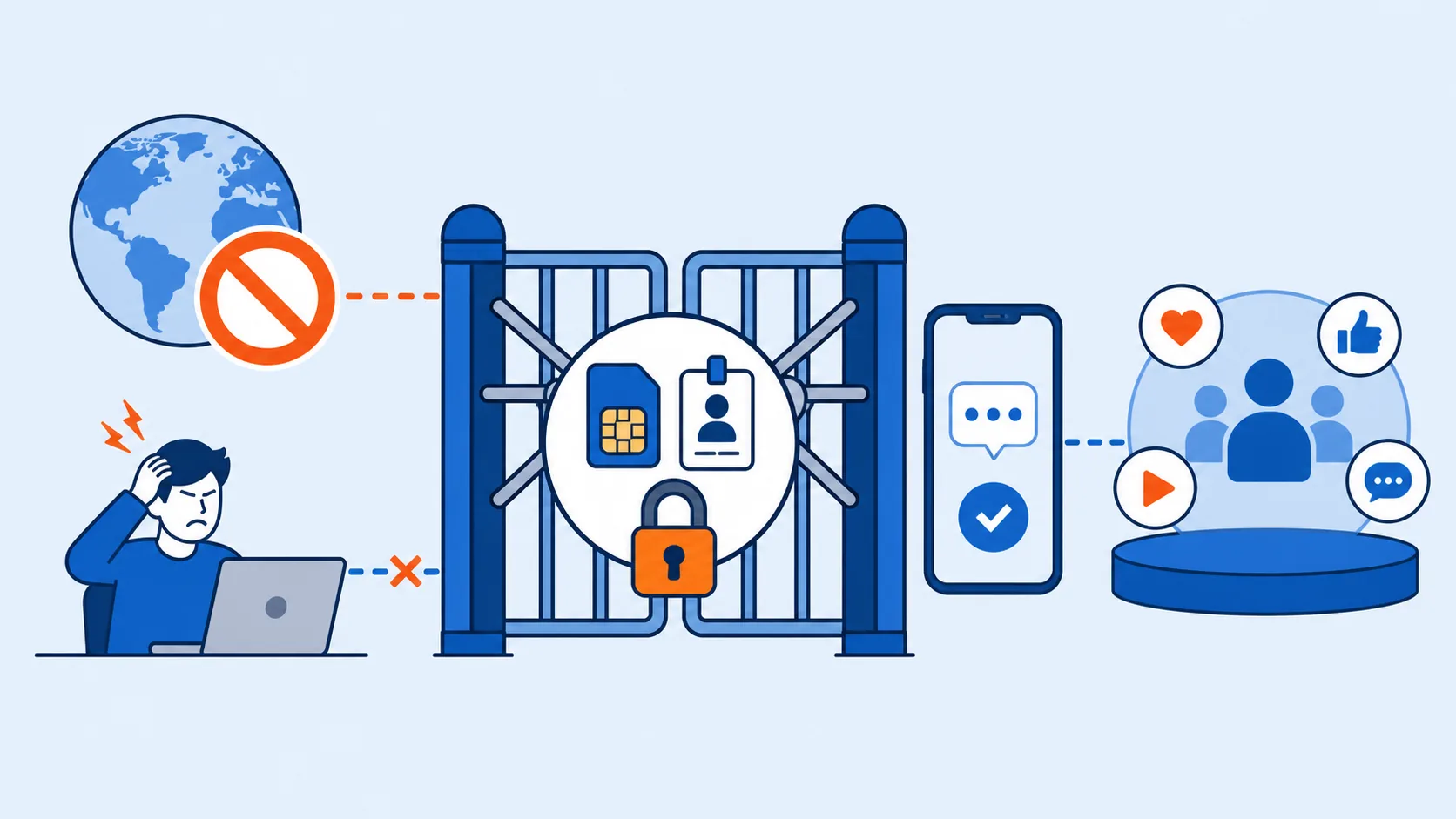
The first is the official channel. These platforms' developer programmes are aimed at their own in-app ecosystems and partners; for external developers, and especially for companies based outside China, the bar for data-type interfaces is high, and in practice it is difficult to obtain the data volume and historical depth an analysis needs.
The second is identity. Most functions require a login for full browsing, and registration normally requires a Chinese mobile number plus real-name verification. Overseas teams have neither the number nor the matching identity documents, so they are stopped at step one.
The third is connectivity and risk control. Accessing from outside China regularly means unstable connections, content that does not render, and accounts prompted for extra verification. Platform risk-control systems adjust what is visible based on access behaviour, so whether you can see something is not a stable state at all — the same procedure can return different results at different times.
The fourth is language and specification. Platform interfaces, documentation and field names exist only in Simplified Chinese, and the terminology is a world of its own. Traditional Chinese or English-speaking teams also have to handle script conversion, word segmentation and vocabulary mapping before the data can enter their existing analysis systems.
Data walls: connectivity, anti-scraping, disappearing content and compliance
Even once access is solved, the data itself sits behind several walls. The first is the network environment: there is systematic separation between the Chinese internet and the outside world, and cross-border connections differ from ordinary international routes in both latency and stability. For teams collecting on a long-running schedule, data completeness ends up hostage to swings in connection quality.
The second is platform-side access restriction. Platforms generally apply rate controls and manage content visibility, and what a logged-out visitor can see is quite limited. Data availability is the result of active management by the platform, the rules shift over time, and any collection process has to be built on the assumption that they will.
The third is the content lifecycle. Content around a public opinion event often has a very short life: the highest-traffic posts and comments are frequently deleted or hidden around the time the incident settles, so by the point you need to look back, the original discussion is usually gone. This is exactly where continuous collection and evidence preservation earn their keep — only material captured and stored as the event unfolds gives you something to analyse afterwards, a comparable time series, and a basis you can defend externally.
The fourth is compliance, and one common misconception is worth flagging: information being public does not mean it can be freely collected, stored and reused. Whether a given source is usable has to be judged source by source on at least four points — whether the platform's terms permit automated extraction, the copyright status of the content, whether it contains personal data and whether that processing stays within what is necessary for a specified purpose, and whether cross-border transfer is involved. China's data export rules, or the GDPR where the data subjects are in the EU, may each impose different requirements on the very same dataset. We recommend maintaining a source register that records how each source was obtained, the terms it relies on, whether it contains personal data, the retention period and the deletion mechanism. The scope that actually applies to you, and the operational requirements that follow, should be determined by the latest announcements from the competent authorities and by your own legal or compliance team.
Comparing access routes: how the four approaches really differ
There are four routes in practice, and they differ widely in feasibility and hidden cost.
| Access route | Feasibility | Setup cost | Data stability | Coverage depth | Compliance burden |
|---|---|---|---|---|---|
| Official open API | Effectively out of reach for developers outside China | Low, but applications rarely succeed | Stable once granted | Limited to what the platform opens up | Governed by platform terms |
| In-house crawler | Technically possible, but a high bar | High, plus continuous maintenance | Breaks easily when platforms change | Depends on the headcount you commit | Entirely on you |
| Western social listening tools | Available immediately | Low, usually subscription-based | Stable | Coverage of Chinese platforms is generally limited | Handled by the vendor |
| Third-party data API | Feasible; usable as soon as it is integrated | Moderate, including integration effort | Varies with the provider's operational capability | Set by the monitoring scope in your plan | Sources and terms must be clarified with the provider |

The official open API looks like the most legitimate route, yet it is the first one ruled out. What is opened up serves in-app ecosystems and partners; companies based outside China very rarely win authorisation for data-type interfaces, and even when they do, the queryable fields and historical depth may not match what the work requires.
An in-house crawler is not technically impossible, but its cost structure is routinely underestimated. Beyond writing the code, you have to handle account acquisition, the cross-border connection environment, field remapping after every platform revision, and a backfill mechanism for outages — continuous operations work, not a one-off build. Without people committed to it for the long haul, it typically stalls after a few platform changes, leaving gaps in the time series that can never be filled retrospectively.
Western social listening tools are a different trade-off. Products in this category, typified by Brandwatch and Meltwater, are mature in source coverage and reporting for Western platforms and are already standard equipment at many international brands. What to watch for is a general limitation of the category: Western social listening tools tend to have limited coverage of Chinese platforms. That reflects how open each platform is and how licensing is arranged rather than any single product's shortcoming, and actual coverage should be confirmed against each vendor's own source list.
A third-party data API hands the access problem to a specialist provider, which takes on collection, cleaning and field structuring so the client receives analysis-ready data over an API. LargitData's Social Media API sits in this category — one option to compare on your evaluation list, not the only answer. When choosing a provider, confirm source scope, field definitions, update mechanism, historical backfill capability, and the terms and compliance documentation they are able to supply.
What is each of the three datasets good for?
The most direct application of Xiaohongshu data is market research for brands and e-commerce. Notes spell out usage situations and reasons for buying, which lets you reconstruct the consumer decision path; tracking note volume and topic shifts within a category shows consumer trends rising and falling; and analysing the content formats and engagement of KOCs helps plan collaboration partners and creative direction. For brands not yet in the China market, this is one of the lowest-cost ways to assess the competitive landscape in a category.
Weibo data is centred on public opinion and risk monitoring. How fast an incident spreads, which accounts are taking part, and when opinion leaders weigh in are all indicators of whether an issue will escalate. For brands, it is an early-warning source ahead of a crisis; for teams following public issues, Weibo's repost structure shows how a claim grows from a small circle of discussion into a nationwide topic, and preserves a timeline you can trace back through.
Douyin data leans toward trend awareness and content strategy. Which themes the recommendation system is currently amplifying, what breakout content has in common, and how long a topic's volume cycle runs all shape content scheduling and media pacing. Because momentum shifts so quickly, this kind of analysis needs continuous data — a single sample easily misses the whole curve.
The real value tends to emerge in cross-platform analysis. The same incident often looks different on each: the controversy surfaces and spreads on Weibo, Xiaohongshu shows shifting assessments from actual users, and Douyin may extend the momentum through derivative content. Looking at one platform alone makes it easy to misjudge the scale and nature of an event — Weibo buzz may have died down while negative word of mouth on Xiaohongshu is still accumulating and eating into sales. Only by overlaying the time series from all three can you tell whether something is short-term noise or lasting brand damage.
Further Reading
FAQ
Need Weibo, Xiaohongshu or Douyin data?
Talk to the LargitData team about the Social Media API — source scope, field definitions and how integration works — and run a trial on the brand terms you care about.
Contact Us View the Social Media API