What Is Media Monitoring & Sentiment Intelligence? A Complete Guide to Principles, Methods, and Applications
Sentiment Analysis combines natural language processing (NLP), machine learning, and big data technologies to extract, analyze, and quantify public opinion and emotional polarity from massive volumes of web text. As social media, news portals, and forums proliferate, the sheer scale of daily public discussions vastly exceeds manual review capacity. Capturing public sentiment in real time provides enterprises with early-mover advantages across brand governance, crisis mitigation, and market positioning. This guide analyzes core concepts, technical principles, use cases, and best practices for elevating decision quality through sentiment platforms.
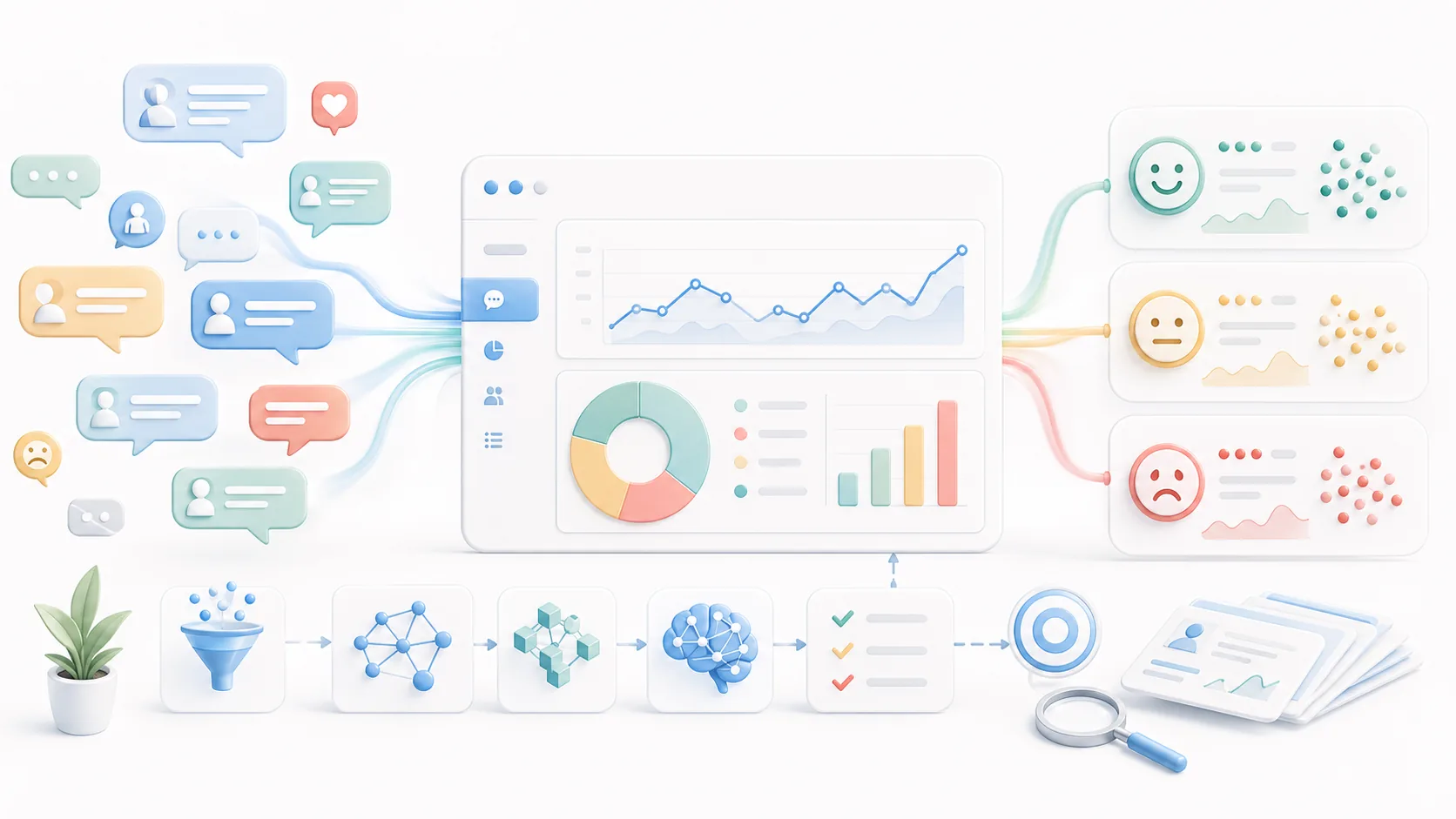
The Definition and Core Concepts of Sentiment Intelligence & Media Monitoring
Sentiment analysis — also known as opinion mining — refers to the automated identification, through computer programs, of the subjective emotions, attitudes, and evaluations expressed in text. Its core objective is to transform unstructured textual data into quantifiable sentiment indicators such as positive, negative, or neutral. The technology is built on the foundation of NLP and integrates multiple sub-technologies including syntactic analysis, semantic understanding, and contextual inference.
Modern sentiment analysis has moved well beyond simple positive/negative classification. Advanced sentiment systems can identify more nuanced emotional dimensions such as anger, joy, anxiety, and anticipation, and can even perform Aspect-Based Sentiment Analysis (ABSA) — evaluating sentiment separately for distinct aspects within the same piece of text. For example, a product review might express a positive attitude toward "price" while holding a negative view of "after-sales service"; an advanced sentiment analysis system can capture these fine-grained distinctions individually.
The data sources for sentiment analysis are extremely broad, encompassing social media posts (Facebook, Instagram, Twitter/X, PTT, Dcard), news coverage, blog articles, forum discussions, product reviews, customer service conversation logs, and more. Through large-scale data collection and real-time analysis, enterprises can build a complete picture of the public conversation to understand what consumers think about their brand, products, competitors, and broader industry trends.
Technical Principles and Methods of Media Monitoring Analysis
The technical approaches to sentiment analysis have evolved through several generations. Early methods were primarily based on sentiment lexicons — predefined lists of positive and negative words — counting the frequency of various sentiment terms in text to determine overall emotional polarity. While simple and intuitive, this approach cannot effectively handle negations, irony, wordplay, and other complex linguistic phenomena.
Second-generation approaches introduced machine learning technology, particularly supervised learning. Models were trained on large volumes of manually labeled data to learn the correspondence between text features and sentiment labels. Common algorithms include Support Vector Machines (SVM), Naive Bayes, and Random Forest. These methods achieved significant improvements in accuracy but still depended on manual feature engineering and placed high demands on the quality and quantity of training data.
The current state of the art in sentiment analysis relies on deep learning and large language models (LLMs). Through Transformer-based pre-trained language models such as BERT and GPT, systems can deeply understand the semantic context of text and deliver more precise sentiment judgments even when confronted with complex linguistic expressions, metaphors, and irony. Furthermore, these models possess cross-lingual transfer learning capabilities, allowing knowledge learned in one language to be applied to sentiment analysis tasks in other languages.
Beyond sentiment classification, a complete sentiment analysis system incorporates several additional key technologies: Topic Detection automatically identifies trending discussion topics; Trend Analysis tracks how public opinion shifts over time; Influence Analysis evaluates the amplification effect of key opinion leaders (KOLs); and Anomaly Detection identifies abnormal spikes in public sentiment in real time, enabling early crisis warnings.
Enterprise Use Cases for Media Monitoring Analysis
Brand reputation management is one of the most central applications of sentiment analysis. By continuously monitoring online discussions related to their brand, enterprises can track changes in brand perception in real time. When negative sentiment begins to spread, the sentiment system can issue an alert immediately, enabling the PR team to respond swiftly and prevent the situation from escalating. Simultaneously, positive user reviews can be captured in real time and used as marketing material or input for product improvement.
Market research and competitive analysis is another important application domain. By analyzing spontaneous consumer discussions on social media and forums, enterprises can obtain market insights that are more authentic and more timely than traditional survey research. Sentiment analysis can reveal consumers' acceptance of new products, reactions to pricing strategies, and evaluations of competitors — key intelligence that helps enterprises make data-driven business decisions.
In the government and public policy domain, sentiment analysis is widely used for public opinion research and policy evaluation. Government agencies can analyze online sentiment to gauge public support for and opposition to specific policies, enabling timely adjustments to policy direction or enhanced public communication efforts. During election periods, sentiment analysis is also used to track shifts in candidate approval ratings and the intensity of election issues.
The financial industry is another common application of sentiment analysis. Some investment institutions incorporate sentiment data into corporate risk monitoring and market sentiment tracking, as a supplement to existing signals. Academic research has examined the relationship between social sentiment and market prices, but the conclusions vary with the sample period, target asset, data source, and methodology used — this is not a stable, universally applicable rule. In practice, using it for investment decisions should involve backtesting against your own data, with attention to out-of-sample performance, data lag, and overfitting risk. This section does not constitute investment advice.
How do I choose the right plan?
When selecting a sentiment analysis tool, enterprises need to evaluate multiple dimensions. The first is data coverage: can the tool capture data from the most important social media platforms, news sites, and forums in the target market? In the Taiwan market in particular, coverage of local forums such as PTT, Dcard, and Mobile01 is critical. The second is language support: for enterprises that need to monitor multilingual sentiment, the tool must have strong multilingual processing capabilities across Traditional Chinese, Simplified Chinese, English, Japanese, and other languages.
Analytical accuracy and depth are also critical evaluation criteria. An excellent sentiment analysis tool must not only correctly classify sentiment polarity but also provide advanced capabilities such as aspect-based sentiment analysis, topic clustering, and trend prediction. Furthermore, timeliness is paramount — in the social media era, public opinion can spread rapidly within hours, and the tool must be capable of near-real-time data collection and analysis.
Visualization and reporting capabilities are equally important. A well-designed dashboard enables managers to grasp the full sentiment landscape at a glance, while automated report generation can save analysts significant time. Finally, API integration capabilities allow sentiment data to be seamlessly fed into an organization's existing CRM, BI, and other systems, maximizing the value of the data.
How should you evaluate sentiment analysis? Five practical considerations
Many evaluation processes start with the wrong question: "What's your accuracy rate?" Without a defined test set, language, industry, and labeling criteria attached, that number is almost meaningless for comparison. The following five dimensions are what actually determine whether a sentiment analysis system works well for your use case.
First is annotator agreement. Sentiment labeling is inherently subjective — the same post can be labeled differently by different people. When building a test set, have at least two annotators label independently and calculate an agreement metric such as Cohen's Kappa. If human-to-human agreement is already low, a model's performance can't realistically exceed that ceiling. In that case, the fix is to write clearer labeling guidelines — what counts as negative, how to distinguish complaints from objective statements, whether criticism of a third party counts as negative toward the brand — rather than switching models.
Second is sarcasm and negation. Negation in Chinese is scattered and varied: phrases like "不錯" (not bad), "沒什麼不好" (nothing wrong with it), and "哪裡好了" (what's good about it) all literally contain negative words, yet carry different meanings. Sarcasm relies even more heavily on tone particles, punctuation, and community-specific context (such as platform-specific slang conventions). When evaluating, deliberately build a challenge set of sarcastic and negated examples and score this category separately, rather than letting it get diluted by a large volume of easy samples.
Third is industry-specific vocabulary. The same word can carry opposite sentiment polarity across industries: "波動" (volatility) skews negative in finance, "肝" (grinding) is neutral or even lightly joking in gaming discussions, and "陽性" (positive) in a medical context is not good news. A general-purpose model won't know your product line names, model numbers, channel nicknames, or competitor abbreviations — so deployment usually requires a custom dictionary plus a small amount of in-domain labeled data for fine-tuning. Confirm whether your vendor supports this kind of customization.
Fourth is mixed sentiment. Real-world reviews are rarely single-polarity: "the product is good but customer service was terrible" contains both positive and negative sentiment. If a system only outputs a single polarity, this kind of content gets compressed into neutral or lands randomly on one side, distorting the statistics. Aspect-Based Sentiment Analysis, which ties sentiment to specific aspects (price, quality, logistics, service), is a capability worth specifically requiring during evaluation — at minimum, confirm how the system handles a text that touches multiple aspects.
Fifth is how to build the test set. We recommend random sampling from your own real-world data rather than using a vendor-provided demo dataset. Sampling should cover different platforms, time periods, and topics, and deliberately retain a share of difficult samples (sarcasm, mixed sentiment, heavy emoji use, mixed Chinese-English text, typos). The test set doesn't need to be large, but it should be fixed as a benchmark for version comparisons, and rerun whenever the model or dictionary is updated to check for regressions. Additionally, if the distribution of positive, negative, and neutral labels is heavily imbalanced, look at precision and recall for each category, not just overall accuracy.
Future Trends in Media Monitoring Analysis
With the rapid development of generative AI and large language models, sentiment analysis is entering a new wave of technological innovation. Future sentiment systems will possess stronger semantic comprehension capabilities, be able to process multimodal data (text, images, video, audio), and deliver more precise sentiment assessments and predictive analytics.
Real-time sentiment alert systems will become increasingly intelligent — capable not only of detecting sentiment events that have already occurred but also of issuing early warnings at the very onset of a crisis through pattern recognition and predictive modeling. In addition, personalized sentiment analysis reports will become a key trend, with systems automatically generating customized insight reports tailored to the needs of different departments (marketing, PR, product, customer service).
For enterprises that value brand reputation and market insight, building robust sentiment analysis capabilities is no longer optional — it is an essential competitive competency in the digital age. Choosing the right tools and methods will help organizations stay attuned to a fast-changing public opinion landscape and make smarter, more informed decisions.
Further Reading
FAQ
References
- Liu, B. (2012). Sentiment Analysis and Opinion Mining. Morgan & Claypool Publishers. [DOI]
- Pang, B., & Lee, L. (2008). Opinion mining and sentiment analysis. Foundations and Trends in Information Retrieval, 2(1–2), 1–135. [DOI]
- Devlin, J., Chang, M.-W., Lee, K., & Toutanova, K. (2019). BERT: Pre-training of deep bidirectional transformers for language understanding. NAACL-HLT 2019. [arXiv]
- Socher, R., et al. (2013). Recursive deep models for semantic compositionality over a sentiment treebank. EMNLP 2013. [PDF]
Want to Learn More About Media Monitoring Solutions?
Contact our team of experts to learn how InfoMiner can help your enterprise stay on the pulse of public opinion in real time and make more precise business decisions.
Contact Us