What Is a Large Language Model (LLM)? A Comprehensive and Accessible Explanation
Large Language Models (LLMs) represent one of the most transformative breakthroughs in modern artificial intelligence. From the GPT series to Claude, Gemini, and Grok, LLMs have fundamentally altered human-computer interaction and unlocked unprecedented application paradigms across industries. Starting from foundational concepts, this guide comprehensively examines LLM technical architectures, evolutionary history, capability boundaries, and enterprise adoption strategies to provide a holistic understanding of this transformative technology.
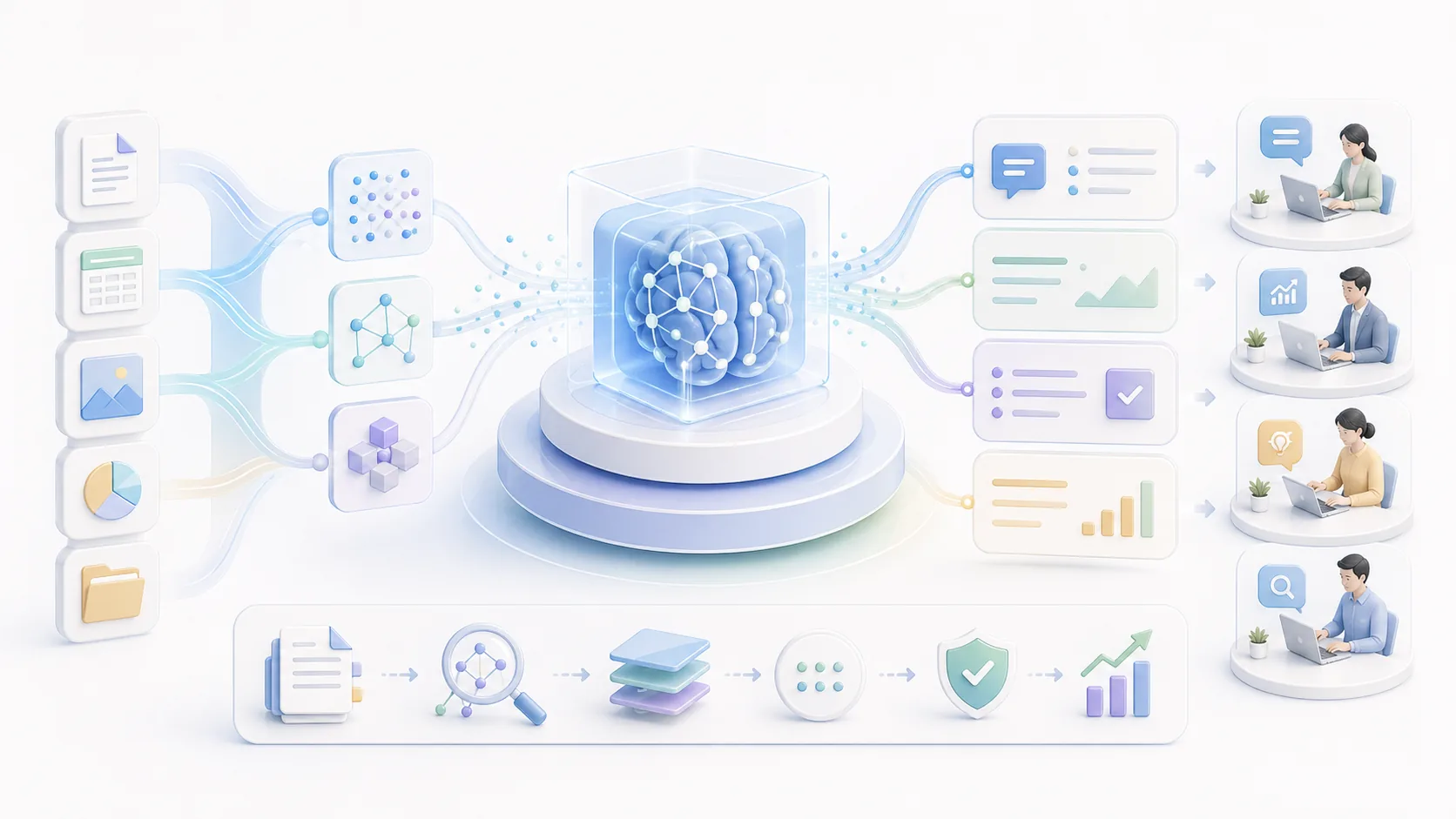
Fundamental Concepts and Development History of LLMs
A large language model (LLM) is a deep learning model trained on massive volumes of text data, with a core capability of understanding and generating human language. The word “large” refers to the model's parameter count: parameters are the numeric values adjusted during training, encoding the linguistic and world knowledge the model has learned from data. Modern LLMs span a wide range of parameter scales, from open-weight models with billions of parameters that can run on a single graphics card, to flagship closed-source models whose scale vendors don't disclose; most commercial models don't reveal their exact parameter count, so parameter figures shouldn't be treated as a capability indicator — actual performance also depends on training data, training methods, and subsequent alignment tuning.
The development of LLMs can be traced back to the Transformer architecture proposed by Google in 2017. Prior to this, NLP relied primarily on recurrent neural networks (RNNs) and long short-term memory networks (LSTMs), both of which faced performance bottlenecks when processing long text sequences. The Transformer introduced the attention mechanism, allowing the model to simultaneously attend to all positions in an input sequence — dramatically improving both long-text processing capability and training efficiency.
In 2018, Google's BERT and OpenAI's GPT each demonstrated the remarkable potential of pre-trained language models. BERT uses a bidirectional training strategy and excels at text understanding tasks, while GPT employs an autoregressive training approach and excels at text generation. As models such as GPT-2 and GPT-3 continued to scale up in subsequent years, researchers discovered that increasing model size gives rise to "emergent abilities" — capabilities that smaller models do not possess but that appear suddenly in larger models, such as chain-of-thought reasoning and few-shot learning.
The launch of ChatGPT in late 2022 catalyzed the global LLM revolution. Leading technology companies subsequently unveiled foundational models, including Anthropic's Claude, Google's Gemini, and xAI's Grok. The open-source and open-weights ecosystem concurrently delivered self-hostable architectures such as Llama, Mistral, Gemma, GPT-OSS, and Taiwan's NSTC-supported TAIDE—optimized specifically for Traditional Chinese semantics—empowering enterprises and researchers to deploy and fine-tune models within proprietary infrastructure.
Technical Principles of LLMs: Transformers and Training Methods
The Transformer — the core architecture of LLMs — consists of an encoder and a decoder, though most modern generative LLMs use only the decoder component. The key innovation of the Transformer is the self-attention mechanism, which allows the model to compute the relevance of each token to every other token in a sentence as it processes that token, thereby capturing rich contextual information.
LLM training proceeds in two primary phases. Phase 1 is Pre-training: models perform self-supervised learning across massive text corpora via next token prediction. Through this objective, models acquire multifaceted linguistic competencies spanning syntax, factual knowledge, and reasoning. Pre-training demands massive computational infrastructure: exact GPU clusters and runtimes depend on parameter scale, dataset size, context length, parallelization efficiency, and hardware generation—seldom fully disclosed. Crucially, pre-training expenditures vastly exceed the budget of typical enterprises, explaining why most organizations adapt existing foundation checkpoints rather than training from scratch.
The second stage is alignment training, also known as reinforcement learning from human feedback (RLHF). Although a pre-trained model has acquired language capabilities, it may generate harmful, biased, or otherwise undesirable content. Alignment training uses evaluations and feedback from human annotators to guide the model toward generating responses that are more helpful, safer, and more honest. This stage is the key that transforms a modern LLM into a practical AI assistant.
In addition, a variety of techniques are used to enhance specific capabilities of LLMs: fine-tuning adapts a model to a particular task or domain; quantization compresses model size to reduce deployment costs; distillation transfers knowledge from a large model to a smaller one; and RAG (retrieval-augmented generation) enables the model to access external knowledge bases.
Capabilities and Limitations of LLMs
Modern LLMs exhibit remarkable capabilities. In text generation, LLMs author articles, reports, emails, and code; for structured tasks with ample examples, outputs serve as ready initial drafts, though quality varies considerably across task complexity, language, domain depth, and prompt engineering—demanding validation against internal evaluation benchmarks rather than assuming human expert equivalence. In comprehension, LLMs execute summarization, translation, sentiment classification, and named entity recognition. In reasoning, they perform logical deduction, mathematical derivation, and problem breakdown. Most strikingly, LLMs demonstrate robust In-context Learning: adapting to novel tasks with just a few exemplar demonstrations in prompt contexts.
However, LLMs also have limitations that must be acknowledged. "Hallucination" is the most widely discussed problem: an LLM may confidently generate information that sounds plausible but is factually incorrect. This occurs because LLMs are fundamentally statistical text generation systems rather than true knowledge reasoning engines. In addition, an LLM's knowledge has a time cutoff and it cannot answer questions about events after its training data ends; models may also encode biases present in their training data; and performance on mathematical and logical tasks requiring precise calculation remains inconsistent.
Understanding these limitations is critical for enterprise applications. This is precisely why supplementary technologies such as RAG (retrieval-augmented generation), tool calling, and guardrails are so important in enterprise AI deployments — they help organizations harness the powerful capabilities of LLMs while effectively managing the associated risks.
Enterprise Applications and Deployment Strategies for LLMs
When adopting LLMs, enterprises must first choose an appropriate deployment approach. The API call model is the fastest way to get started — enterprises can use cloud LLM services (such as the OpenAI API or Anthropic API) directly without managing any infrastructure. This approach suits scenarios with lower security requirements and modest usage volumes, but may raise concerns about data being transmitted to third parties.
For enterprises with stringent data security mandates, On-Premise Deployment offers an optimal architecture. Organizations deploy open-weight LLMs within proprietary servers or private clouds, ensuring inference prompts and sensitive documents never traverse external networks. While requiring GPU infrastructure investments and SRE operational labor, teams must note: upstream OS/model update mirrors, monitoring telemetry streams, backup/log destinations, and privileged administrator credentials remain distinct data flows that must be audited individually—physical on-premise containment alone does not automatically eliminate data leakage vectors.
A hybrid model combines the advantages of both approaches: sensitive data is processed on-premise while general tasks are handled via cloud APIs, striking a balance between security and cost-effectiveness. Regardless of which deployment model is chosen, integrating RAG technology to give the LLM access to the enterprise's proprietary knowledge base is the key to maximizing AI's practical value in enterprise contexts.
Common enterprise LLM use cases include: intelligent customer service and conversational chatbots, document summarization and knowledge management, code assistance and automated testing, content generation and marketing copywriting, data analysis and report generation, and process automation and decision support. Successful LLM deployment requires well-defined use-case definitions, robust evaluation metrics, and ongoing performance monitoring and optimization.
Further Reading
FAQ
References
- Vaswani, A., et al. (2017). Attention is all you need. NeurIPS 2017. [arXiv]
- Brown, T., et al. (2020). Language models are few-shot learners (GPT-3). NeurIPS 2020. [arXiv]
- Wei, J., et al. (2022). Emergent abilities of large language models. Transactions on Machine Learning Research. [arXiv]
- Ouyang, L., et al. (2022). Training language models to follow instructions with human feedback (InstructGPT). NeurIPS 2022. [arXiv]
Want to Learn How to Deploy LLMs in Your Enterprise?
Contact our team of experts to discover the AI solution best suited to your enterprise's needs — from intelligent customer service to knowledge management, we provide comprehensive LLM application support.
Contact Us