On-Premise vs Cloud AI Deployment: How Should Enterprises Choose?
As enterprise AI adoption accelerates, "Should AI systems be deployed in the cloud or on-premise?" has become a critical question every IT decision-maker must confront. Cloud deployment has attracted a large number of organizations with its flexibility and low barrier to entry, while on-premise deployment has won over security-sensitive organizations with its data security guarantees and full control. This article provides a comprehensive comparison of both deployment models across dimensions including technical architecture, security, cost, and performance, helping enterprises make the choice best suited to their needs.
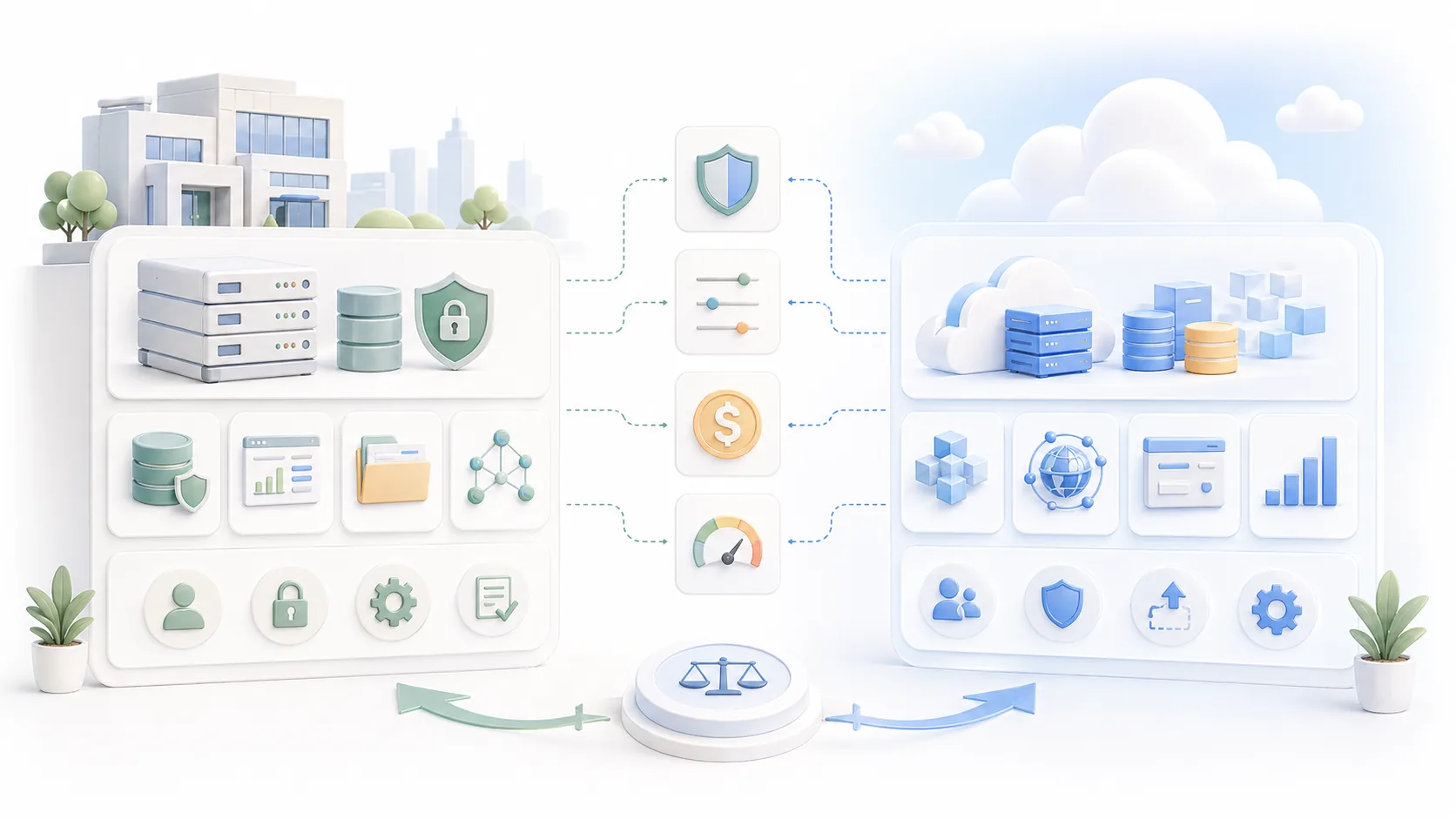
Advantages and Limitations of Cloud AI Deployment
Cloud AI deployment refers to enterprises accessing AI computing resources and model services provided by third-party cloud providers (such as AWS, Azure, or GCP) or AI service vendors (such as OpenAI or Anthropic) over the internet. Under this model, AI model training, inference, and management all take place on the cloud provider's infrastructure, and the enterprise simply accesses services through an API or web interface.
The most significant advantage of cloud deployment is its low barrier to entry and rapid activation. Enterprises do not need to invest heavily in GPU servers and supporting infrastructure, nor do they need a specialized AI infrastructure operations team — they simply register an account, obtain an API key, and they are ready to start. This allows small and medium-sized businesses or organizations making their first foray into AI to begin their AI journey at very low initial cost.
Elastic scalability is another major advantage of cloud deployment. AI workloads are often highly variable — request volumes during peak periods can be several times or even tens of times the normal level. Cloud services can automatically scale computing resources up or down based on demand, and enterprises pay only for what they actually use, avoiding the need to over-invest in infrastructure just to handle peak loads.
However, cloud deployment also has clear limitations. The most fundamental concern is data security and privacy. When using cloud AI services, the enterprise's input data - including documents, voice recordings, and images - must be transmitted over the internet to a third-party server for processing. While major cloud providers offer encrypted transmission and data protection commitments, in highly sensitive sectors such as finance, healthcare, government, and critical infrastructure, transmitting confidential data to a third party always raises compliance and security concerns.
In addition, the long-term cost of cloud services may exceed initial expectations. Although upfront investment is lower, as usage grows, per-call or consumption-based billing can cause the long-term Total Cost of Ownership (TCO) to surpass that of building in-house infrastructure. Network latency is also a consideration — for real-time inference applications that require extremely low latency, the round-trip delay to the cloud may not meet requirements.
Advantages and Considerations of On-Premise AI Deployment
On-premise AI deployment refers to an enterprise deploying AI computing infrastructure and models within its own data center or office premises, with all data processing and model inference taking place within the organization's physical control boundary. This model provides the highest level of data security and control.
Data security is the most frequently cited advantage of on-premise deployment. With correct configuration, input queries, uploaded documents, and model outputs can stay within the enterprise's own environment without being processed by an external service, which does genuinely reduce the risk of handing data to a third party. But to be clear: on-premise deployment only changes the data flow and trust boundary, it does not eliminate the possibility of data leakage. Insider privilege abuse, compromised endpoints and accounts, misconfigured firewalls or permissions, backups and logs copied to unmanaged locations, and tampered components in the software supply chain are all risks that exist on-premise as well, and arguably require more effort to harden since there is no cloud provider's default protection to fall back on. What actually determines the level of risk is the degree of network isolation, identity and access management, key custody, control over update sources, log retention and monitoring, and whether endpoint protection is in place.
High sovereign control is another foundational advantage of on-premise deployment. Enterprises independently decide model selection, system configuration, update schedules, and access policies, remaining immune to vendor policy revisions, terms adjustments, or pricing hikes. Regarding service availability, offline-architected on-premise systems remain unaffected by external internet outages; however, verify beforehand that license validation, model fetching, and telemetry monitoring do not depend on external connections, or the system may fail to initialize when disconnected.
On the compliance front, deployment location is just one of many controls and should not be treated as the criterion for compliance. Taiwan's Personal Data Protection Act, the regulations of each competent authority, and frameworks such as the EU GDPR focus on the purpose of collection and informed consent, retention periods, how data subjects can exercise their rights, the conditions for cross-border transfer, and oversight responsibility for outsourced processing. None of these requirements are automatically satisfied just because the server sits in your own server room. For the public sector, agencies are rated at cybersecurity responsibility levels A through E under the sub-regulations of the Cyber Security Management Act, with different levels mapping to different required controls; the competent authority is the Ministry of Digital Affairs. The Executive Yuan also approved and issued the Reference Guidelines for the Use of Generative AI by the Executive Yuan and Subordinate Agencies in 2023, which can serve as a reference during adoption. A more practical way to put it: on-premise deployment can support some compliance controls, but whether it actually complies still has to be verified item by item against the data flow and governance settings. The actual scope of application and operational requirements are still subject to the competent authority's latest announcements and the determination of your agency's (or company's) legal counsel.
However, on-premise deployment requires significant upfront investment. Enterprises need to purchase GPU servers (such as high-end GPUs like the NVIDIA A100 or H100), supporting networking and storage equipment, and relevant software licenses. In addition, they must have the operational capability to manage AI infrastructure, including system installation and configuration, model deployment and updates, and performance monitoring and tuning. This can be a challenge for small and medium-sized businesses that lack a dedicated professional IT team.
Scalability is another factor to consider with on-premise deployment. Once the hardware configuration is fixed, increasing computing capacity requires purchasing additional equipment — it cannot scale flexibly on demand the way cloud services can. Enterprises therefore need to make reasonable forecasts of future usage growth when planning on-premise infrastructure.
The most common mistake in cost comparisons is comparing a cloud monthly fee directly against a hardware quote. To get numbers that are actually comparable, both sides should use total cost of ownership (TCO) and include the following items: (1) hardware procurement and depreciation period, including GPU servers, storage, and networking equipment; (2) server room space, racks, power, and cooling, which is often not a small amount for high-power-draw GPUs; (3) software licensing and subscriptions; (4) operations staffing, including system administration, model deployment, and monitoring, which is the item most often left out; (5) the recurring investment needed for model updates and retuning; (6) redundancy and backup, including offsite backup and disaster recovery drills; (7) security controls such as network segmentation, log retention, and auditing; and (8) a reserve for upgrades and expansion. On the cloud side, the corresponding items to include are: inference usage fees, data transfer fees, storage fees, support tier fees, and a projected growth curve as usage scales.
When building the estimate, we recommend using 'cost per unit of work' as the basis for comparison (for example, cost per thousand requests or per hour of processing), and explicitly writing down your assumptions: projected usage, the ratio of peak to off-peak, the hardware depreciation period, the staffing allocation ratio, and the annual growth rate of usage. Then run a sensitivity analysis: if usage turns out to be only half the projection, or doubles, does the conclusion flip? In most cases, on-premise is more favorable when usage is stable and consistently high, cloud is more favorable when usage is volatile or still in an exploratory stage, and where the tipping point falls depends heavily on the assumptions above. So the point isn't to copy someone else's conclusion, but to write your own assumptions down clearly and revisit them periodically.
Hybrid Deployment: The Best-of-Both-Worlds Strategy
A growing number of enterprises are adopting hybrid deployment strategies that combine the advantages of both cloud and on-premise approaches. A typical hybrid architecture keeps AI processing tasks involving sensitive data on-premise to ensure data security, while routing general tasks with lower security requirements — or training tasks that require large amounts of computing resources — to the cloud to leverage its flexibility and cost advantages.
For example, a financial institution might deploy a RAG system on-premise to handle internal document queries and customer data analysis, while using cloud AI services for public information sentiment analysis and marketing content generation. This architecture allows the enterprise to protect sensitive data while flexibly leveraging the latest cloud AI capabilities.
Effective hybrid deployment requires a well-defined data classification framework — clearly specifying which data is highly sensitive (must be processed on-premise) and which is general-purpose (can use cloud services). It also requires a unified management platform to coordinate cloud and on-premise AI services, ensuring a consistent user experience and operational efficiency.
How do I choose the right plan?
When selecting an AI deployment model, enterprises can evaluate along the following dimensions. The first is data sensitivity: if the data being processed involves personal privacy, trade secrets, or government-classified data, on-premise deployment is the safer choice. The second is regulatory compliance: certain industries such as finance, healthcare, and government have explicit data localization or data processing restrictions, and it is necessary to confirm that the chosen solution complies with them.
The third dimension is usage scale and growth expectations: small-scale use or short-term projects suit the cloud's consumption-based billing model, while large-scale and sustained use may make on-premise deployment more cost-effective over the long term. The fourth is technical team capability: on-premise deployment requires a certain level of AI infrastructure operations expertise, and if the organization lacks the relevant talent, it should consider choosing an on-premise solution vendor that provides comprehensive technical support.
Fifth is latency requirements: for real-time inference requiring ultra-low latency (such as live ASR or industrial defect inspection), on-premise deployment eliminates network transmission jitter. Sixth is offline availability: if AI systems must function in disconnected or unstable network environments, offline-capable on-premise setups are typically necessary; architectural alternatives include edge devices with batch caching or hybrid semi-offline sync during connectivity windows. Before selection, confirm license validation and model updating workflows function fully offline.
We recommend that enterprises not treat this decision as a binary either-or choice, but rather flexibly combine cloud and on-premise solutions based on the requirements of each application scenario. As AI applications mature and usage grows, the deployment strategy should be continuously reviewed and optimized.
Further Reading
FAQ
References
- NIST (2023). "Artificial Intelligence Risk Management Framework (AI RMF 1.0)." NIST AI 100-1. DOI: 10.6028/NIST.AI.100-1
- European Parliament (2024). "The EU Artificial Intelligence Act." Regulation (EU) 2024/1689. EUR-Lex
- Sagiroglu, S. & Sinanc, D. (2013). "Big Data: A Review." Int. Conf. on Collaboration Technologies and Systems. DOI: 10.1109/CTS.2013.6567202
Want to find the right AI deployment solution for your enterprise?
Contact our expert team for a tailored assessment of the AI deployment strategy that best suits your organization, balancing security, performance, and cost-effectiveness.
Contact Us