Evaluating RAG adoption costs: a complete cost analysis of build-it-yourself vs. purchase vs. on-premise deployment
There are three main ways enterprises adopt RAG (Retrieval-Augmented Generation): subscribing to a cloud SaaS plan, building a cloud RAG architecture in-house, or adopting an on-premise deployment solution. The cost structure, technical barriers, and maintenance burden differ significantly across these three paths. This article provides a complete TCO (total cost of ownership) analysis covering engineer labor costs, LLM API fees, vector databases, hardware investment, and long-term maintenance, helping technical decision-makers make the best choice for their budget and security requirements.
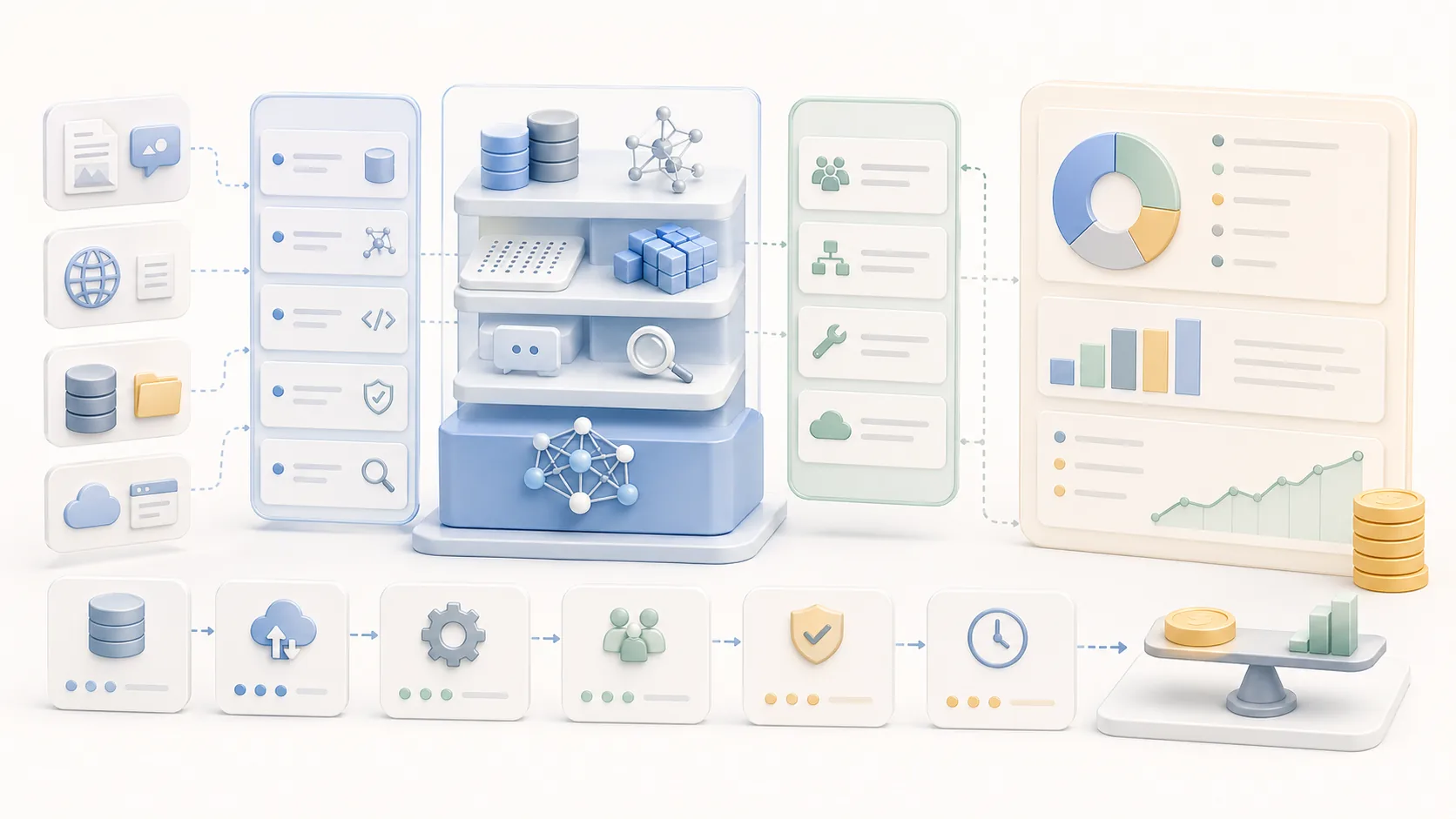
Three paths to RAG adoption and their cost structures
Before evaluating the cost of RAG adoption, it's essential to first understand the cost logic behind each of the three deployment paths. The cost composition differs completely between paths, and directly comparing monthly fee figures while ignoring hidden costs is one of the most common mistakes enterprises make in procurement decisions.
| Cost dimension | Cloud SaaS procurement | Self-built cloud RAG | On-Premise Deployment |
|---|---|---|---|
| Initial setup cost | Low (onboarding fee NT$0–200K) | Medium-high (architecture design + development NT$1M–5M) | High (hardware + deployment NT$2M–10M+) |
| Engineer staffing needs | Low (0.5 FTE maintenance) | High (3–5 full-stack/ML engineers) | Medium (1–2 IT/ML engineers for operations) |
| LLM API costs | Included in the subscription fee | Self-funded (billed by usage) | Self-funded, or free with open-source models |
| Vector Database Cost | Included in the subscription fee | Self-funded (cloud plan billed by usage) | Self-hosted (open-source options like Milvus are free) |
| Data Security | Depending on the vendor tier, data may reside in the cloud | Controllable, but still dependent on the cloud service provider | Higher — primary data flows can stay within the internal network (update, logging, and backup paths still need to be confirmed) |
| Applicable scenarios | SMEs that need fast adoption, have limited budgets, or lack IT resources | Tech companies with in-house technical capability that need high customization | Organizations with high security requirements, such as finance, healthcare, and government |
Each path has scenarios where it makes sense. Cloud SaaS's core advantage is fast adoption and a low barrier to entry, suiting enterprises with limited budgets or insufficient IT resources; a self-built solution offers the highest technical flexibility but requires bearing the highest labor and complexity; on-premise deployment is common among organizations whose data cannot leave the premises — the initial investment is higher, but under sustained high-volume usage, the amortized unit cost may end up lower than continuously paying API fees. Whether that holds true needs to be calculated against your own actual usage.
Cloud SaaS procurement cost analysis
Procuring a cloud RAG SaaS platform is the fastest path to production readiness. Subscription fees for RAG platforms on the market vary considerably depending on features and scale.
Typical plan price ranges
Entry-level plans (suited to proof-of-concept or small departments) typically run NT$5,000–20,000 per month, including a limited document count, basic Q&A functionality, and a standard LLM model. Mid-size enterprise plans run about NT$20,000–80,000 per month, covering more document storage, multi-tenant management, custom knowledge-base categorization, and API integration. Large enterprise plans run NT$80,000 or more per month, typically offering a dedicated deployment environment, SLA guarantees, advanced access control, custom prompt management, and dedicated technical consulting services.
Key cost evaluation points
When procuring a SaaS plan, pay special attention to the following billing items: the document page or token cap (whether exceeding it requires an add-on purchase), the concurrent query limit (whether performance slows during peak hours), the LLM model version (whether the latest flagship models such as GPT-5.6 or Claude Sonnet 5 are available), and whether custom features require additional fees.
Labor and infrastructure costs of building a RAG system in-house
The cost of building a RAG system in-house often exceeds expectations, mainly because the following hidden costs are easy to underestimate.
Estimating LLM API usage costs
Embedding costs are typically extremely low: mainstream lightweight embedding models cost only a few cents per million tokens, so indexing several thousand enterprise documents often costs only tens to a few hundred NT dollars, and it's a one-time expense (rerunning is only needed if you re-chunk or switch models). What actually scales with usage is the generation cost per query, and that portion must be calculated using your own assumptions — you cannot borrow someone else's monthly fee figures.
The calculation formula is simple: monthly cost equals (monthly query count × input tokens per query ÷ 1,000,000 × input unit price) + (monthly query count × output tokens per query ÷ 1,000,000 × output unit price). Taking the rates published in July 2026 as an example, GPT-5.6 comes in three tiers — Sol ($5/$30), Terra ($2.50/$15), and Luna ($1/$6) (units in USD per million tokens); Claude offers Opus 5 ($5/$25), Sonnet 5 ($3/$15), and Haiku 4.5 ($1/$5); Gemini 3 Pro is $2/$12, and Gemini 3 Flash is $1.50/$9.
Plugging in a concrete set of assumptions: 500 queries per day (about 15,000 per month), 2,000 input tokens per query (question plus retrieved passages), 500 output tokens, at an exchange rate of NT$32/USD. If you use GPT-5.6 Terra, input is 15,000 × 2,000 ÷ 1,000,000 = 30 million tokens, times $2.50 = $75; output is 15,000 × 500 ÷ 1,000,000 = 7.5 million tokens, times $15 = $112.5, for a total of about $187.5, or roughly NT$6,000/month. Under the same conditions, switching to Sol comes to about $375 (roughly NT$12,000/month), while switching to Luna comes to about $45 (roughly NT$1,440/month).
This calculation reveals two things. First, at small-to-medium usage volumes, LLM API fees are often far lower than labor costs, so decision-making should focus on staffing and data governance rather than API unit prices. Second, the variable most likely to cause costs to spike is "input tokens per query," not the number of queries: if you widen the retrieved passages from 5 to 20 chunks, input tokens can multiply several-fold and costs rise in step; multi-turn conversations that carry the full history, or agentic multi-step retrieval, can also push the actual token count per query far above expectations. We recommend logging the real usage field from API responses during the PoC phase, and budgeting from measured token counts rather than estimates.
Vector Database Cost
For cloud vector databases, Pinecone's Serverless plan is quite low-cost for small applications (up to 1 million vectors), running about NT$300–3,000 per month. But once the document base scales to several million vectors, costs can reach NT$5,000–30,000/month. Weaviate Cloud has a similar cost structure, while Zilliz Cloud (the cloud version of Milvus) tends to be relatively cheaper at equivalent scale. If you choose to self-host an open-source vector database (such as Milvus, Chroma, or Qdrant), the software itself is free, but you'll need to cover server costs and maintenance labor.
Engineer labor costs
Building a RAG system in-house typically requires the following roles: data engineers (responsible for document ETL pipelines and web crawlers), ML engineers (responsible for embedding model selection, chunking strategy, and reranking), and backend engineers (responsible for API development and system integration). At Taiwan market rates, a senior AI engineer's annual salary runs about NT$1.2M–2M, so assembling a 3–5 person RAG development team alone reaches an annual labor cost of NT$4M–9M. This doesn't even include the ongoing labor required for maintenance: changes to social platform API specs and LLM model updates both require continuous engineer attention.
| Self-built cost item | Small scale (<200 queries/day) | Medium scale (200–1,000 queries/day) | Large scale (>1,000 queries/day) |
|---|---|---|---|
| LLM API monthly fee (based on the assumptions above) | NT$1,200–4,800 | NT$2,400–24,000 | NT$12,000 or more |
| Vector Database Monthly Fee | NT$300–3,000 | NT$3,000–10,000 | NT$10,000–30,000 |
| Cloud compute (API server) monthly fee | NT$1,000–5,000 | NT$5,000–20,000 | NT$20,000–80,000 |
| Engineer maintenance cost (monthly amortized) | NT$30,000–60,000 (0.5 FTE) | NT$80,000–150,000 (1 FTE) | NT$200,000+ (2+ FTEs) |
| Estimated total monthly cost (sum of all rows) | NT$32,500–72,800 | NT$90,400–204,000 | NT$242,000 or more |
The LLM API row is derived from the assumptions above (2,000 input tokens and 500 output tokens per query, model rates taken across the GPT-5.6 Luna-to-Sol range, exchange rate NT$32/USD) and is for illustration only; please recalculate using your own company's measured token counts and the current official rates. API pricing changes frequently — always defer to each vendor's latest official announcement. In the table, "Estimated total monthly cost" is the sum of the lower and upper bounds of each row under the same scenario, respectively; vector database and cloud compute fees also vary by plan, region, and usage, so please refer to each provider's official pricing page.
Total cost of ownership (TCO) analysis for on-premise deployment
On-premise RAG deployment is typically the first choice for organizations with strict data security requirements, such as financial institutions, healthcare institutions, and government agencies. Although the initial investment is higher, over the long run, the advantage of not needing to continuously pay LLM API fees may make the overall TCO more competitive.
Hardware investment estimate
The core hardware requirements for on-premise RAG deployment include: an inference server (for running self-deployable models such as the National Science and Technology Council's TAIDE, Gemma 4 31B, GPT-OSS, Mistral, etc.; Taiwanese government agencies and regulated industries generally may not use models from Chinese vendors, so confirm your organization's sourcing restrictions before model selection), a vector database server, and a document storage server.
It's worth noting that "how many users" cannot directly tell you "how many GPUs are needed": for the same 200-person organization, needing to support 3 concurrent queries at peak versus 30 concurrent queries can mean an order-of-magnitude difference in required compute. The correct estimation sequence is: first confirm peak concurrent query count (not total headcount), then confirm the input length and expected output length per query, set acceptable limits for time-to-first-token and full-response latency, select the model parameter count and quantization precision (the same card can host a far larger model at 4-bit quantization than at FP16), and finally measure the actual concurrent throughput a single card can support with the chosen model on candidate hardware, then work backward to determine how many cards are needed and whether multiple nodes are required. Skipping this step and procuring based purely on headcount is the most common source of over-buying or under-provisioning in on-premise projects.
GPU and server pricing changes rapidly and is heavily affected by model, supply availability, whether it's a full system or a bare card, warranty period, and procurement channel, so this article does not list specific figures. We recommend that once your requirement specifications are finalized, you request current formal quotes directly from two or three system integrators, and require the quote to state the date, model, warranty scope, and delivery time. At the same time, include ancillary facilities such as networking equipment, UPS systems, racks, and data-center air conditioning, to avoid underestimating total investment by comparing GPU unit prices alone.
Annual Maintenance Cost
The annual maintenance cost of on-premise deployment should be estimated item by item and then summed, rather than summarized with a single percentage. The following demonstrates with a set of explicit assumptions (assuming a hardware purchase price of NT$4M):
- Hardware maintenance contract: most vendors' annual fee falls between 10% and 15% of the purchase price, i.e., NT$400K–600K/year. The actual percentage and coverage (whether it includes on-site replacement, spare-part turnaround) should be confirmed against the quote.
- Electricity cost: this must be calculated yourself as "equipment rated power × average load factor × 24 hours × 365 days × per-unit electricity price," and remember to also include the power consumption of cooling and UPS systems (overall data-center power draw is typically significantly higher than the servers alone). Taiwan's industrial and commercial electricity rates are time-of-use and adjusted annually — please calculate using Taiwan Power Company's currently published rates and your company's actual contracted capacity; this article does not estimate on your behalf. For this type of configuration, this item typically doesn't account for a large share of overall maintenance cost, but it can grow significantly under high load or when electricity rates rise.
- IT operations staffing: amortized at 0.3–0.5 FTE, this comes to approximately NT$360K–600K/year based on Taiwan market salary levels.
- Model and system upgrades: including model version updates, dependency upgrades, and regression testing, about NT$40K–200K/year, depending on update frequency and the rigor of validation.
Adding the items above to your own calculated actual electricity cost gives your company's annual maintenance cost range. Taking the three items with stated figures here as an example, the lower bound is 40 + 36 + 4 = about NT$800K, and the upper bound is 60 + 60 + 20 = about NT$1.4M, with actual electricity cost still to be added. For the sake of the TCO demonstration that follows, we'll temporarily use NT$800K–1.4M/year as an example figure; the actual number must be recalculated using your own quotes and electricity rates.
5-year TCO estimate
Continuing with the example assumptions above (hardware purchase NT$4M, annual maintenance NT$800K–1.4M), the 5-year TCO can be derived item by item as follows:
- Year 1 = hardware NT$4M + implementation and onboarding (architecture design, system integration, data governance) NT$1M–1.6M + first-year maintenance NT$500K–1.4M, totaling about NT$5.5M–7M.
- Years 2–5 = annual maintenance NT$800K–1.4M × 4 years, totaling about NT$3.2M–5.6M.
- 5-year cumulative = 550 + 320 = about NT$8.7M (low estimate scenario); 700 + 560 = about NT$12.6M (high estimate scenario).
If you switch to SaaS instead, the cost over the same period likewise needs to be worked out yourself: at a monthly fee of NT$60K–100K, 5 years comes to 60K × 12 × 5 = about NT$3.6M, up to 100K × 12 × 5 = about NT$6M. It's worth noting that these two sets of figures hold only under the assumptions above and are not a general comparison. Changing any assumption (hardware spec, concurrency, staffing, SaaS plan tier, token usage) will substantially shift the result. For a formal decision, we recommend putting both options into the same year-by-year cash flow table and additionally performing a sensitivity analysis: adjust usage, labor cost, and hardware price up and down by 30% respectively and see whether the conclusion flips. If a 30% swing is enough to change the answer, that means the decision is overly sensitive to assumptions, and you should gather more reliable usage data before finalizing. Beyond this, the value of an on-premise plan often isn't limited to book cost — it also includes keeping data from leaving the premises, regulatory-compliance flexibility, and lower marginal cost as long-term usage grows.
Hidden costs and risk assessment
Regardless of which deployment method you choose, the following categories of hidden cost are easily overlooked during procurement evaluation and should be factored into budget planning.
Data preparation and knowledge base construction costs
The quality of a RAG system depends heavily on the quality of its knowledge base. Enterprise documents are often scattered across different systems (SharePoint, Google Drive, local hard drives, legacy ERP systems), come in inconsistent formats (scanned PDFs, HTML, Word), and contain a large amount of duplicate or outdated information. The labor cost of cleaning, organizing, and standardizing these documents is often higher than building the system itself. This portion of the work hours should be estimated after taking inventory of document status, rather than applying a generic figure. We recommend first sampling 100 representative documents, measuring the actual time needed to process each one (including determining whether it's the latest version, whether it needs re-OCR, whether tables need manual correction), then multiplying by the total document count to extrapolate. Sampling also reveals the real cost driver: it's usually not the number of documents, but the proportion of scanned files and the degree of version duplication.
Evaluation, testing, and quality optimization costs
Once a RAG system goes live, it requires ongoing evaluation and optimization. Building an evaluation dataset (containing representative questions and reference answers), running system tests, analyzing failure cases, and tuning chunking strategy and prompt design all require input from personnel with AI expertise, and this is often underestimated as "just testing." The time optimization requires depends on the strictness of acceptance criteria, how complete the evaluation set is, and the distribution of failure-case causes (retrieval issues are usually resolved quickly, while missing or contradictory information in the documents themselves requires going back to fix the data). We recommend scheduling optimization into fixed-cadence iterations, retesting on the same evaluation set each round and recording score changes, using "no significant improvement over two consecutive rounds" as the convergence criterion rather than presetting a number of months.
End-user training costs
The adoption rate of a new system often hinges on how well end users accept it. Employees unfamiliar with AI tools may need systematic training courses, operation manuals, and ongoing technical support. Underestimating training costs can result in poor usage rates after the system is deployed, failing to realize the expected return on investment.
Budget planning from proof of concept to full-scale adoption
We recommend that enterprises divide RAG adoption into three phases for budget planning, with each phase having clear acceptance criteria and go/no-go decision points, to avoid committing a large amount of resources at once without achieving the expected results. The following describes the goals and deliverables for each phase; actual budgets and timelines vary enormously across phases, and should be estimated item by item based on your own scope, calibrating each subsequent phase's budget using actual cost data from the previous phase rather than reusing someone else's reference figures.
Phase 1: Proof of concept (PoC)
The goal is to verify whether RAG technology can solve a specific business problem. Typically, a clearly scoped use case is chosen (such as an HR FAQ bot or a product manual lookup tool), and a prototype is quickly built using a cloud API.
There's no generic figure to apply to this phase's budget and timeline — it should be determined by three variables: the number of documents to include and their format condition (scanned files and version chaos will substantially lengthen the preparatory work), how many existing systems need to be integrated, and the rigor of the acceptance criteria. A practical approach is to lock down the scope first: clearly list the documents to include, the number of pilot users, and the systems that need integration, then request a work-hour estimate from vendors or the internal team based on that — rather than setting a budget figure first and squeezing the scope to fit it afterward.
The acceptance threshold should likewise be determined by business risk, not by applying a fixed percentage. Scenarios like internal knowledge lookup, where "a wrong answer just costs extra time," can tolerate a lower accuracy rate; scenarios involving external customer service or regulatory compliance need higher accuracy, plus an additional requirement that the rate of "honestly declining to answer when no data is found" meets its target. Before setting thresholds, we recommend first measuring the current baseline (the accuracy rate and time spent when employees currently look things up manually) as a reference point, so you know how much of an improvement counts as success. Thresholds should include at least three items: the answer accuracy rate for key question types, whether citations genuinely support the answers, and the correct decline rate for unanswerable questions.
Phase 2: Pilot Implementation
Go live formally within a specific department or business process, expand the knowledge base to the full scope of business documents, establish a monitoring mechanism to track usage rates and satisfaction, and continuously optimize based on actual usage feedback. This phase is also the key decision point for confirming the final deployment architecture (SaaS / self-built / on-premise).
Phase 3: Production Rollout
Expand the RAG system across the entire enterprise or multiple departments, integrate it into existing workflows and IT systems (such as ERP, CRM, and collaboration tools like Teams/Slack), establish a mechanism for continuously updating the knowledge base, and establish a long-term maintenance and evolution plan for the system. The cost of this phase varies enormously depending on enterprise scale and deployment method; we recommend using actual cost data from the PoC and Pilot phases for a more precise budget estimate.