Defense & Critical Infrastructure Intelligence Solutions
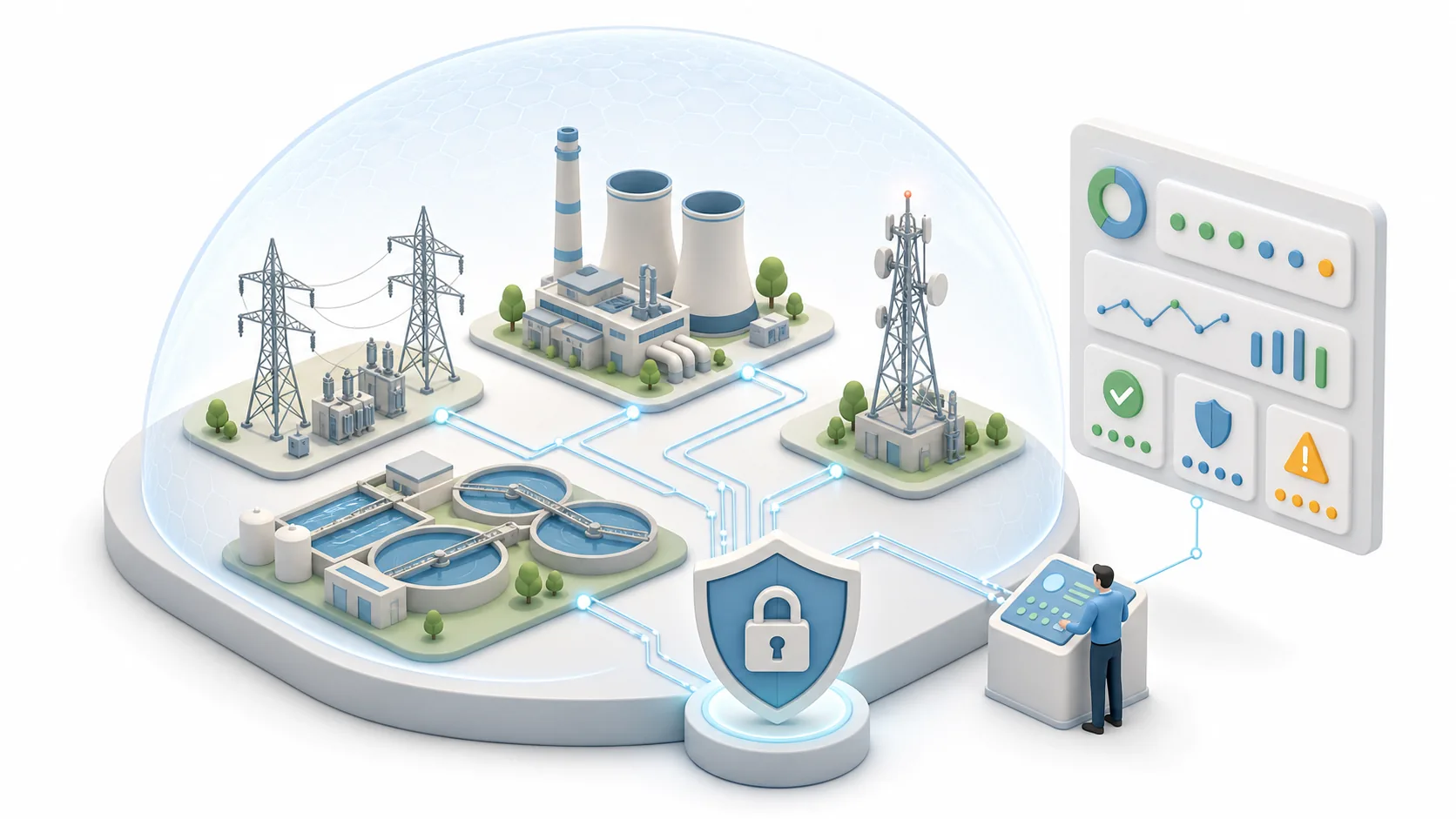
Public sector bodies, government agencies, and critical infrastructure operators face compounding challenges across geopolitical friction, supply chain disruption, and narrative manipulation—alongside strict data sovereignty mandates. LargitData unifies InfoMiner risk intelligence, supply chain vetting, and the RAGi on-premise AI engine to deliver fully deployable intelligence architectures keeping data strictly on-premises.
Four Core Use Cases
In an increasingly complex information environment, these are the four intelligence capabilities government, defense, and critical infrastructure organizations need most:
- Disinformation and Fake News Detection:Automatically ingests and cross-references multi-source feeds to identify cross-platform disinformation narratives, tracing propagation vectors and early seed nodes to issue alerts before discourse spirals out of control. Note: the system flags anomaly signals and diffusion traits; final truth verification requires human investigative fact-checking.
- Identifying information manipulation and coordinated narrative-shaping:Analyzes narrative framing, sentiment mobilization, and synchronized posting behavior to help agencies understand the methods and scale of large-scale influence operations. The judgments produced are probabilistic assessments, suitable as investigative leads but not appropriate as a standalone conclusion.
- Anomaly Accounts and Coordinated Inauthentic Behavior Detection:Detects troll farms, bot networks, and Coordinated Inauthentic Behavior (CIB), revealing suspicious coordinated clusters via posting cadences, interaction graphs, and semantic content similarity. Observable fidelity depends on platform-specific API data exposures.
- Open-source intelligence collection (OSINT):Continuously gathers intelligence from publicly accessible, legally lawful sources—spanning news media, social platforms, forums, open sanctions registries, and public procurement gazettes—transforming fragmented data points into actionable assessment intelligence.
Industry Challenges
Government, defense, and critical infrastructure organizations operate in a risk environment far more complex than that of ordinary enterprises:
- Rising geopolitical risk:Shifts in cross-strait relations, international trade policies, and export controls can disrupt supply chains and operations on short notice, demanding persistent intelligence surveillance.
- Disinformation and Narrative Manipulation:Fake news, disinformation, and coordinated inauthentic campaigns propagate within hours to undermine public trust and institutional stability, demanding real-time detection and analytical response.
- Supply chain security threats:Critical infrastructure supply chains involve major public interests; if any link involves a sanctioned entity or a high country-risk supplier, the consequences can be severe.
- Data Sovereignty and Classified Data Governance:Many agencies, under internal policy or requirements from higher authorities, restrict sensitive data from being outsourced or processed via offshore cloud services, imposing strict operational requirements on the deployment method.
- Cyber security compliance pressure:Public-sector bodies and critical infrastructure providers are assigned a cyber security responsibility level (A through E, five tiers) under the Cyber Security Management Act, with different levels corresponding to different control measures and audit-trail requirements.
Industry Solutions
LargitData delivers integrated solutions spanning risk intelligence, supply chain security, and on-premise AI for public sector and critical infrastructure organizations:
InfoMiner: Risk Intelligence and Disinformation Monitoring
- Real-time multi-source surveillance across news, social channels, forums, and public registries to capture geopolitical risks and disinformation signals.
- Detects fake news, coordinated narrative manipulation, and anomalous account clusters, tracing dissemination paths and illicit campaign patterns.
- Screens against OFAC, EU, UN, and international sanctions watchlists, identifying designated entities and affiliated counterparties (screening reflects publicly published versions; matches require human verification).
- AI sentiment analysis and anomaly velocity detection issue alerts before risks escalate; threshold sensitivities are tunable per project requirements with balanced precision/recall.
Learn MoreInfoMiner Social Listening
RAGi On-Premise — On-Premise AI Knowledge and Assessment Engine
- Synthesizes external intelligence feeds with internal knowledge bases into an on-premise AI engine, drafting situation assessment reports subject to analyst review.
- Under on-premise architecture, data processing and LLM inference run exclusively within institutional intranets with zero external cloud transmission.
- Supports natural language queries, empowering analysts to rapidly retrieve intelligence and case precedents with clickable source citations.
- Can be paired with the QubicX on-premise AI hardware platform as the deployment vehicle; actual hardware selection is assessed based on model scale and concurrency requirements.
Learn MoreRAGi Enterprise AI Retrieval-Augmented Generation Engine; QubicX On-Premise AI Platform
Key Capabilities
- Disinformation Detection: Identifying suspicious multi-platform content and tracing viral dissemination vectors.
- Information Manipulation Analysis: Decoding narrative framing, emotional triggers, and coordinated inauthentic campaign dynamics.
- Anomaly Account Detection: Uncovering troll farms, botnets, and coordinated inauthentic clusters.
- Risk Intelligence Surveillance: Continuous monitoring across geopolitical tensions, industrial vulnerabilities, and open web feeds.
- Sanctions Watchlist Screening: Cross-referencing OFAC, EU, UN, and multilateral enforcement watchlists.
- Supply Chain Security Review: Evaluating supplier country risk, corporate registry filings, and public contract performance.
- Open Source Intelligence (OSINT): Establishing actionable intelligence on publicly accessible, lawful sources.
- On-Premise AI Analysis and Briefing Generation: In-network analytics and draft synthesis with zero external data egress.
- Audit trails and source traceability: ensuring that intelligence outputs are verifiable and traceable.
- Items requiring custom integration: closed-platform data, intelligence from non-public sources, and deep integration with an agency's existing systems all require a feasibility assessment and licensing confirmation first.
Capability boundaries: what's ready out of the box and what needs evaluation
Clarifying the line between "ready to use" and "requires customization" before procurement does more to prevent acceptance disputes than comparing feature lists. Below, we break this down into three categories based on actual delivery difficulty:
| Category | Item | Prerequisites and constraints |
|---|---|---|
| Ready to use | Keyword monitoring, sentiment analysis, and abnormal-volume alerting across public news, social platforms, and forums | Source coverage depends on the plan and data-source licensing; gaps may appear when a platform redesigns or blocks crawling, and these need to be addressed through a gap-reporting mechanism. |
| Ready to use | Public sanctions and watchlist matching | Uses officially published versions as the data source; Chinese translated names, transliteration variants, and entities that share the same name can produce false matches, requiring manual review and alias maintenance. |
| Requires configuration and tuning | Detection of coordinated inauthentic behavior and anomalous account clusters | Relies on publicly available platform fields (post timing, interaction relationships, content similarity); closed platforms or those without a public API cannot be covered. Judgments are probabilistic assessments requiring manual verification. |
| Requires configuration and tuning | Vendor country-risk and affiliated-entity assessment | Based on publicly available business registration, sanctions/penalty, and procurement records across jurisdictions; the degree of public disclosure varies greatly by country, and cross-border layered ownership structures often cannot be fully reconstructed. |
| Requires custom assessment | Non-public source intelligence, closed communities, and deep coverage of specific language communities | The legality and authorization of data acquisition must be confirmed first, with coverage and quality verified through a proof of concept before being included in the formal scope. |
Deployment: On-Premise First, Ensuring Data Sovereignty
Public sector and critical infrastructure organizations enforce stringent data residency mandates. LargitData offers an on-premise-first deployment model: RAGi On-Premise deploys the AI engine within the institutional intranet, paired with the QubicX on-premise hardware platform to execute all data ingestion, indexing, and LLM inference entirely on-premises without transmitting data to external clouds. This architecture fulfills zero-data-egress compliance while delivering advanced AI situational intelligence.
There's no single standard answer for hardware selection. Viable options range from a server with a single professional-grade GPU, to an integrated desktop AI workstation, to a multi-node cluster. Which one is actually appropriate depends on the following conditions:
- Model scale and quantization method: parameter count and quantization precision directly determine the required VRAM capacity.
- Concurrent users and acceptable response latency: doubling the number of simultaneous online users usually can't be handled by pushing a single machine harder.
- Knowledge base document volume and update frequency: vector index rebuild time grows with document volume.
- Server room conditions: existing constraints on rack space, power supply, cooling, and network segmentation.
- Operations model: whether a high-availability architecture, redundant nodes, and an offline update process are needed.
Before formal procurement, we recommend running a small-scale performance validation using your organization's actual documents and typical queries, and writing acceptance criteria for response latency, concurrency, and accuracy into the contract, rather than relying solely on the numbers on a spec sheet.
Data Governance and Cyber Security Compliance
All external intelligence collected by this solution originates from publicly accessible, legally lawful sources—including public sanctions lists, open procurement registries, news media, and open web data. The platform provides RBAC access controls, encrypted storage, immutable audit logging, and data retention enforcement to support cybersecurity and PDPA personal data compliance (subject to validation per deployment topology and governance policies). All intelligence outputs cite source lineages, ensuring assessment findings withstand institutional scrutiny.
Common regulatory aspects that need to be confirmed together include: the responsibility level assigned under the Cyber Security Management Act and its corresponding control measures,Personal Data Protection Act provisions on collection, processing, and use; GDPR requirements when EU data subjects are involved; and the Executive Yuan's 2023 "Executive Yuan and Subordinate Agencies (Institutions) Guidelines for the Use of Generative AI." During deployment, we recommend that security, legal, and business units jointly confirm data classification and grading, retention periods, and the division of responsibility for outsourcing management.
The actual scope of application and operational requirements are still subject to the competent authority's latest announcements and the determination of your agency's (or company's) legal counsel.
Use Cases
Scenario 1: Disinformation and Coordinated Manipulation Detection
Institutions deploy InfoMiner to monitor cross-platform narrative propagation. The platform identifies suspected fake news, coordinated inauthentic behavior, and anomalous account clusters, analyzing posting tempos and network graphs to issue early alerts during initial diffusion stages. This equips decision-makers to grasp the mechanics and blast radius of information operations. Operationally, pair alerts with human fact-checking workflows, treating system warnings as investigative leads rather than conclusions.
Scenario 2: Continuous supply chain security review
Institutions establish continuous surveillance mechanisms for mission-critical vendors. The platform automatically matches public sanctions lists, tracking supplier-related adverse media coverage and country-level geopolitical risks, and issuing push alerts upon watchlist updates or material events—allowing procurement and security departments to proactively evaluate alternative sourcing. Sanctions matching generates homonym false positives, requiring cross-verification against unified business numbers and jurisdictions of incorporation.
Scenario 3: On-Premise Analysis of Classified Intelligence
For high-classification analytical operations, institutions deploy RAGi On-Premise paired with QubicX on-premise hardware appliances, retaining all analytics strictly within internal networks. Analysts query historical intelligence and case precedent in natural language with zero external data transmission, fulfilling rigorous data residency mandates. Before deployment, inventory approved data categories, authorization hierarchies, and query audit log retention schedules.
Questions to confirm when evaluating vendors
Differences between intelligence-type systems mostly lie in the data and processes, not the interface. We recommend asking vendors to answer the following in writing, either in the requirements document or during vendor consultations:
- What is the data source list and update frequency? Which sources are self-built crawlers and which are externally licensed? Can the data still be used after the license expires?
- How are deduplication rules defined? When the same news story is reprinted by multiple outlets, is it counted as one item or multiple in the volume statistics?
- How far back can historical data be traced? Is there an extra charge for backfilling historical data?
- How are gaps reported when a platform is redesigned or blocked? Is there a service-level agreement and remediation mechanism in place?
- How are sentiment analysis and anomaly detection evaluated? What dataset and annotation guidelines are used for the calculation? Can misjudged cases be reviewed?
- Can alert sensitivity and false-positive rates be adjusted per project? Who bears the cost of handling false positives?
- For on-premise deployment, do model updates, vulnerability patches, and license verification require an internet connection? What is the offline update procedure?
- What fields does the audit trail record? How long is it retained? Can it be exported for review by a higher authority or auditing unit?
- What is the process for background checks, confidentiality agreements, and access-permission revocation for outsourced personnel?
Further Reading
FAQ
Want to learn about our defense & critical infrastructure intelligence solution?
Contact LargitData's technical advisory team to architect an on-premise risk intelligence and supply chain security solution keeping data strictly within your intranet.
Contact Us Book a Demo