How to analyze online public opinion with social listening
A spike in complaints tells a brand that something needs attention. It does not explain whether customers dislike the product, cannot complete a payment, or are sharing the same news story. Those situations need different responses. Before counting positive and negative posts, the analyst needs a question that the collected material can actually answer.
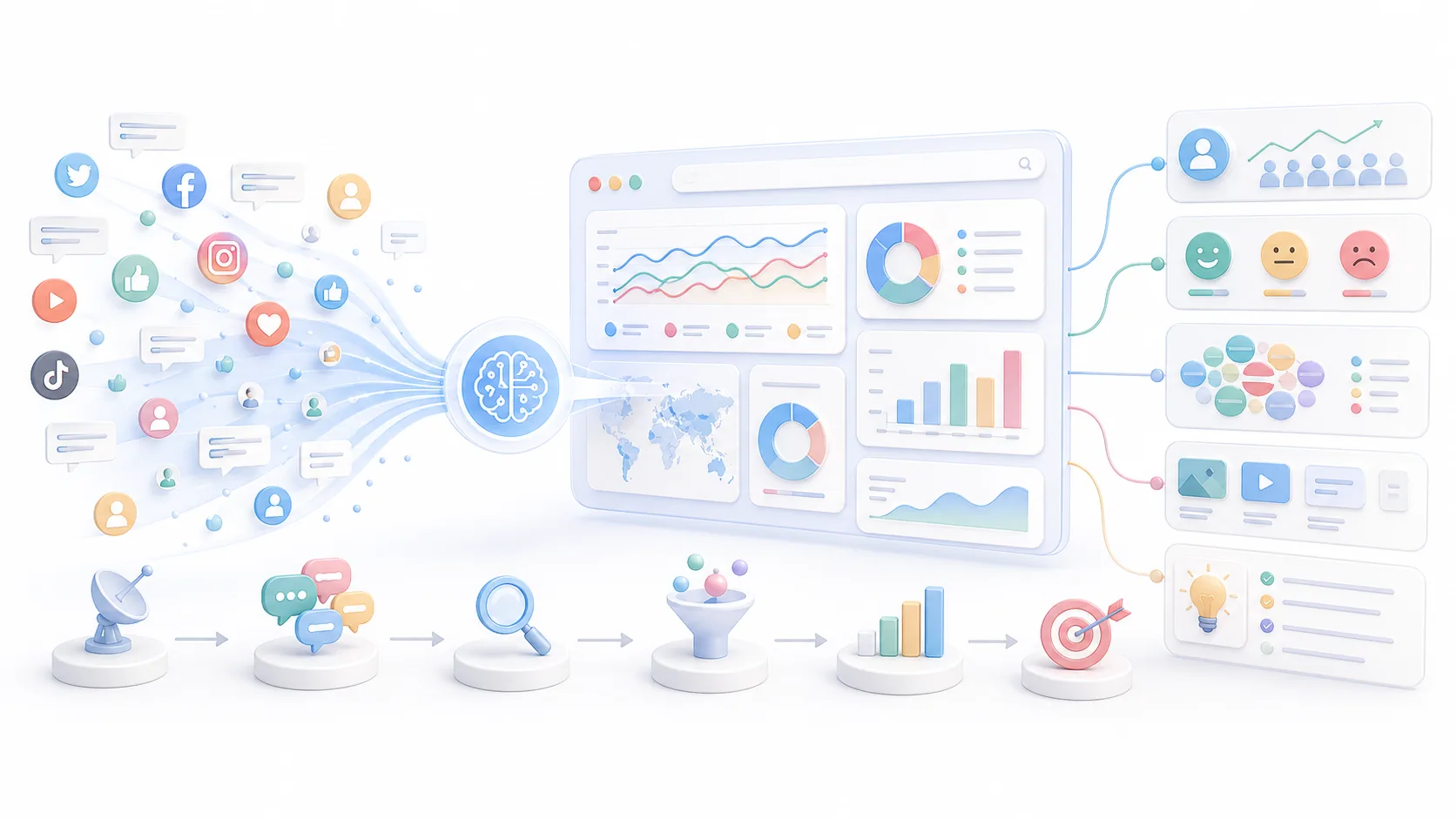
For a hypothetical product launch, the work begins with choosing search terms and continues through checking an alert and writing a report. Each step should help explain what people are discussing, preserve the evidence behind it, and identify what to investigate next.
What does social listening measure?
Social listening is the systematic collection and interpretation of publicly available online discussion about a topic, organization, product, or event. Sources may include news, forums, public social posts, and comments, depending on the tool and its access agreements. In Taiwan, this work is often called online public opinion analysis. It examines expressed views and the way a discussion develops.
Sentiment analysis is one part of that work: it classifies the attitude expressed in a piece of text, sometimes toward a particular subject. Social listening also asks who is discussing an issue, what triggered it, which sources are spreading it, and what has changed. A negative label is useful only when we know what the writer is negative about.
Public discussion also has a sampling problem. People who post are different from people who remain silent, and private groups may be outside the collection scope. The AAPOR report on social media research explains why social media users cannot simply stand in for the whole population. A favorable share of collected comments is therefore not a public approval rating, and a candidate's discussion volume is not a vote forecast.
Start with a decision you can investigate
Suppose a fictional company has launched a rechargeable desk lamp. The support team wants to know why complaints increased during the first week. “Track our brand” is too broad: the results could include recruitment posts, older products, and unrelated companies with similar names. A better question is: what problems are buyers reporting about this lamp after launch, and which reports need a response?
That question determines the material to collect. Search for the company name, the product name, model number, common abbreviations, and likely misspellings. Review a sample before adding exclusions. If an abbreviation also means a sports team, remove that use without accidentally excluding relevant comparisons. Keep a short query log so another analyst can reproduce the scope.
The same approach works for other purposes. Brand research can identify recurring reasons for praise or complaints. Competitor research can compare product issues within the same source and time window. Public communication teams can identify questions people are struggling to understand. An influencer review can examine the relevance of an author's discussion and responses rather than treating follower count as proof of influence.
These uses require different questions. Combining them into one dashboard makes it harder to tell whether a change matters.
Choose a tool for the part of the work you need
A small project can begin with web alerts and manual review. A team following multiple products across news and forums needs more consistent collection, deduplication, and reporting. The following tools play different roles; their outputs should not be treated as interchangeable counts.
Google Alerts helps you notice new web results
Google Alerts sends email when Google finds new results matching a search topic. Enter a company or product name, open the options, choose the relevant source types, language, region, frequency, and delivery address, then review the first notifications. Try a product-specific alert alongside a broader company alert to see which is more useful.
Advantages
It is straightforward to set up and can help a small team notice newly discovered web pages without repeatedly running the same search.
Limitations
An alert reflects the results Google finds and delivers. It does not establish complete forum or social coverage, and it is not a historical discussion database with a consistent denominator for share-of-voice analysis.
Google Trends shows changes in search interest
Google Trends helps check whether interest in a search term is rising within a selected place and period. Compare the lamp's product name with the brand name and record the geography, dates, and whether you selected a search term or a topic. This can help frame a discussion spike: people may be searching for an explanation after seeing a news report.
Advantages
It provides another view of attention and makes relative changes in search interest easier to examine.
Limitations
The index is normalized from 0 to 100. It is not an absolute search count, a count of social posts, or a measure of positive and negative opinion. Comparisons depend on the selected scope.
InfoMiner brings supported public discussion into one workflow
InfoMiner combines supported news, social, and forum sources with keyword searches, time and source filters, topic and sentiment analysis, summaries, and notifications. This is useful when an analyst needs to inspect a discussion, follow its development, and share evidence with colleagues. Confirm the required platforms, historical period, languages, collection restrictions, and notification options for the actual service plan.
Advantages
A common workspace reduces the manual work of collecting results from separate sources. Analysts can move from a volume change to the underlying content and organize recurring themes for review.
Limitations
Coverage depends on platform access and the contracted service. Private or unavailable content creates gaps. Automated labels and summaries still need checking, especially with sarcasm, mixed opinions, quoted criticism, and ambiguous names.
How to analyze the lamp launch in InfoMiner
The following workflow describes the analysis tasks rather than assuming a particular screen layout. Available controls and delivery channels should be confirmed in your account.
- Write down the question and scope. Define the product, launch date, review period, languages, and supported sources. For the hypothetical lamp, the question is which buyer problems appeared after launch. Keep pre-launch material separate so anticipation is not mixed with use experience.
- Build and test the keyword set. Add the brand, model, abbreviations, and spelling variants through the available query controls. Read a sample of results, note irrelevant matches, and revise the scope. Save the query and the reason for each exclusion.
- Inspect the volume change. Open the content around the spike. Check whether it comes from separate buyers, one widely shared review, repeated news coverage, or reposts. Record how the system counts articles, posts, and comments before calling the number a count of people.
- Group reports by the problem described. For this example, useful categories might be charging, brightness, delivery, and payment. These are proposed categories, not observed results. Review the original text in each group and distinguish an actual experience from a question, quotation, or rumor.
- Configure an alert that someone can act on. Choose the relevant query and available notification channel, such as email or LINE where supported. Assign a reviewer, test delivery, and agree on what needs escalation. A rise in discussion should trigger inspection; it does not by itself prove a product defect.
- Record the evidence and the next step. Keep the source URL, timestamp, relevant passage, issue category, and review status. Send a charging complaint to the team that can verify the symptom; send an unclear instruction to the documentation owner. Track whether the question was answered.
Notice the change in the analyst's job. Instead of forwarding a chart labeled “negative sentiment,” the analyst can explain which issue is growing, show the original reports, state the coverage limits, and identify who needs to investigate.
Read the metrics without losing their meaning
Discussion volume is a count within a defined collection scope. A news article and its comments may be separate records. One author may publish repeatedly, and syndicated stories may repeat the same information. Before comparing two weeks, check that the query, sources, counting rules, and collection availability stayed consistent.
A time-series peak should lead you back to the posts that produced it. A review, discount campaign, outage, or misleading screenshot can all create attention, but their implications differ. Describe the event you verified and leave the cause uncertain when the evidence is incomplete. Online discussion can spread rapidly through replies and reposts; the largest visible thread is not automatically the most widespread customer experience.
Share of voice compares a subject's collected discussion with a defined comparison set. It can answer whether one brand received more attention than another under matched conditions. It cannot establish market share. If one brand's name is also a common word, unresolved search noise can distort the comparison before any sentiment model is involved.
Sentiment needs a subject. “The lamp looks good, but the checkout page keeps failing” contains praise for the product and criticism of the purchase process. A single negative label loses that distinction. Review representative examples from each topic, allow neutral or uncertain cases, and record label corrections. Public posts are often subjective and incomplete; that is a reason to inspect their meaning, not to discard them.
Use AI to organize evidence you can still check
A language model can propose themes and summarize a batch of retrieved posts. Give each source an identifier and require the summary to point back to the relevant records. Then check whether each statement is supported and whether a small but serious issue disappeared in the summary. Do not publish an invented percentage or a claim about all customers because the model phrased it confidently.
Images and video need the same discipline. OCR can recover text from a screenshot, and speech recognition can turn an interview into searchable text. Preserve the original image or video reference, time position, and context. A clipped quote or an old screenshot can change the interpretation even when the extracted words are accurate.
If the task also needs internal product documentation or previous incident records, retrieval-augmented generation, or RAG, can supply relevant documents to the model while it writes an answer. Keep those internal references distinguishable from the public posts being analyzed. Retrieval helps make evidence available; it does not guarantee that the generated answer uses it correctly.
An automated workflow can assemble a draft brief and notify the assigned reviewer. External replies, customer promises, and public statements need an authorized human decision. Forecasting future discussion is a separate task that requires historical evaluation; a convincing generated narrative is not evidence that a crisis has been predicted.
Write a report someone can use
A useful first report can be short. State the question, dates, sources, query scope, and gaps. Explain the main themes with linked examples, show how they changed during the review period, and distinguish verified findings from questions still awaiting investigation. Assign a next step and an owner to issues that require action.
For the hypothetical lamp, “complaints increased” is an observation that starts the work. “Several collected posts describe difficulty completing payment; here are the original links, the dates, and the unresolved details for the checkout team to verify” is a finding another team can investigate. After that team responds, the analyst can check whether the same issue continues to appear.
That feedback loop gives the monitoring process a purpose. Once the scope and review method are working, use the InfoMiner product overview to confirm which collection, analysis, and notification functions your team needs.