AI Agent implementation costs: a complete budget planning guide from PoC to production
AI Agent (AI agent) has become a core investment for enterprise digital transformation, but the cost gap between proof of concept and full production can exceed 10x. This article gives enterprise IT decision-makers, CIOs, and technical leads a complete breakdown of AI Agent costs, covering PoC-stage budgets, production costs, LLM API cost estimates, staffing estimates, and how platform-based solutions can significantly reduce build-it-yourself costs.
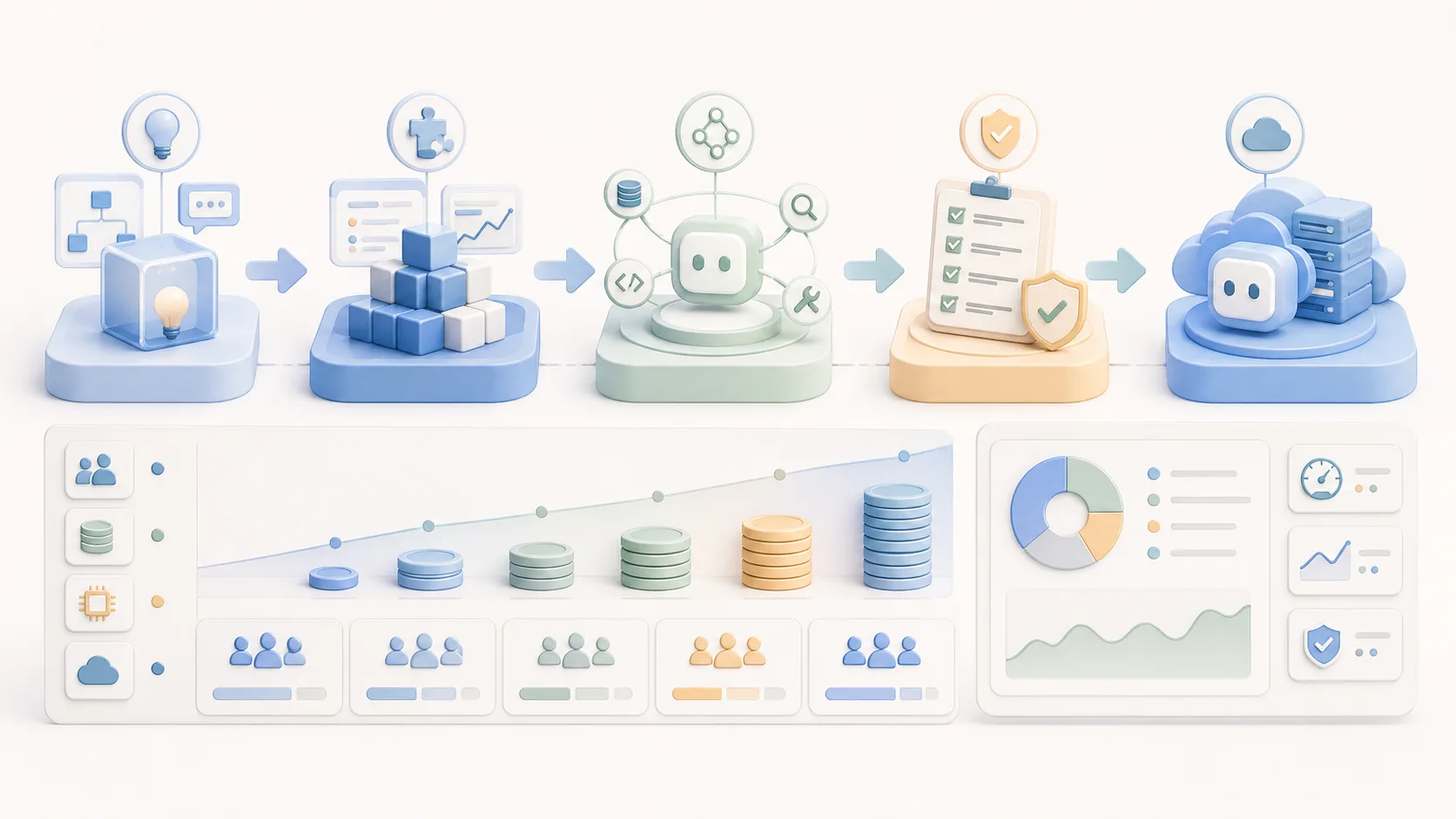
Breaking down the cost components of building an AI Agent
The cost structure of an AI Agent system is more complex than that of traditional IT systems, mainly because it involves multiple layers of technical components, each with its own cost structure. Understanding these cost components is the first step toward setting a realistic budget.
The five major components of AI Agent costs
- LLM API costs: an AI Agent's core decision engine relies on a large language model. Every Agent reasoning loop consumes tokens, and multi-step reasoning for complex tasks often consumes far more tokens than expected. This is the hardest-to-predict variable cost in an AI Agent.
- Tool-calling and integration costs: an AI Agent's value comes from its ability to operate external tools (database queries, API calls, document generation, browser operations, and more). Integration development costs for each tool range from a few days to several weeks, depending on system complexity and API design quality.
- Memory and state management costs: an effective AI Agent needs to maintain conversation history, task state, and user preferences. This involves costs for a vector database (long-term memory) and a caching system (short-term memory).
- Monitoring and observability costs: an AI Agent in production must have a complete monitoring system to track every step of Agent execution, tool-call results, and LLM output quality. This cost is often overlooked during the PoC stage, yet it is indispensable in production.
- Engineering labor costs: designing the Agent architecture, writing system prompts, developing tool functions, and testing and optimization all require professionals with AI engineering skills. This is the largest and hardest-to-control cost of all.
| Cost component | Share of total cost (build in-house) | Share of total cost (purchase a platform) |
|---|---|---|
| Engineering labor (design, development, optimization) | 55–70% | 20–35% (mainly integration work) |
| LLM API costs | 15–25% | Included in platform fees or self-supplied |
| Infrastructure (vector database, cache, queues) | 10–15% | Included in platform fees |
| Monitoring and security tools | 5–10% | Included in platform fees |
| Platform license fees | 0% (using open-source frameworks) | 30–50% |
PoC-stage budget planning
The goal of the PoC (proof of concept) stage is to validate, at minimum cost, whether an AI Agent can solve a specific business problem. Taiwanese enterprises typically budget NT$500,000–2,000,000 for a PoC, with the range depending on scenario complexity and the technical path chosen.
NT$500,000–800,000 PoC (lightweight scenarios)
Suited to Agent scenarios with a single tool and a linear workflow, such as a “customer-service Q&A Agent” (needing only RAG plus answer generation) or a “data-query Agent” (querying internal databases and generating summaries). Typically completed by 2–3 engineers in 6–8 weeks, using cloud LLM APIs (such as GPT-5.6 or Claude Sonnet 5), open-source frameworks (LangChain or LlamaIndex), and a cloud vector database. LLM API costs during the PoC usually stay under NT$3,000–10,000.
NT$800,000–1,500,000 PoC (medium-complexity scenarios)
Suited to Agent scenarios requiring multiple tool calls or conditional branching, such as an “IT operations automation Agent” (calling multiple APIs and running scripts) or a “procurement workflow assistant Agent” (querying multiple systems and generating documents). Typically requires 3–4 engineers over 8–12 weeks, along with a more complete testing framework and error-handling mechanisms.
NT$1,500,000–2,000,000 PoC (high-complexity scenarios)
Suited to multi-Agent collaboration scenarios, such as a “research and analysis Agent system” (a search Agent, an analysis Agent, and a report-writing Agent working together) or a “business development AI assistant” (a complex workflow integrating CRM, email, and calendar). These scenarios require more engineering resources for inter-Agent coordination mechanisms, error-recovery logic, and human-in-the-loop design.
Estimating costs for full production
Moving from PoC to production typically increases costs by 3–5x. This gap mainly comes from the following factors.
Annual cost estimates by company size
| Company type | Agent usage scale | Annual LLM API costs | Annual engineering labor costs | Annual infrastructure costs | Estimated total annual cost |
|---|---|---|---|---|---|
| Small and mid-sized enterprise (50–200 employees) | 100–300 Agent tasks per day | NT$300,000–800,000 | NT$1,200,000–2,000,000 (1–1.5 FTE for maintenance) | NT$200,000–500,000 | NT$1,700,000–3,300,000 |
| Large enterprise (500+ employees) | 1,000–5,000 Agent tasks per day | NT$2,000,000–6,000,000 | NT$4,000,000–8,000,000 (3–5-person AI team) | NT$1,000,000–3,000,000 | NT$7,000,000–17,000,000 |
| Government Agencies / State-Owned Enterprises | 200–1,000 Agent tasks per day | On-premise LLM selected based on security requirements (cost shifts to hardware) | NT$2,000,000–4,000,000 (including outsourcing) | NT$3,000,000–8,000,000 (on-premise hardware amortization) | NT$5,000,000–12,000,000 |
Pricing reflects each vendor's official published rates as of July 2026 (USD per million tokens). API pricing changes frequently; refer to each vendor's latest official announcement for current rates.
The estimates above assume an in-house build. Purchasing an enterprise AI Agent platform can reduce engineering labor costs by 50–70%, but adds a platform license fee (typically an annual fee of NT$500,000–2,000,000). For most mid-to-large enterprises, the total cost of a mature platform is typically 30–50% lower than building in-house, and adoption is faster.
Estimating LLM API usage costs
LLM API costs are the most important variable cost for an AI Agent, and consumption is directly affected by task complexity, the number of tool calls, and context-window size. The estimates below cover common scenarios to give enterprises a concrete reference point for budget planning.
Cost comparison of major LLM models (2025–2026 reference)
| Model | Input cost (per million tokens) | Output cost (per million tokens) | Applicable scenarios |
|---|---|---|---|
| GPT-5.6 Sol | $5 USD | $30 USD | The most complex reasoning and multi-step Agent tasks |
| GPT-5.6 Terra | $2.50 USD | $15 USD | General Agent tasks balancing quality and cost |
| GPT-5.6 Luna | $1 USD | $6 USD | High-frequency, low-complexity batch Agent tasks |
| Claude Sonnet 5 | $3 USD | $15 USD | Long-document analysis, code generation, complex reasoning |
| Claude Haiku 4.5 | $1 USD | $5 USD | High-frequency lightweight tasks, real-time response scenarios |
| Qwen 3.8 72B(自建) | Free (hardware costs apply) | Free (hardware costs apply) | High-security, high-volume scenarios |
Estimating token consumption for real-world scenarios
A typical AI Agent task (taking an enterprise Q&A Agent as an example) usually includes: a system prompt (roughly 500–2,000 tokens), conversation history (roughly 1,000–5,000 tokens), tool-call results (roughly 500–3,000 tokens), and final answer generation (roughly 200–1,000 tokens). Calculated with GPT-5.6, a complete Agent task consumes about 3,000–10,000 tokens, costing roughly NT$1–4. At 500 tasks per day, monthly costs run about NT$15,000–60,000.
One thing to note in particular: a Multi-Agent system can consume 3–10x the tokens of a single Agent, because coordination between Agents and repeated plan-execute cycles both consume tokens. When planning budgets, it's advisable to set aside a 2–3x API cost safety margin for complex Multi-Agent scenarios.
The long-term cost of staffing and maintenance
The labor cost of an AI Agent is often severely underestimated during budget planning, mainly because AI Agents are far more complex to maintain than traditional software systems.
AI engineer salary benchmarks (Taiwan, 2025–2026)
- AI application engineer (1–3 years' experience): monthly salary NT$60,000–100,000, annual salary approximately NT$720,000–1,200,000
- Senior AI engineer (3–5 years' experience): monthly salary NT$100,000–160,000, annual salary approximately NT$1,200,000–2,000,000
- AI architect / tech lead (5+ years' experience): monthly salary NT$160,000–250,000+, annual salary approximately NT$2,000,000–3,000,000+
- Prompt engineer / AI product manager: monthly salary NT$60,000–120,000, annual salary approximately NT$720,000–1,500,000
Maintenance challenges unique to AI Agents
Once a traditional software system is developed, its maintenance workload is relatively stable. AI Agents, however, face several unique maintenance challenges: LLM model version updates can change an Agent's behavior, requiring retesting and adjustment; changes to external API and tool specifications require quick updates to tool functions; prompts need continuous optimization based on real-world failure cases; and AI Agent “hallucinations” can lead to incorrect tool calls, requiring robust monitoring and rollback mechanisms.
When planning budgets, enterprises are advised to set the annual maintenance cost of an AI Agent at 25–40% of the initial build cost — higher than the 15–20% typical for traditional systems, reflecting the special complexity of maintaining AI systems.
How framework choice affects long-term costs
When choosing an AI Agent framework, enterprises need to weigh long-term maintenance costs alongside technical capability. Open-source frameworks (such as LangGraph, AutoGen, and CrewAI) carry no license fee, but they require engineers to deeply understand the framework's internals, and frequent version updates mean a higher maintenance workload. Commercial AI Agent platforms (such as LargitData RAGi) offer a more stable API interface, a complete management console, and technical support. While they carry a license fee, they significantly reduce the depth of AI engineering expertise required — and for most enterprises, the total cost ends up lower.
How to evaluate the business value and ROI of an AI Agent
For CIOs and business owners, the key to evaluating an AI Agent investment isn't the technology itself, but whether it can generate quantifiable business value. Below are several practical ROI evaluation frameworks.
Quantifying efficiency gains
The most direct source of ROI is automating manual work. The formula: (time spent per task) × (monthly task volume) × (hourly wage) × (automation rate) = monthly benefit. Below is a worked example built on openly stated assumptions — the numbers are only meant to illustrate the calculation method; actual benefits must be recalculated using your own company's data. Assume an AI Agent helps with the initial review of 50 procurement requests per day, each of which originally took a person 20 minutes, over 22 working days per month, with an estimated automation rate of 80%: monthly manual hours = 50 requests × 20 minutes × 22 days ÷ 60 = about 367 hours, of which roughly 293 hours can be automated. Estimating with an employee earning a monthly salary of NT$50,000 (roughly NT$313/hour), the monthly benefit is about NT$90,000, and the annual benefit is about NT$1,100,000. If build-and-maintenance costs are NT$1,500,000–2,500,000, payback would take more than two years — which is also why automating a single process usually isn't enough to justify an Agent project on its own; in practice, one platform supporting multiple processes is used to amortize the cost. When running an ROI calculation, always substitute your own task volume, hourly wage, and automation rate — never apply the example numbers directly%.
The value of reducing error rates
Manual operations are prone to errors from fatigue or oversight, and once an error enters downstream processes, the cost to correct it is usually far higher than the original cost of the task. AI Agents can effectively reduce this kind of careless error in tasks with clear rules and exhaustively enumerable decision conditions. However, the degree of improvement depends heavily on the original process's error-rate baseline and how rule-based the task is — it should be measured with your own sample data rather than applying an industry average. The savings from reduced error rates tend to be especially significant in scenarios such as financial reconciliation, compliance review, and data entry.
The business value of faster response times
A customer-service AI Agent can compress response time from hours to seconds. In customer service, first-response time shows a clear positive correlation with customer satisfaction — an observation that holds fairly consistently across most service industries in practice, though the exact size of the improvement varies by industry, customer segment, and issue type, and should be validated with your own satisfaction-survey data. For e-commerce and financial services, faster service response directly affects conversion rates and customer retention, and the business value can far exceed the AI Agent's direct cost savings.
Reducing AI Agent build-it-yourself costs with RAGi
LargitData's RAGi platform provides enterprise-grade AI Agent capabilities, including a built-in RAG knowledge base, a tool-calling framework, Multi-Agent collaboration support, and a complete monitoring and management interface. Enterprises adopting the RAGi platform can skip the work of building a RAG knowledge base, tool-calling framework, and monitoring interface in-house, typically shortening the timeline from PoC to production significantly and reducing reliance on scarce AI engineers — labor-cost savings are often the largest single contributor to overall benefit. For mid-to-large enterprises with no plans to build out a full AI team, RAGi offers a practical option that balances technical capability with cost efficiency.