How to monitor election disinformation: a task checklist for the 60 days before the election
The monitoring checklist in this article covers voting and vote-counting procedures, candidate statements, polls and audio-video content. The closer to polling day, the shorter the time for verification and clarification, so the division of labor and response methods should be settled before the election. This article uses Taiwan's 2026 local elections as an example to organize the operational checklist, which can also be adapted for later elections at all levels.
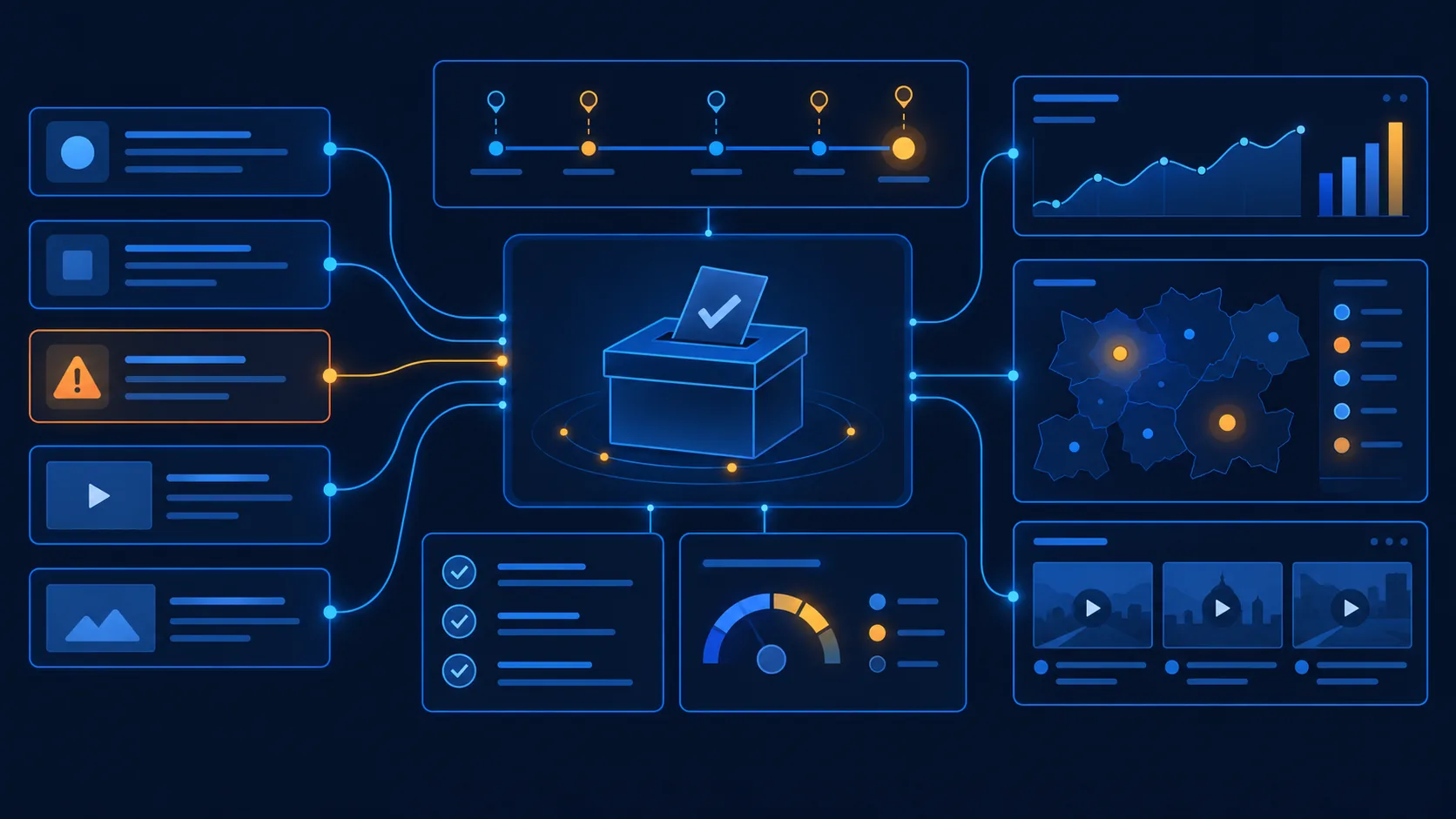
Quick answer: how do you monitor election disinformation?
Election disinformation monitoring is the practice of continuously collecting public content from news, social media, forums and public messaging-app communities during an election, identifying suspicious information related to voting and counting procedures, candidates, polls and deepfake audio and video, tracking its spread, issuing tiered alerts, and then handing it to people for verification. Before the election, three things need to be in place: a list of topics and sources, a tiered alert and verification workflow, and clarification and reporting channels; around election day, monitoring moves to high frequency. The system produces suspicious signals; whether something is true or false, and how to respond, is decided by people.
Who it is for
- Central and local election authorities: ensure voting and counting information is accurate and maintain public trust
- Local governments: handle claims awaiting verification that are driven by the election and concern public services within their jurisdiction
- Campaign teams of any camp: spot suspected forged content targeting their own candidate early
- Media and fact-checkers: build a list of claims awaiting verification and find where a claim first appears in the currently observable data
Five categories of suspicious information to monitor during an election
In their 2017 report Information Disorder, written for the Council of Europe, Wardle and Derakhshan divided information disorder into misinformation, disinformation and malinformation. In monitoring practice you do not need to decide first which kind something is; this article uses five categories by content type, because each category has different responders and verification methods. Everything in the table is content awaiting verification and does not mean it has been confirmed false.
| What to monitor | Typical patterns | Observable signals | Primary responders |
|---|---|---|---|
| Voting and vote-counting procedures | Voting dates, locations or ID requirements that differ from official announcements, or claims that a certain way of marking the ballot makes it invalid | Keyword combinations inconsistent with official announcements; the same graphic appearing on multiple social platforms at the same time | Election authorities |
| Candidate-related statements | Suspected forged screenshots of remarks, quotations taken out of context, impersonated official accounts or campaign materials | Text in images that does not match the original source; new accounts posting in bursts; similar posts appearing in sync | The candidate camps and media concerned |
| Poll-related content | Poll graphics of unknown origin or in the name of impersonated organizations; poll data circulating during the blackout period | Original data with no identifiable publisher; graphics reposted across platforms within a short time | Election authorities, media |
| Suspected deepfake audio and video | Voice or video clips of candidates suspected of being synthesized or altered | Suspicious signals from video and deepfake detection; characteristics of the posting account; mismatch with the person's existing public footage | The candidate camps and fact-checking organizations concerned |
| Post-election claims about results | Factual statements about vote counting or results that need verification, or old footage relabeled with a new time and place | Abnormal volume during the vote-counting period; old images or videos reappearing with new captions | Election authorities, local governments |
The key is in the right column. For claims about voting procedures and results, we recommend that election authorities fact-check first; for candidate and audio-video content, the camps concerned can provide original materials and responses. Poll-related content should be recorded separately: dissemination during the blackout period concerns publication rules, which is a separate matter from whether the content is true. Criticism of election administration or results is normal speech; what needs verification are the unconfirmed factual statements within it.
Who needs monitoring: different goals, different boundaries
A monitoring plan should explicitly list the monitoring targets, verification scope and response responsibilities of each user.
| User | Monitoring focus | Boundaries to observe |
|---|---|---|
| Election authorities | Claims about voting and vote-counting procedures; announcements issued in the name of impersonated agencies | Clarify only procedural facts, and take no position on candidates, parties or policy platforms |
| Local governments | Claims needing verification that are driven by the election and concern public services within the jurisdiction | Maintain administrative neutrality; limit responses to verifiable facts within the agency's remit |
| Campaign teams | Suspected forged screenshots, fake quotes, impersonation accounts and deepfake audio and video targeting their own candidate | Used only to identify and clarify forged content, not to track or label critics |
| Media and fact-checkers | The earliest position, spread range and variants of a claim awaiting fact-checking within the currently observable data | When reporting, avoid reproducing the original text or audio and video in full, to reduce secondary spread |
Neutrality means that what gets monitored is determined by content type, not by political position. For content involving identifiable individuals, first confirm the legal basis and necessary scope for collecting, processing and using personal data. Taiwan's fact-checking ecosystem includes the Taiwan FactCheck Center, MyGoPen and the Cofacts community of collaborative verification, and their published fact-check results can be added to the comparison list.
Checklist: from 60 days before the election to after the count
The checklist has five phases. The frequencies are starting suggestions from this article and should be adjusted to your scope and staffing.
| Phase | Tasks | Monitoring frequency | Deliverables |
|---|---|---|---|
| 60 days before the election | Take inventory of sources: election authority notices, official accounts of candidates and parties, local communities and forums; include abbreviations and homophones in keywords; build a volume baseline; assign a verification owner according to the tiered alert table below; settle the verification record format and the clarification window | Daily routine report | Source and keyword list, tiered alert table, contact table |
| 30 days before the election | Start narrative clustering and track claim variants; compile a comparison list of claims already fact-checked; bring video and image-card monitoring online; run one drill from alert to clarification; schedule operations for the poll blackout period | Twice-daily reports plus real-time alerts | Narrative list, comparison list, drill review notes |
| 7 days before the election | Set the duty roster; prepare clarification material on procedural claims in line with election authority notices; lower the alert threshold for procedural claims; review false positives every day | A round every few hours plus real-time alerts | Duty roster, clarification material pack, daily false-positive review |
| Election day | Handle procedural claims in one place; keep real-time contact with election officials; prioritize tier 1 alerts; record the time, basis and owner of every action taken | On duty throughout | Action records, real-time reports |
| After the count | Monitor claims about vote counting and results; decide when to reduce frequency based on open cases, procedural claims still circulating and alert volume; review false positives and time taken to respond as a reference for adjusting thresholds next time; retain or delete data as required | Intensive on the night of the count, then daily, then reduced as appropriate | Incident record, review report |
Taking Taiwan's 2026 local elections as an example, the Central Election Commission issued the election announcement on August 20, and election day is November 28. If you have less than 60 days to prepare, compress the first phase into one week and prioritize setting up tiered alerts and the verification contact point; keywords can be added as you go.
Tiered alerts: by content type, degree of spread and likely impact
Tiers are set by the combination of three conditions, not by content type alone. The following is this article's suggested starting scheme and can be adjusted to your remit.
| Tier | Criteria | Response |
|---|---|---|
| Tier 1 | Specific factual statements about voting, counting, results or candidates (including suspected deepfake audio and video) that have already spread across platforms and could affect voting or election operations | Immediately notify the duty owner and start verification and clarification |
| Tier 2 | Content of the same type, but with spread still limited to a single platform or a few communities; or content that has spread but with limited impact | Schedule for verification the same day and keep watching how the spread changes |
| Tier 3 | Low spread, or repeated claims for which fact-check results already exist to compare against | Include in the daily report and compare against existing fact-check results |
A suspected deepfake video is not automatically placed in tier 1: a video that appears on only one account and has almost no reposts goes in tier 2, with the original file preserved; escalate it when it appears on a new platform or reposts rise noticeably. Items that have been clarified and whose volume has fallen can be downgraded; record every upgrade and downgrade.
Deepfake audio and video: a category that needs planning in advance
Deepfake audio and video deserve separate planning: the Civil Servants Election and Recall Act added Article 104, paragraph 2 in 2023, under which a person who meets the elements of paragraph 1 and uses the deepfake methods set out in that paragraph faces imprisonment of up to seven years; video can be reposted across platforms and is hard to catch with text keywords; and verification may need the original file and expertise in audio and video analysis.
| Step | What the system can provide | What human verification must add |
|---|---|---|
| Discovery | Monitor related audio and video across YouTube, TikTok/Douyin, Threads, Facebook and LINE communities | Confirm the earliest position and version in the currently observable data |
| First screening | Video and deepfake detection produce suspicious signals; on-screen text and image recognition help with comparison | Judge whether it is synthesized or altered; a score is not a forensic conclusion |
| Tracing the source | Track the spread path, the earliest account in the currently observable data and the repost network | Compare against public schedules and original footage, and confirm with the person concerned |
| Records | Case management can be customized to an agency's workflow, keeping verification records (screenshots, original links, capture times) | Where legal proceedings are involved, separately confirm how to preserve and forensically examine the material |
Two reminders. First, after lossy recompression a video may lose picture or audio quality, which affects judgment, so keep the earliest version you obtained. Second, the deepfake problem cuts both ways: a forged video may be taken as real, and a real video may be claimed to be fake; in both cases go back to the original material and confirm with the person concerned.
How to read the metrics: four extra reading tips from a disinformation angle
The three basic misuses of volume, sentiment ratios and anomaly signals are covered in the article “Election sentiment analysis and public opinion tracking”. Below are four more reading tips related to verifying suspicious information.
| What is observed | The wrong conclusion that is easy to draw | A more reasonable reading |
|---|---|---|
| Related volume rises after a clarification is published | The original claim is still spreading and the clarification is ineffective | Count the original claim and the clarification discussion separately; what is rising may be reposts of the clarification |
| A claim has very low volume on the major platforms | Impact is limited and no action is needed | It may already be circulating in messaging-app communities or short-video platforms; check the time lag between platforms |
| A group of accounts post the same slogan at the same time | This is coordinated inauthentic behavior | Simultaneous posting is not enough to prove coordinated inauthentic behavior; you still need to check account identity, source disclosure and content |
| Deepfake detection gives a high suspicion score | The video is definitely forged | This is the starting point for verification; a low score does not mean it is genuine either, and in both cases go back to the original material |
The third row needs an explanation of the criterion. In its 2020 CIB report, Meta defined coordinated inauthentic behavior as coordinated manipulation of public debate for a strategic goal, with fake accounts at the core of the operation; enforcement is based on the deceptive nature of the behavior, not on the content itself. So you cannot conclude such behavior from simultaneous posting alone; and being publicly named does not make the content correct, as factual statements can still be verified through the usual process. Identifying coordination and anomalous account clusters is a probabilistic assessment and needs tuning.
Legal reminders: spreading rumors, deepfakes and the poll blackout
The directly relevant current provisions are mainly in the Civil Servants Election and Recall Act. The table below summarizes the key points of each provision and what they mean for monitoring.
| Provision | Key points | What it means for monitoring |
|---|---|---|
| Article 104, paragraph 1 | A person who, intending to cause a candidate to be elected or not elected, or a recall to pass or fail, spreads rumors or disseminates false matters that are sufficient to harm the public or others, is punishable by imprisonment of up to five years | Design the format for keeping verification records before the election; where legal proceedings are involved, separately confirm how to preserve and forensically examine the material |
| Article 104, paragraph 2 | Added in 2023: a person who commits the offense in the preceding paragraph using deepfake audio, images or electromagnetic records of the candidate, the person subject to recall, or the lead proposer of the recall in person is punishable by imprisonment of up to seven years | Grade suspected deepfake audio and video by spread and impact, and preserve the original file first |
| Article 53, paragraph 3 | From ten days before election day until voting closes, poll data about candidates or the election, and other election or recall material that looks like poll data, may not be published, reported, disseminated, commented on or quoted in any way | Such material is something to monitor, and what is recorded is the act of publishing, separate from whether the content is true; your own outward-facing reports must be checked too |
Monitoring itself also has boundaries: collection is limited to public content, the unit of analysis is topics and spread patterns, profiling of individuals beyond the purpose is avoided, and the Personal Data Protection Act and platform terms of service are followed; criticism, satire and expression of opinion are not targets for action. Whether content is true is judged by fact-checkers on the evidence; whether something is illegal is determined by the competent authority according to law, and being judged false does not mean being illegal. The provisions are as published in the Laws and Regulations Database of the Republic of China and the Central Election Commission's announcements.
2026 Election Research Lab: use public volume as a background reference
The dashboard built by LargitData with InfoMiner, called “2026 Taiwan Election Lab”, shows real-time volume for all 22 counties and cities in Taiwan. It is not a poll, does not predict results and does not judge whether a message is true.
It works well as a background reference: compare whether a suspicious claim you have spotted appeared while discussion was heating up in a given county or city, to judge whether it rode on an existing topic or suddenly emerged in a quiet period. Disinformation monitoring itself still has to be set up separately using the checklist in this article.
Further Reading
- Fake News Detection and Cognitive Warfare Monitoring System
- What is cognitive warfare? How it differs from fake news, information manipulation and FIMI
- How does AI detect fake news? Five methods and what they cannot do
- Election sentiment analysis and public opinion tracking
- Social listening crisis handling SOP: a 7-step guide to PR crises
- Critical Infrastructure and Public Sector Intelligence
FAQ
Want to build a disinformation monitoring process before the election?
LargitData can help you take stock of monitoring scope, design tiered alerts and verification workflows, and explain feasible ways to adopt them.
Contact Us