The Complete Guide to OCR: Principles, Technology, and Applications of Optical Character Recognition
OCR (Optical Character Recognition) is a technology that converts characters found in images, scanned documents, or handwritten text into machine-readable text. From early simple template-matching approaches to today's deep-learning-powered intelligent recognition, OCR has evolved over decades to become an essential foundational technology for digital transformation. This article provides a comprehensive breakdown of OCR's technical principles, core algorithms, application scenarios, and solution selection criteria.
The Basic Principles and Technological Evolution of OCR
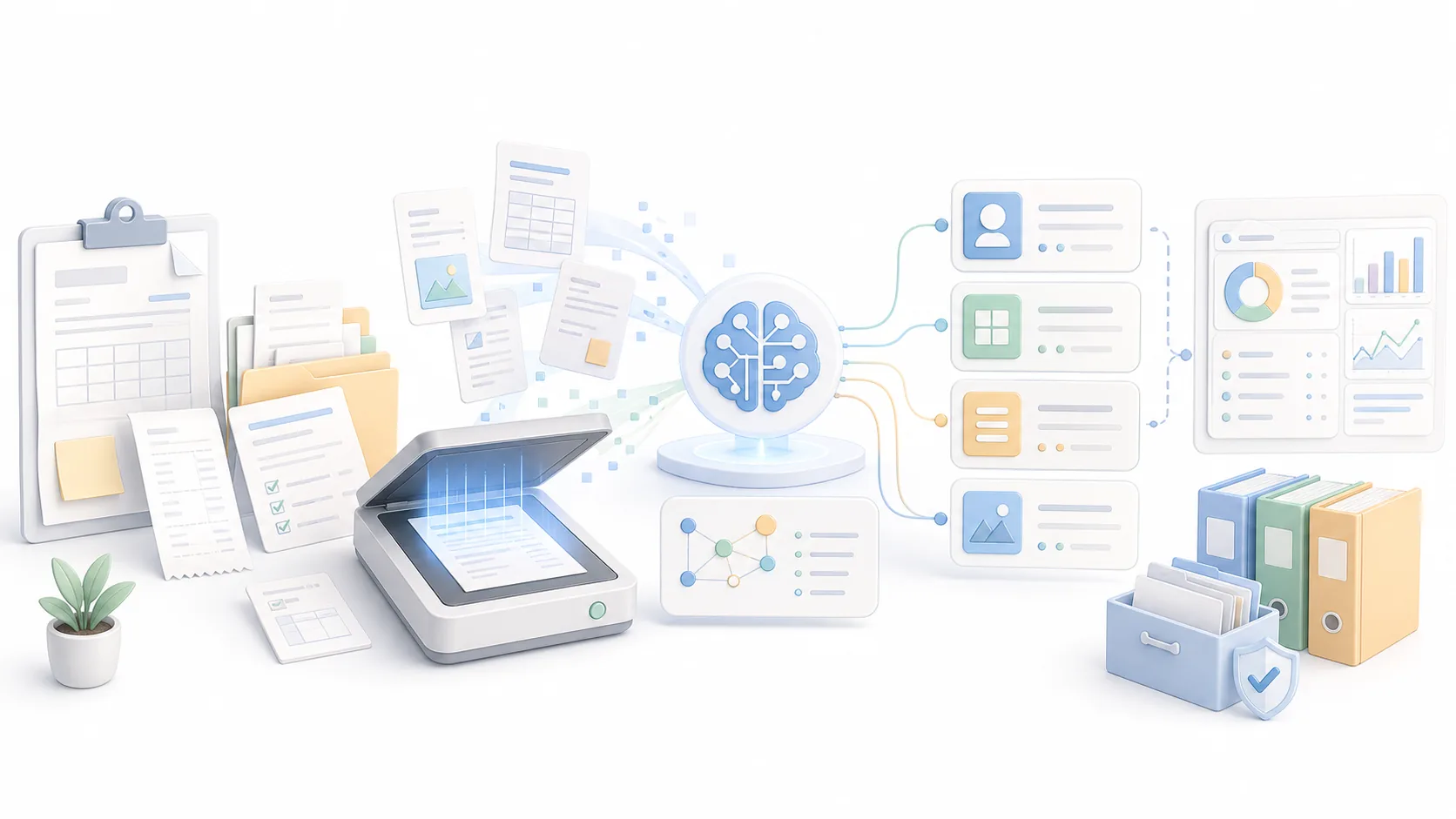
The core goal of OCR technology is to enable computers to "read" text within images. While this seems straightforward, it actually involves multiple complex technical steps. A complete OCR processing pipeline typically includes: image pre-processing (denoising, binarization, skew correction); layout analysis (distinguishing text regions, image regions, and table regions); text line detection and segmentation; individual character or full-line recognition; and post-processing (language model correction and format reconstruction).
Early OCR systems relied primarily on Template Matching: the system pre-stored standard templates for each character and recognized input by comparing images against those templates. This approach worked reasonably well for standardized printed fonts, but performance degraded significantly when faced with font variations, blurry images, or handwritten text.
Feature extraction-based machine learning methods subsequently became the mainstream approach. Systems would extract various visual features from character images — such as stroke directions, junction positions, and enclosed regions — and then use classifiers (such as SVM or random forests) for recognition. This improved tolerance for font variation, but still required extensive manual feature engineering.
Modern OCR technology has fully embraced deep learning. Convolutional Neural Networks (CNN) are used for automatic visual feature extraction; Recurrent Neural Networks (RNN) or Transformer models handle sequence modeling; and the CTC (Connectionist Temporal Classification) loss function resolves the alignment problem between input and output sequences of different lengths. End-to-end deep learning models can produce text output directly from image input without manually designed intermediate features, dramatically improving recognition accuracy and applicability.
The Unique Challenges and Breakthroughs of Chinese OCR
Chinese OCR faces considerably more demanding technical challenges than English OCR. The first is the sheer size of the character set: common Chinese characters exceed 6,000 (under the GB2312 standard), and when rare characters and Traditional Chinese characters are included, the total can reach tens of thousands — far beyond the 26 letters plus numerals and symbols of English. This means the classifier in a Chinese OCR system must handle a vastly larger class space.
A second challenge is the structural complexity of Chinese characters. Chinese characters are square-form characters composed of strokes, and many characters are visually very similar to one another (e.g., 己, 已, 巳, or 未, 末). This demands a high level of fine-grained discrimination from the recognition system. Additionally, Chinese documents frequently mix Chinese and English text alongside numerals, requiring the system to support multilingual recognition.
Traditional Chinese OCR is more difficult than Simplified Chinese OCR because Traditional characters have more strokes and greater structural complexity. Characters such as 龍, 鬱, and 體 have extremely high stroke density, making them significantly harder to recognize in low-resolution or blurry images. Furthermore, the document formats, layout conventions, and typeface styles used in Taiwan have their own distinctive characteristics, requiring targeted model optimization.
There's a point that's often confused: current OCR solutions actually fall into several different types and shouldn't all be lumped together as "multimodal models." The first type is a detect-plus-recognize pipeline toolchain, for example, Baidu's open-source PaddleOCR. It isn't a single model but a full toolkit (the PP-OCR series) chaining together modules for text detection, orientation classification, and text recognition, where the recognition module traditionally used a CRNN-style architecture combining a CNN with CTC; later versions have progressively adopted lighter-weight or attention-based recognition networks. The second type is a Transformer-based end-to-end recognition model, such as Microsoft's TrOCR, which uses an image Transformer encoder paired with a text decoder to convert a cropped text image directly into a string, performing well in scenarios like handwriting. The third type is the vision-language models of recent years, which can read an entire page image in one pass and output structured results, making them well suited to documents with complex layouts or ones requiring field-level semantic understanding. These three types differ in input granularity, output format, and computational cost, so before choosing a solution you should first confirm whether you need plain text extraction, layout reconstruction, or field-level semantic understanding. Post-processing with a language model also helps reduce errors caused by visually similar characters.
Diverse application scenarios
Document digitization is OCR's most traditional and widespread application. Government agencies, financial institutions, healthcare providers, and other organizations managing large volumes of paper records use OCR to convert historical documents into searchable digital files, dramatically improving data accessibility and management efficiency. Beyond text recognition, OCR can also preserve the original document's layout structure and produce structured electronic document formats.
Identity document and invoice recognition is another high-value application domain. In scenarios such as bank account opening, insurance claims, and tax filing, OCR can automatically extract key information from national ID cards, passports, invoices, and receipts — names, ID numbers, amounts, and more — greatly reducing manual data entry time and error rates. These applications typically combine layout analysis and field localization techniques to ensure accurate extraction of critical information.
License plate recognition (LPR/ANPR) is a classic OCR application in the transportation sector. Parking management systems, traffic violation detection, and electronic tolling systems all rely on OCR to recognize license plate numbers in real time. These applications must contend with variable lighting conditions, vehicle speed, and camera angles.
In recent years, OCR has taken on an increasingly important role in e-commerce and retail. Product label recognition, price tag reading, and inventory counting can all be automated through OCR. In addition, OCR combined with AI translation technology enables real-time multilingual document translation, making it extremely practical for international business operations.
How do I choose the right plan?
When selecting an OCR solution, enterprises should first clarify their specific application scenario and requirements. Different use cases place very different demands on an OCR system: document digitization prioritizes batch processing capacity and layout preservation; identity document recognition prioritizes accuracy on specific fields and processing speed; scene text recognition prioritizes adaptability to complex, uncontrolled environments.
Recognition accuracy is the most fundamental evaluation criterion, but it must be assessed using real data from the target scenario rather than relying solely on vendor-supplied benchmark results. For Traditional Chinese documents in particular, it is essential to confirm that the system has been specifically optimized for Traditional Chinese. Other important considerations include processing speed, supported input formats (images, PDF, scanned documents), and output formats (plain text, structured JSON, format-preserving documents).
Before discussing accuracy, you need to clarify which kind of accuracy is being discussed. The most basic is character error rate (CER): after aligning the recognition result with a manually verified ground truth, you tally the total count of substitution, deletion, and insertion errors and divide by the total number of characters in the ground truth, it measures whether "the characters were read correctly." But what enterprises actually care about is often field extraction accuracy: whether fields like the invoice number, unified business number, amount, and date are completely correct. These two figures can differ significantly: a document's overall CER might be very low, yet it could still be voided entirely because one digit was misread in the amount; conversely, a document might have scattered errors in the body text but every key field correct, which is perfectly usable for an automated workflow. We therefore recommend measuring both when evaluating a system, and additionally tracking "fully correct rate" and "manual-review-required rate" specifically for key fields.
Difficulty also varies significantly by document type and shouldn't be lumped together. Clear printed text is the easiest; handwriting is heavily affected by how neat the writing is, filling in a tidy table by hand and writing freehand in a scrawled style represent two very different levels of difficulty; seals and red stamps often overlap with the underlying text, interfering with both detection and recognition simultaneously, and usually require additional color-separation processing; tables require reconstructing structure in addition to text, and borderless tables, merged cells spanning columns, and tables continuing across pages are all common failure points. In addition, faded old documents, copies that have been photocopied multiple times, and official documents with stamps and handwritten annotations layered together are all far more difficult than a clean digital file export.
Input image quality often determines the outcome more than switching models does. Scan resolution is the most direct factor: when resolution is too low, stroke-dense Traditional Chinese characters blur together, and no model can recover from that; a skewed scan, perspective distortion from photographing at an angle, curvature at a book's binding, creases, and shadows can all throw off text-line detection. As a result, preprocessing steps like deskewing and background/noise removal often deliver more noticeable improvement than switching models. When shooting with a phone camera, uneven lighting and glare are the most common problems. In practice, we recommend standardizing the image-capture process first (fixed resolution, flat placement, avoiding shadows) before discussing model selection.
Last but most important: test with your own real documents. The public benchmark figures vendors provide typically come from clean data close to their training distribution, which is unlikely to reflect the actual state of your company's documents. We recommend preparing a representative test set covering a number of typical documents, worst-quality documents, and the document type with the highest volume, each annotated with manually created ground truth and key-field labels; use this same dataset to compare different solutions, while recording processing speed and the manual-review-required rate. This test set can also be reused later when switching versions or vendors, making it an asset worth investing in once.
The choice of deployment model is equally important. Cloud OCR services have a low barrier to entry and are easy to integrate, but they require uploading documents to a third-party server, which may be unsuitable for sensitive documents. On-premise deployment ensures that all document data remains entirely within the organization, making it appropriate for industries with strict data security requirements such as finance, healthcare, and government. API usability and integration capability with existing systems are also important factors affecting the long-term user experience.
Future Directions in OCR Development
With the development of multimodal large language models, OCR is undergoing a profound technical transformation. Next-generation document understanding models can not only recognize text but also comprehend higher-level information such as a document's semantic structure, table relationships, and image-text correspondence. This means that future OCR systems will no longer be mere "text extractors" but intelligent systems capable of truly "understanding" document content.
Another important trend is the deep integration of OCR with other AI technologies. OCR combined with NLP enables automatic document summarization, classification, and information extraction; combined with knowledge graphs, it can structurally organize entities and relationships found in documents; combined with RAG technology, it enables AI assistants to retrieve information from and answer questions about scanned documents directly. These integrated applications are establishing a new paradigm for intelligent document processing.
Further Reading
FAQ
References
- Smith, R. (2007). "An Overview of the Tesseract OCR Engine." Proc. 9th Int. Conf. on Document Analysis and Recognition (ICDAR). DOI: 10.1109/ICDAR.2007.4376991
- Shi, B., Bai, X., & Yao, C. (2017). "An End-to-End Trainable Neural Network for Image-based Sequence Recognition." IEEE TPAMI, 39(11). DOI: 10.1109/TPAMI.2016.2646371
- Du, Y., et al. (2022). "PP-OCRv3: More Attempts for the Improvement of Ultra Lightweight OCR System." arXiv:2206.03001
Want to learn more about OCR solutions?
Contact our expert team to learn how LargitData's OCR services can help your organization achieve document digitization and automated processing.
Contact Us