On-Premise AI vs. Cloud AI: Complete TCO Comparative Analysis Between QubicX and Cloud Solutions
One of the most critical decisions enterprises face when adopting AI is choosing between on-premise deployment (such as QubicX) and cloud AI services. This is not just a matter of technical architecture; it's a comprehensive judgment call spanning financial investment, data sovereignty, and long-term strategy. This article provides an in-depth analysis across multiple dimensions, including total cost of ownership (TCO), data security, performance, and compliance, giving decision-makers a complete comparison framework.
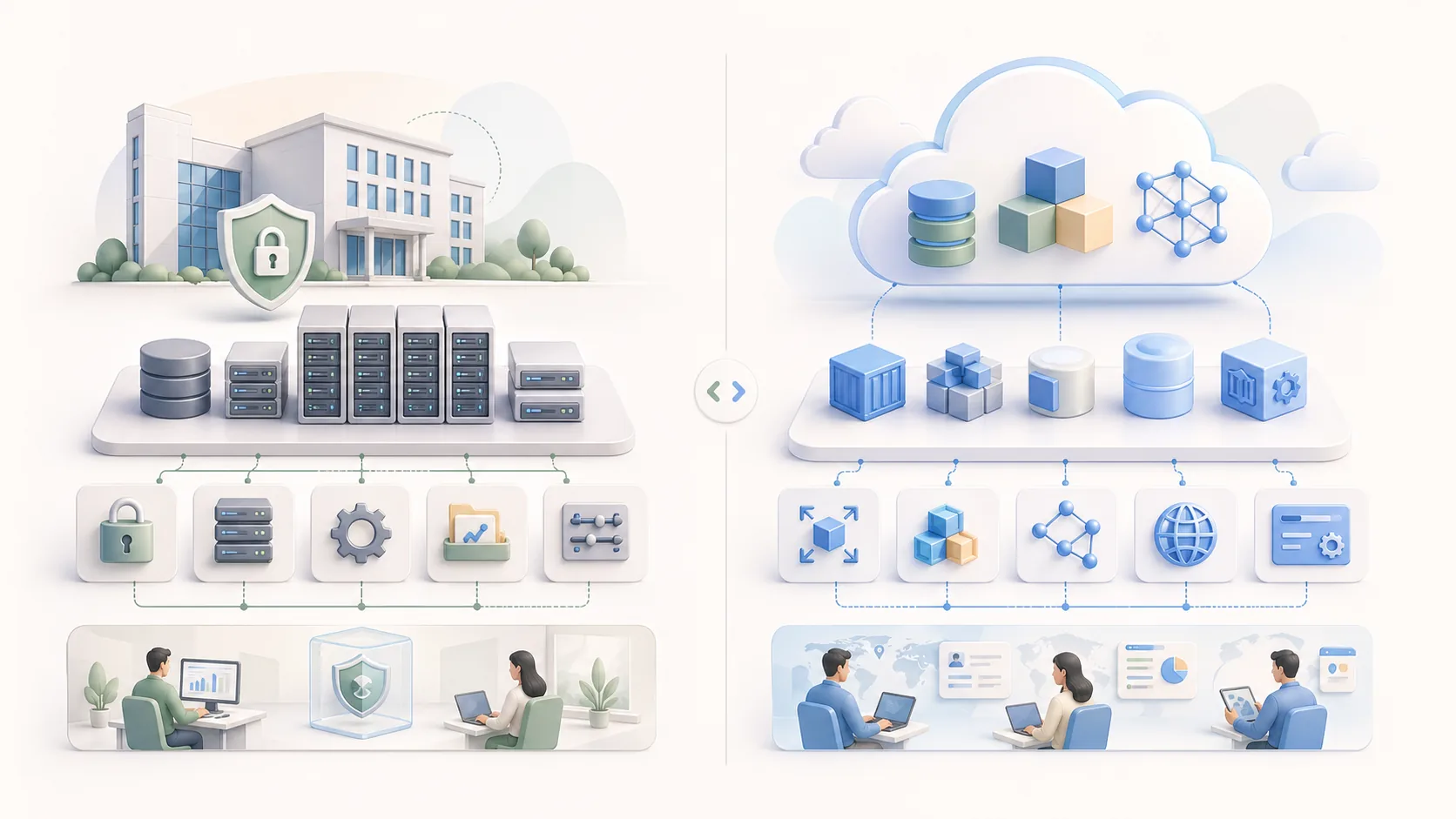
Essential Differences Between On-Premise vs. Cloud AI
The fundamental architectural difference between on-premise AI deployment and cloud AI services lies in the ownership of computing resources and the flow of data. An on-premise solution (such as QubicX) deploys the GPU servers, AI software framework, and models entirely within the enterprise's own or leased data center, so data never leaves the enterprise's physical boundary. Cloud AI services (such as Azure OpenAI Service, AWS Bedrock, Google Vertex AI, or the OpenAI/Anthropic APIs directly) instead send data via an HTTPS API to the provider's cloud data center for inference, then return the results.
This architectural difference has effects that go well beyond data security. In terms of cost structure, on-premise deployment is capital expenditure (CapEx): a large upfront cost with very low marginal cost thereafter; cloud services are operating expenditure (OpEx): no upfront investment, but ongoing usage-based billing, with cost growing linearly with usage. In terms of control, on-premise users have full autonomy over model selection, system configuration, and update timing; cloud service users are subject to the provider's API version policy, price changes, and terms-of-service updates.
A hybrid strategy is also a viable option: placing highly sensitive data processing on-premise (QubicX) while handling general publicly available information analysis in the cloud, to strike a balance between security and flexibility. This article focuses on comparing pure on-premise vs. pure cloud, to clearly illustrate the extreme characteristics of each model.
Five-year total cost of ownership (TCO) comparison analysis
The following is a five-year TCO comparison based on a typical usage scenario for a mid-sized enterprise (roughly 50 million tokens of LLM inference demand per month).
| Cost item | On-Premise (QubicX) | Cloud AI service |
|---|---|---|
| Initial hardware purchase (Year 0) | NT$3-5 million (4-card A100-80G server or equivalent spec) | NT$0 |
| Software/platform licensing (Year 1-5) | NT$300-600 thousand (QubicX platform annual fee including maintenance support) x 5 | Subject to Cloud Provider Pricing |
| LLM API/inference cost (per year) | ~NT$0 (marginal cost is very low) | Roughly NT$600 thousand-1.8 million/year (depending on usage and model) |
| Electricity cost (per year) | Roughly NT$150-250 thousand (annual electricity for a 4-card server) | NT$0(含在服務費中) |
| Operations staffing (per year) | Roughly NT$200-400 thousand (1 part-time IT staff member) | Roughly NT$100-200 thousand (API integration maintenance) |
| 5-year total cost (low estimate) | NT$625 萬 | NT$400~1,100 萬 |
| 5-year total cost (high estimate) | NT$1,125 萬 | NT$1,000~2,000 萬以上 |
The estimate above is a scenario result based on the assumptions noted earlier (roughly 50 million tokens per month, a 4-card server spec, a single part-time IT staff member): under these assumptions, on-premise deployment typically reaches breakeven around year 2-3, after which the accumulated savings continue to grow. The actual payback period will vary with model pricing, hardware depreciation schedule, real utilization, operations staffing, and cost of capital, so we recommend re-running the estimate with your own company's usage and cost structure. If enterprise AI usage keeps growing, the cost advantage of the on-premise option becomes even more pronounced, since its marginal cost approaches zero while cloud costs increase linearly with usage.
It's worth noting that cloud AI service pricing has limited transparency. Beyond the per-call API fee, there may also be data transfer fees (egress charges), storage fees, and surcharges for advanced features. When evaluating TCO, enterprises should ask the provider for a complete list of fee items and run a detailed estimate based on actual usage, rather than relying solely on the basic per-token rate.
Data Sovereignty and Regulatory Compliance Advantages
For many Taiwanese enterprises, data sovereignty and regulatory compliance, not cost, are the primary reason for choosing on-premise deployment. Below is a compliance analysis for three major regulated industries:
Financial Industry
The Financial Supervisory Commission (FSC) imposes strict data security regulations on financial institutions. Financial institutions using external cloud services must file a "material outsourcing" declaration and ensure the cloud provider meets specific security standards. More importantly, given how sensitive customer transaction data, credit data, and investment portfolios are, many financial institutions, from a compliance and risk management standpoint, tend to keep AI processing on-premise to avoid the compliance risk and potential disputes that come with sending data outside the organization.
Government Agencies
The Cyber Security Management Act establishes security responsibility levels for agencies and corresponding system protection baselines, with clear control requirements for how agencies handle classified data. In practice, processing that involves official secrets or highly sensitive data typically does not use an offshore cloud service that hasn't been approved by the agency. It should be noted that the deployment location alone does not equal passing a security audit; an audit also covers access control, usage logging, supply chain and outsourcing management, and procurement conditions, among other controls. On-premise deployment satisfies the data-location and environment-control requirements within that audit and is a necessary foundation for passing it, but it must still be paired with a complete set of controls, and the final determination should follow your agency's security responsibility level and the competent authority's latest regulations.
Healthcare
The Personal Data Protection Act (PDPA) imposes the highest level of protection requirements on medical information, which is classified as special personal data. Sending a patient's medical records, diagnostic records, genetic data, and similar information to an offshore AI provider for processing carries significant PDPA compliance risk. The Ministry of Health and Welfare's medical information system security regulations also tend to require that sensitive medical data be processed in a compliant environment, making on-premise deployment currently the safest compliance choice.
Performance and latency comparison
At the performance level, the difference between on-premise deployment (QubicX) and cloud AI services is mainly reflected in the following dimensions:
| Performance dimension | On-premise QubicX | Cloud AI service |
|---|---|---|
| Average response latency (TTFT) | 50-200ms (enterprise internal network) | 500ms-3s (depends on network quality and provider) |
| Concurrent request ceiling | Freely scalable, depending on hardware configuration | Limited by the service level agreement (SLA) |
| Offline availability | 100% (does not depend on an external network) | Depends on an internet connection |
| Data transfer cost | NT$0 | Billed by traffic |
| Service availability SLA | Designed around your own infrastructure | Typically 99.9% (but no compensation for non-local network failures) |
For applications that require extremely low latency, such as real-time speech recognition, instant customer-service chatbot responses, or real-time quality control AI on a production line, the latency advantage of on-premise deployment is quite critical. Latency on an enterprise internal network is typically under 1ms, whereas the round-trip time (RTT) of an API request, even on a good network, still takes several hundred milliseconds; adding model inference time, total latency can reach 1-3 seconds, which is a noticeably worse user experience for real-time interactive applications.
Enterprise selection decision framework
Below is a structured selection decision framework that enterprises can score against their own situation:
Situations that favor on-premise deployment (QubicX)
- The data being processed involves sensitive content such as personal privacy, trade secrets, medical information, financial records, or government-classified data
- Subject to industry regulations with explicit data-localization requirements, such as finance, healthcare, or government agencies
- Monthly LLM usage exceeds 10 million tokens and is expected to keep growing
- Need to ensure AI services remain available during a network outage (high business-continuity requirement)
- Need full control over the AI model version, parameter settings, and knowledge base
- Existing AI services are already showing noticeable cloud API cost pressure
Situations that favor cloud AI services
- Running a proof of concept (PoC) and the AI application scenario and usage level are not yet confirmed
- Usage is unstable or has pronounced seasonal peaks, making it unwise to over-invest in hardware for peak capacity
- Need to use the latest frontier models (such as the newest versions of GPT or Claude) for which no open-source alternative yet exists
- The AI application scenario doesn't involve highly sensitive data and has relatively low compliance requirements
- The enterprise has no data center space or power capacity to deploy GPU servers
Industries Best Suited for On-Premise Deployment
Based on a comprehensive assessment of data sensitivity, regulatory requirements, and usage characteristics, the following industries are best suited to an on-premise AI deployment approach:
Financial Services (Banking, Insurance, Securities)
The data financial institutions handle covers highly sensitive content such as customer personal data, account information, transaction records, and risk assessment reports, and they are under strict FSC oversight. AI application scenarios include intelligent customer service, loan review assistance, compliance document analysis, and internal knowledge management, all of which involve confidential data that should not leave the organization. On-premise deployment not only lowers regulatory risk but also strengthens the AI system's auditability.
Government Agencies and Public Sector
Government agencies have the strictest data sovereignty requirements. AI applications such as intelligent document processing, policy knowledge bases, and citizen service chatbots must all run in an environment that meets government security standards. On-premise deployment is not only the compliant choice, it also avoids the risk of service disruption caused by changes in cloud service policy.
Healthcare and biotech
AI applications in healthcare institutions (such as medical record summarization, diagnostic assistance, and medical document processing) inevitably involve special personal data, and the penalty risk under the PDPA makes on-premise deployment nearly the only compliant option. R&D data at biotech companies (such as new drug research data and clinical trial data) is also among the most sensitive trade secrets and should not be sent to a cloud service for processing.
Manufacturing and technology
AI applications in manufacturing, such as predictive equipment maintenance, quality inspection, and knowledge management, typically run in a factory environment where network conditions are unstable and extremely low latency is required. Tech companies' R&D data, patented technology, and codebases are core intellectual property and are not suited to being uploaded to a cloud service for AI processing.
Further Reading
- Complete Guide to On-Premise AI Deployment: Planning and Implementation for Self-Hosted Enterprise AI Infrastructure
- GPU Server vs. Cloud AI API: Complete Enterprise AI Infrastructure Cost Estimation Guide
- The security advantages of on-premise AI: 5 key reasons enterprises choose local deployment to protect their data
- On-Premise vs Cloud AI Deployment: How Should Enterprises Choose?
FAQ
References
- Financial Supervisory Commission (2023). Regulations Governing Internal Operating Systems and Procedures for the Outsourcing of Financial Institution Operations. fsc.gov.tw
- Department of Cyber Security, Executive Yuan (2023). Cyber Security Management Act (資通安全管理法) and related subordinate regulations. moda.gov.tw
- Gartner (2024). "Magic Quadrant for Cloud AI Developer Services." Gartner Research.
- Personal Data Protection Act (個人資料保護法), as amended in 2015. law.moj.gov.tw
Want a TCO estimate report tailored to your enterprise's scale?
Tell us your current AI usage and budget, and our consultants will provide a customized 5-year TCO comparison analysis to help you make the most cost-effective decision.
Request a TCO estimate