GPU Server vs. Cloud AI API: Complete Enterprise AI Infrastructure Cost Estimation Guide
'Is purchasing an on-premise GPU server cost-effective?' is the most frequent financial question facing enterprises adopting AI. While cloud AI APIs offer low entry barriers, recurring costs escalate rapidly as usage scales. Grounded in actual hardware configurations and API rate tables, this guide provides enterprise decision-makers with comprehensive financial modeling—covering break-even horizons, hidden power and maintenance overhead, and cash flow comparisons—to empower financially sound investments.
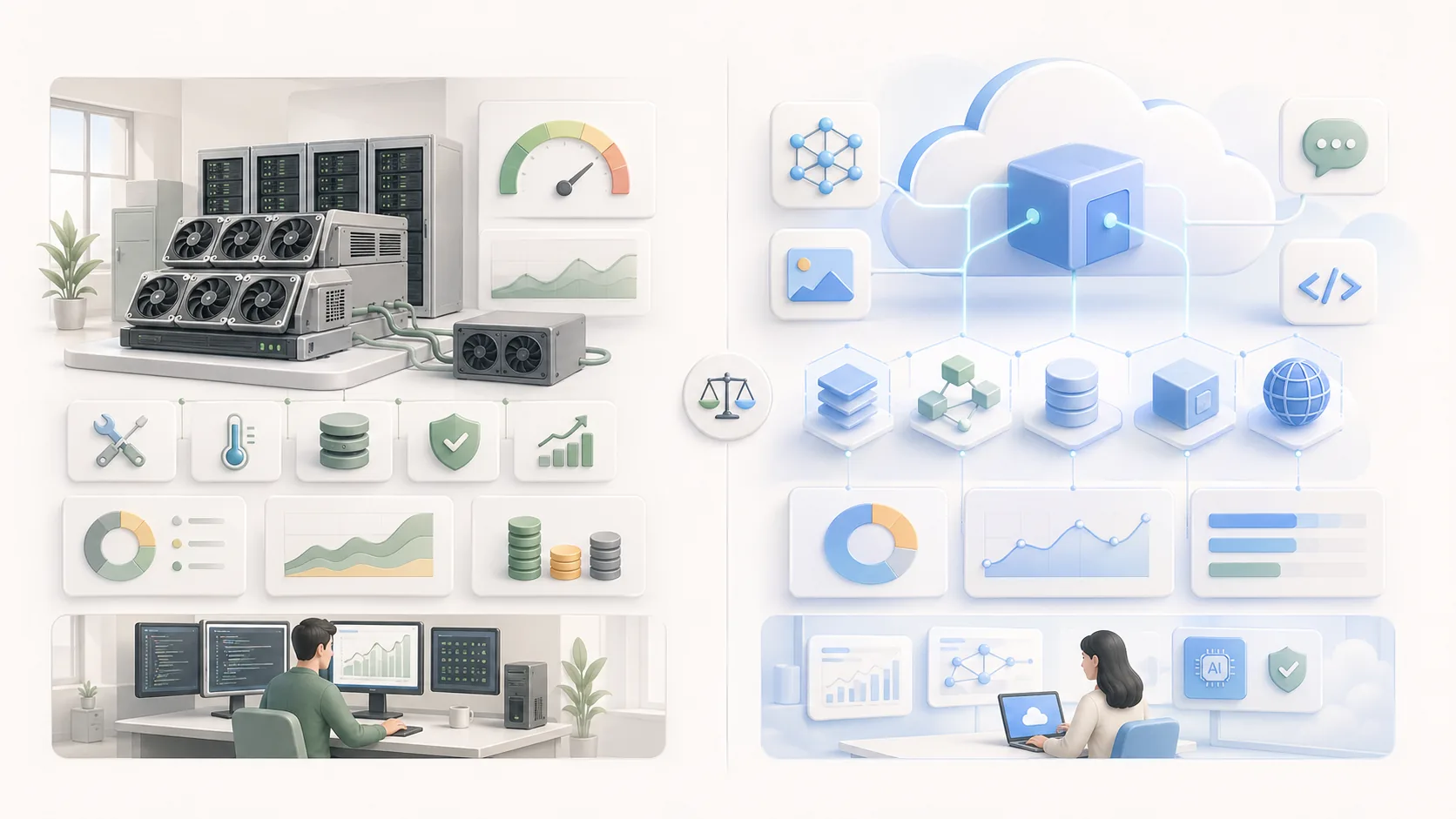
GPU Server Procurement Cost Breakdown
Enterprise GPU server procurement costs span a wide spectrum from hundreds of thousands to tens of millions of NT dollars, primarily determined by GPU model, quantity, and companion hardware. Below is a cost breakdown across common enterprise deployment configurations:
| Deployment Specification | GPU Configuration | Hardware Procurement Cost Estimate | Supported Model Scale | Max Monthly Inference Capacity (Est.) |
|---|---|---|---|---|
| Entry-Level (SMEs) | 2× RTX 4090(各 24GB) | NT$400,000–600,000 (including server host) | 7B–13B Quantized Models | Approx. 200M–500M tokens |
| Standard (Mid-Sized Enterprises) | 4× NVIDIA L40S(各 48GB) | NT$2,000,000–3,000,000 (including server) | 70B Quantized Models | Approx. 1B–3B tokens |
| Enterprise (Large Enterprises) | 8× NVIDIA A100-80G(SXM) | NT$7,000,000–10,000,000 (DGX A100) | 70B Full Precision / 405B Quantized | Approx. 5B–20B tokens |
| Flagship (AI Centers) | 8× NVIDIA H100-80G(SXM5) | NT$12,000,000–20,000,000 (DGX H100) | 405B Full Precision / Training & Fine-Tuning | Approx. 10B–50B tokens |
Pricing reflects each vendor's official published rates as of July 2026 (USD per million tokens). API pricing changes frequently; refer to each vendor's latest official announcement for current rates.
Taking the 'Standard' 4× L40S configuration as an example, hardware costs roughly NT$2,500,000, which over a 5-year depreciation schedule equals ~NT$42,000 in monthly depreciation. Adding platform software licensing (~NT$400,000/year) and electricity costs (~NT$15,000/month), the average monthly total cost of ownership is ~NT$90,000–100,000. If this system delivers 1 billion tokens of monthly inference volume, the cost per million tokens is approximately NT$9–10.
Note that hardware cost estimates reflect 2024–2025 market pricing; the GPU market fluctuates with AI demand. When procuring, request quotes from multiple system integrators and verify inclusions like OS licenses, 3-year hardware warranties, and deployment setup services. Some vendors offer financing leases for GPU servers, converting major CapEx outlays into predictable monthly OpEx to optimize cash flow.
Cloud AI API Cost Structure and Estimation
Cloud AI API pricing is typically structured per million tokens, split into input and output charges, with output tokens usually costing 2 to 5 times more than input tokens. Below are pricing rates for major cloud AI providers (referencing 2025 market rates):
| Service | Model | Input Rate (/Million Tokens) | Output Rate (/Million Tokens) | 100M Tokens Monthly Fee Estimate (3:1 Input-to-Output Ratio) |
|---|---|---|---|---|
| OpenAI | GPT-5.6 Terra | USD $2.50 | USD $15.00 | Approx. NT$19,000–25,000 |
| OpenAI | GPT-5.6 Luna | USD $1.00 | USD $6.00 | Approx. NT$1,200–1,600 |
| Anthropic | Claude Sonnet 5 | USD $3.00 | USD $15.00 | Approx. NT$23,000–30,000 |
| Gemini 3 Pro | USD $2.00 | USD $12.00 | Approx. NT$9,500–13,000 | |
| Azure OpenAI | GPT-5.6 Terra | USD $2.50 | USD $15.00 | Approx. NT$19,000–25,000 (same as OpenAI) |
Taking 100 million tokens per month with GPT-5.6 as an example (3:1 input-to-output ratio, i.e., 75M input + 25M output), monthly fees are: input = 75 × $2.50 = $187.50, output = 25 × $10.00 = $250.00, totaling $437.50 USD (~NT$14,000). Annual cost is ~NT$170,000, 3-year cost ~NT$500,000, and 5-year cost ~NT$850,000.
If volume grows to 1 billion tokens monthly (typical for mid-sized enterprises), the calculation becomes: monthly fee ~NT$140,000, annual fee ~NT$1,700,000, and 5-year cumulative cost ~NT$8,500,000. This exceeds the 5-year total cost of ownership of a standard on-premise GPU server (NT$2,500,000), illustrating why high-volume enterprises favor on-premise deployment.
Break-Even Point Calculation Methodology
The Break-Even Point is the milestone where cumulative on-premise deployment costs equal cumulative cloud API expenditures. Below is the formula and calculation examples:
Calculation Formula
Parameters: On-premise fixed cost = H (hardware procurement) + S (software platform annual fee) × N years + E (electricity) × N years + L (labor) × N years; Cloud variable cost = P (per-token rate) × M (monthly volume) × 12 × N years. The break-even point solves for H + (S+E+L) × N = P × M × 12 × N.
Calculation Example 1: Monthly usage of 200 million tokens with GPT-5.6
- On-Premise (Standard 4× L40S): Hardware NT$2,500,000 + Software NT$400,000/yr + Electricity NT$180,000/yr + Labor NT$300,000/yr = Fixed NT$2,500,000 + Annual OPEX NT$880,000
- Cloud (GPT-5.6, 200M tokens/mo): Monthly fee ~NT$280,000 -> Annual fee ~NT$3,360,000
- Break-even: 250 + 88×N = 336×N -> N ≈ 1.0 year (on-premise cumulative cost becomes lower than cloud after ~12 months)
Calculation Example 2: Monthly usage of 50 million tokens with GPT-5.6
- Cloud Annual Fee: Approx. NT$840,000
- Break-even: 250 + 88×N = 84×N -> In this scenario, cloud cost is lower than annual on-premise OPEX alone; on-premise is not cost-effective (unless required by compliance or security policies)
This calculation demonstrates that below 50 million tokens monthly, entry-level cloud models (like GPT-5 mini) cost substantially less than on-premise setups. For monthly volumes above 100M–200M tokens with mid-to-high tier models, on-premise deployment reaches break-even within 1 to 2 years. For large enterprises surpassing 500 million tokens monthly, on-premise cost advantages become compelling.
Hidden Costs of Electricity and Maintenance
Among the ownership costs of on-premise GPU servers, power consumption and maintenance expenses are easily underestimated hidden outlays that must be factored into TCO models.
Electricity Cost Calculation
A 4-GPU NVIDIA L40S server exhibits a typical full-load power draw of ~3,000W (including CPUs, RAM, storage, and cooling); under inference workloads at 60–70% utilization, average draw is ~2,000W. At Taipower commercial rates (~NT$4.0/kWh), monthly electricity = 2kW × 24h × 30d × NT$4.0 = NT$5,760 (~NT$6,000/mo), equaling ~NT$72,000 annually.
An 8-GPU A100-80G server (DGX A100) consumes up to 6.5kW under full load, resulting in annual power costs of NT$180,000–250,000. Enterprise server rooms also involve PUE (Power Usage Effectiveness) overhead for HVAC and power distribution, so actual power bills must be multiplied by PUE factors (typically 1.4 to 1.7).
Hardware Maintenance and Warranty
Newly purchased GPU servers typically include a 3-year manufacturer warranty. Post-warranty annual maintenance is estimated at ~NT$50,000–100,000/year for the server chassis (maintenance contracts or spare parts). Replacement costs for consumable components like cooling fans and power supplies must also be factored in. While high-end GPUs (such as A100, H100) rarely fail during warranty, repairs are costly once failure occurs; purchasing extended warranties or maintaining cold spares is recommended.
Datacenter Space Costs
Deploying in an on-premise server room requires accounting for floor lease (or amortization) and facility costs. When leasing colocation racks in an IDC, a standard 42U rack with power and bandwidth in Taiwan costs roughly NT$15,000–50,000 monthly, varying by power density and tier. This component is often overlooked in TCO calculations but significantly impacts final figures.
Cash Flow and Financial Impact Analysis
Beyond absolute Total Cost of Ownership numbers, cash flow timing is equally vital for corporate financial planning. On-premise procurement requires an upfront capital expenditure (CapEx), having an immediate liquidity impact; cloud services spread costs across usage periods (OpEx), reducing short-term cash strain.
Financed Procurement vs. Direct Purchase
Many GPU server vendors and banks offer equipment financing, allowing enterprises to opt for 3- to 5-year installment plans to transform massive CapEx into predictable monthly expenses. For a NT$3,000,000 system, a 5-year financing plan (at 3–5% annual interest) yields monthly payments of ~NT$55,000–60,000. Compared to recurring cloud bills once usage scales up, financed monthly payments can prove far more competitive.
Depreciation Amortization and Tax Benefits
GPU servers qualify as fixed assets eligible for tax depreciation deductions. Under Taiwan tax law, computer equipment has a statutory 3-year depreciation lifespan (straight-line or accelerated methods), meaning NT$3,000,000 in hardware depreciates by NT$1,000,000 annually, yielding ~NT$200,000 in annual tax savings at a 20% corporate income tax rate. Cumulative 5-year tax benefits reach ~NT$400,000–500,000 (depending on depreciation schedule and tax rates).
Cloud vs. On-Premise 5-Year Cash Flow Comparison
Based on 300 million tokens monthly with a GPT-5.6-tier model: the cloud solution incurs ~NT$420,000 monthly (NT$5,040,000 annually), totaling ~NT$25,200,000 over 5 years; the on-premise solution (standard configuration) totals ~NT$6,900,000 over 5 years (hardware NT$2,500,000 + software NT$2,000,000 + electricity NT$900,000 + labor NT$1,500,000), saving ~NT$18,300,000 over 5 years with a compelling ROI.
Criteria Checklist: When Enterprises Should Purchase GPU Hardware
Synthesizing the analysis above, use this checklist to determine whether investing in on-premise GPU servers is right for your enterprise:
- Monthly LLM inference volume consistently exceeds 100 million tokens (calculated on mid-to-high tier models)
- Defined AI use cases with projected usage growth over the next 2–3 years
- Processed data is subject to security/compliance restrictions prohibiting transmission to public cloud services (accelerating business justification)
- Enterprise possesses or can access baseline server operations capabilities (or engages a turnkey full-service vendor)
- Available server room space (owned or IDC colocation) with sufficient power provisioning (at least 5kVA available)
- Financially capable of absorbing upfront CapEx (or backed by equipment financing plans)
If your organization satisfies 4 or more criteria, purchasing on-premise GPU servers is likely the superior long-term financial choice. If satisfying 2 or fewer, cloud AI APIs represent a more appropriate starting point, allowing you to reassess on-premise migration once usage and workloads solidify.
LargitData's QubicX solution offers transparent TCO modeling: simply provide your current and projected usage figures, and our consultants will deliver a detailed 5-year financial comparative analysis to empower data-driven decisions over intuition.
Further Reading
- On-Premise AI vs. Cloud AI: Complete TCO Comparative Analysis Between QubicX and Cloud Solutions
- Complete Guide to On-Premise AI Deployment: Planning and Implementation for Self-Hosted Enterprise AI Infrastructure
- On-Premise vs Cloud AI Deployment: How Should Enterprises Choose?
- How to buy an on-premise AI server: four tiers, representative configurations and facility requirements
FAQ
References
- OpenAI (2025). "OpenAI API Pricing." openai.com/api/pricing
- NVIDIA Corporation (2024). "NVIDIA L40S GPU Datasheet." nvidia.com
- Taiwan Power Company (2025). Electricity tariff schedule (commercial rates). taipower.com.tw
- Varia, J., & Mathew, S. (2014). "Overview of Amazon Web Services." Amazon White Paper.
Looking for an Accurate On-Premise vs. Cloud Cost Comparison Model?
Tell us your current monthly AI usage metrics and cloud services; LargitData consultants will provide a comprehensive cost comparison backed by real-world data to empower optimal investment decisions.
Request Cost Estimation