Taiwan Enterprise LLM Selection Guide 2026: Commercial APIs, Open-Weight Models, and On-Premise Deployment
In 2026, enterprise LLM selection can no longer stop at comparing GPT, Claude, Gemini, and Grok. Qwen 3.8, DeepSeek V4, GLM 5.3, Kimi K3, NVIDIA Nemotron, Meta Muse Glimmer, Gemma 4, and TAIDE have turned open-weight models, on-premise multimodal AI, and AI agents into legitimate options. This guide organizes a selection framework enterprises can apply directly, across six dimensions: Traditional Chinese for Taiwan, data sovereignty, supply-chain policy, licensing, cost, and hardware deployment.
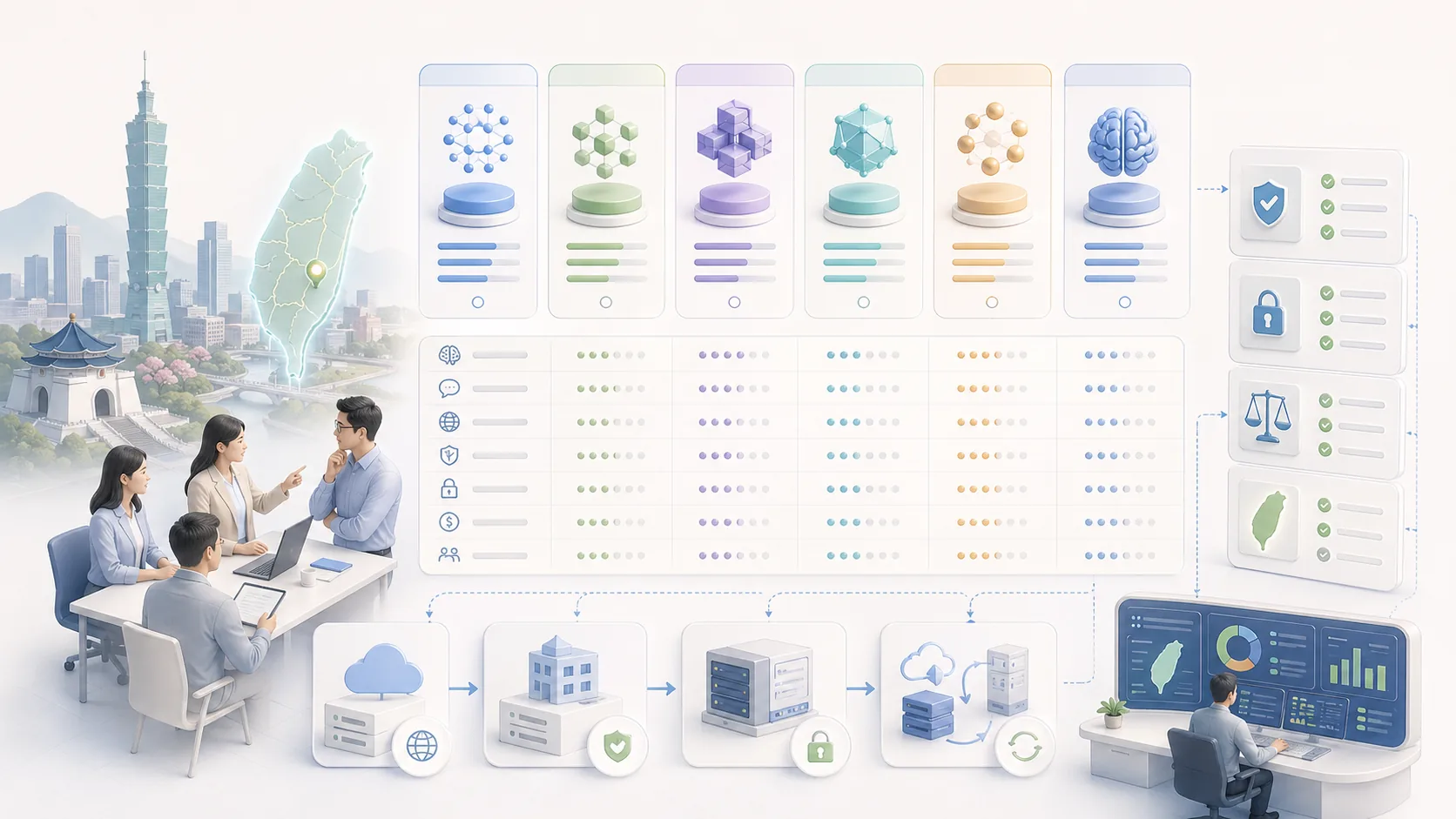
Special Selection Considerations for Taiwan Enterprises
The challenges Taiwan enterprises face in selecting an LLM differ from those of European and American companies. The first is the unique language environment: Taiwan's official and business use is Traditional Chinese, not the Simplified Chinese used in most Chinese-language training data worldwide. Differences in character sets and usage conventions, Taiwan-specific personal and place names and legal terminology, and Taiwan's distinct political and social context all demand a higher standard of Traditional Chinese comprehension from an LLM.
Second is data sovereignty and regulatory compliance. Taiwan's Personal Data Protection Act (PDPA) sets conditions on the cross-border transfer of personal data, and the competent authority may impose restrictions on specific industries or specific countries and regions. The financial industry is additionally bound by the Financial Supervisory Commission's outsourcing and AI-related regulations, while government agencies are subject to the Cyber Security Management Act and bear different levels of security obligations according to their cyber security responsibility level (Levels A through E). When using an offshore cloud API, input data (which may include customer information or trade secrets) leaves the enterprise boundary and is processed offshore, which is the source of data sovereignty concerns. Whether a given situation is lawful and what procedures it requires should still be determined by the competent authority's latest announcements and your company's legal counsel.
Third is the feasibility of on-premise deployment. Some Taiwan enterprises, due to security policies or internal rules, cannot use external cloud APIs and must run LLMs in their own environment. What needs to be confirmed here goes beyond whether weights can be downloaded — it also includes commercial licensing, total model weight size, quantization format, inference framework, hardware capacity, update sources, and vulnerability patching. TAIDE, Gemma 4, Nemotron 3.5 Lightning, Muse Glimmer, Qwen3.8-27B, gpt-oss, and Mistral can all be included in technical evaluation, but whether they can enter the procurement list still depends on agency and industry policy.
Fourth is cost. USD-denominated API fees carry uncertainty as the New Taiwan Dollar exchange rate fluctuates, and for scenarios involving large-scale internal document processing, per-token billing can cause costs to exceed budget. Enterprises need to precisely estimate token consumption under initial usage volumes and set up reasonable budget control mechanisms.
Comparison of mainstream commercial LLM plans
The comparison below summarizes the core characteristics of mainstream commercial LLM API plans in 2026:
| Model | Positioning | Input pricing (USD / million tokens) | Output pricing (USD / million tokens) | Traditional Chinese performance (qualitative) | On-Premise |
|---|---|---|---|---|---|
| GPT-5.6 Sol | Flagship | $5 | $30 | Excellent | Not Supported |
| GPT-5.6 Terra | Balanced | $2 | $12 | Excellent | Not Supported |
| GPT-5.6 Luna | Budget / high-frequency | $0.20 | $1.20 | Good | Not Supported |
| Claude Fable 5 | Top-tier flagship | $10 | $50 | Excellent | Not Supported |
| Claude Opus 5 | Flagship | $5 | $25 | Excellent | Not Supported |
| Claude Sonnet 5 | Workhorse | $3 | $15 | Excellent | Not Supported |
| Claude Haiku 4.5 | Budget / high-frequency | $1 | $5 | Good | Not Supported |
| Gemini 3.1 Pro | Flagship / ultra-long context | $2 | $12 | Good | Not Supported |
| Gemini 3.7 Flash | Budget / high-frequency | $0.75 | $3.75 | Good | Not Supported |
| Grok 4.6 | Flagship | $2 | $6 | Good | Not Supported |
| Azure OpenAI Service | Managed GPT series | Per Azure announcement | Per Azure announcement | Excellent | Not supported (selectable deployment region) |
Pricing is compiled from each vendor's official rates as of August 15, 2026 (USD / million tokens, standard tier, excluding caching and batch discounts). Changes within a three-month window can be substantial: on July 30, OpenAI cut Terra pricing by roughly 20% and Luna pricing by roughly 80%; Claude Sonnet 5 has a promotional rate of $2/$10 per million tokens through August 31; Gemini 3.1 Pro switches to $4/$18 pricing once a prompt exceeds 200,000 tokens, and the Flash series has both 3.5 ($1.50/$9) and 3.6 ($1.50/$7.50) coexisting; xAI replaced 4.5 with Grok 4.6 on August 12 at the same rate. For actual procurement, rely on the vendor's current announcement and contract quote.
This table deliberately lists each variant as a separate row, because what actually drives cost is often which tier you choose within the same family. Output rates between the top-tier and budget versions within the same family can differ by several times. Most enterprises' traffic consists of a small number of difficult tasks plus a large volume of routine tasks; if everything runs on the flagship model, routine tasks can easily consume most of the budget.
Context length is not listed as a fixed guarantee, because the same model's limit can differ across endpoints such as direct API, Azure, and Vertex AI, and long context may be billed separately or run more slowly. Data processing locations and available regions must likewise be confirmed one by one — don't assume a target model is available in a given region just because the vendor has an Asia-Pacific node.
OpenAI GPT-5.6 series
OpenAI is one of the options Taiwan enterprises ask about most, with the most complete ecosystem and third-party tool support (whether it counts as the “market leader” requires defining the market scope and metrics, which this article does not attempt to rank). The GPT-5.6 series offers three tiers — Sol (flagship), Terra (balanced), and Luna (budget) — and builds deep reasoning mode in as a standard capability, suitable for analytical tasks that require multi-step breakdown. Enterprise plans generally include a clause against training the model on customer input data, and a Data Processing Agreement (DPA) can be signed.
The main concern for Taiwan enterprises remains where data is processed. There is no one-line answer to this: actual request routing, where data lands, and whether a specified region is supported depend on whether you're using the direct API or a cloud-managed service (such as Azure OpenAI), the subscription tier, and whether that model is already available in that region. It's advisable to require the vendor, at the procurement stage, to provide written region and data-processing documentation for “the specific model and endpoint you will actually use,” and to confirm retention periods and the scope of human review triggered by abuse detection. Another practical point often overlooked is queue time: batch processing and fine-tuning services can take longer to complete during demand peaks, so if your workflow has a delivery deadline, test the worst case in advance.
Anthropic Claude series
In our projects, the Claude series is a common choice for Traditional Chinese long-document reading comprehension, document summarization, and complex instruction-following, and its long-context capability is particularly useful for RAG scenarios that need to read in multiple documents at once. Anthropic's training approach (Constitutional AI) makes the model relatively conservative around refusals and safety boundaries, which is a plus for outward-facing applications that need guardrails; but conservatism has a cost too — over-refusal will just as easily cause internal users to abandon the tool, so “answering when it should but refuses” should be included as one of the acceptance criteria during rollout.
In terms of model tiering, Fable 5 sits at the very top, Opus 5 is the flagship, Sonnet 5 is the workhorse, and Haiku 4.5 is the budget high-frequency option; in practice, few use cases need everything running on the top tier. Confirm data processing locations and available endpoints for your actual plan directly with the vendor — don't infer all data flows simply from “headquartered in the US.” On cost, Sonnet 5's output rate is $15 per million tokens; in long-output applications (for example, generating review comments line by line), output is often the primary cost driver, so be sure to calculate input and output separately when estimating.
Google Gemini series
Gemini 3.1 Pro is positioned toward ultra-long context and multimodality, suitable for scenarios that need to read in large volumes of documents at once, or process text and charts simultaneously (check the official documentation for the actual usable length). However, “able to read it all in one pass” and “reads it completely” are two different things: exception clauses buried in the middle of a long document are the easiest thing to miss, so it's still advisable to process by section with source citations, and to keep a few documents with known trap clauses as a fixed test set. On cost, also note that Gemini 3.1 Pro switches to a higher rate once a prompt exceeds 200,000 tokens, so stuffing a long document in all at once isn't necessarily the cheapest approach. The Flash series is the budget option for high-frequency, low-complexity batch tasks, and it iterates quickly, so confirm the current version and rate before procurement.
Gemini performs well in Traditional Chinese, but based on our observation, it still lags slightly behind GPT-5.6 and Claude on certain Taiwan-local context and word-choice details. If an enterprise already has Google Cloud infrastructure, using Gemini through Vertex AI typically provides more regional and governance configuration options; the specific selectable regions, and whether the particular model you want to use is already available in that region, need to be confirmed individually within the project settings — don't assume “the region exists” is equivalent to “it's available.”
2026 open-weight LLMs and on-premise options for Taiwan
Enterprise selection should distinguish between commercial APIs, downloadable open-weight models, and fully open source. The table below focuses on open-weight models that Taiwan enterprises can evaluate as of August 2026, and additionally keeps GLM 5.3 as a service-based reference point. Models update quickly, so re-confirm the official model page and license before formal procurement.
| Model | Developers | Latest version | Scale and modality | Access method and license | Role in Taiwan enterprise evaluation | Deployment tier |
|---|---|---|---|---|---|---|
| TAIDE | NSTC TAIDE | Gemma-3-TAIDE-12B-Chat-2602 | 12B Text model | Open-weight, under TAIDE and Gemma terms | Traditional Chinese, Taiwan administrative and local usage baseline | Quantized, testable starting from a single 16 GB-class GPU |
| Gemma 4 | E2B/E4B/26B MoE/31B | Text, image, video; some versions support audio | Open-weight, Apache 2.0 | Western supply chain, edge-to-workstation-class multimodal baseline | From edge devices to 80 GB-class GPUs, depending on version and quantization | |
| Qwen 3.8 | Qwen | Qwen3.8-27B | 27B dense native vision-language model | Open-weight, Apache 2.0 | Comprehensive baseline for Chinese, multimodal, code, and agent tasks | Workstation- or server-class; load-test against quantization and context |
| DeepSeek V4 | DeepSeek | V4-Flash-0731 | 284B MoE / 13B active, text and agent | API and open-weight, MIT | Cost-reference point for code, tool calling, and task completion | Full deployment is a multi-GPU or multi-node undertaking |
| Kimi K3 | Moonshot AI | Kimi K3 | 2.8T MoE / 104B active, native multimodal | API and open-weight, custom Kimi K3 License | Ultra-long documents, deep research, and long-horizon agents | Data-center-scale multi-GPU or multi-node undertaking |
| Nemotron 3.5 Lightning | NVIDIA | 30B-A3B | 30B MoE / 3B active, text and agent | NIM and open-weight, OpenMDW-1.1 | High-throughput agent subtasks and the NVIDIA deployment ecosystem | Workstation- to server-class; the NVFP4 version is better suited to on-premise |
| Meta Muse Glimmer 30B | Meta | Muse-Glimmer-30B | Approximately 29.6B dense, plus a vision encoder | Open-weight, Apache 2.0 | Local multimodal agent, tool use, and failure recovery | Official quantized versions target 24 GB / 32 GB devices |
| GPT-OSS | OpenAI | gpt-oss-20b/120b | Text reasoning and tool calling | Open-weight, Apache 2.0 | Structured output, text reasoning, and a Western supply-chain baseline | The 20b can be tested from a single GPU; the 120b requires a high-capacity GPU |
| GLM 5.3 | Zhipu AI | GLM 5.3 | Text-only, 1M context, forced reasoning | Coding Plan service, API coming soon; the vendor states weights will be released in stages after safety evaluation | Reference point for complex engineering, computer-use, and security tasks as a service | Evaluated as a service; not yet included in the on-premise hardware capacity table |
Note: the deployment tier in the table is a first-pass evaluation range, not a procurement specification. Actual memory requirements depend on the full weight size, quantization format, inference framework, context length, KV cache, vision encoder, and concurrent request volume. A MoE model's active parameter count does not mean only weights of that same size need to be loaded.
TAIDE should still be kept in the mix. Its value isn't in matching massive flagship models on world knowledge, but in providing a fixed baseline for Traditional Chinese, official documents, Taiwan administrative usage, and local terminology. Gemma 4, Muse Glimmer, Nemotron 3.5 Lightning, and gpt-oss offer different sizes, modalities, and the NVIDIA deployment toolchain. Qwen3.8-27B is a good fit as a Chinese multimodal reference point, and DeepSeek V4 and Kimi K3 are suitable for evaluating frontier agent capability, though full on-premise deployment costs considerably more.
Country-of-origin policy can't be reduced to a single “can we use it or not” answer that covers every enterprise. Government agencies already have explicit restrictions on the DeepSeek AI service, and government procurement and specific industries may have their own supply-chain requirements; ordinary private enterprises should evaluate based on data classification, customer contracts, cross-border transfer, model provenance, update channels, and company policy. The most robust approach is to have security, compliance, and procurement jointly confirm the candidate list before the PoC.
On the hardware side, DGX Spark suits individual and small-team prototyping; RTX PRO 6000 Blackwell's 96 GB of GDDR7 suits workstation- or department-level services; H200's 141 GB of HBM3e suits mature, enterprise-shared inference; and DGX B200 and B300 are data-center-class systems for large MoE models, training, and high-throughput services. Before procurement, load-test with real context lengths and concurrent request volumes, and factor data-center power, cooling, networking, and redundancy into the total cost of ownership.
In-depth analysis of Traditional Chinese processing capability
Traditional Chinese processing capability is an important criterion for Taiwan enterprises' model selection. The star ratings below are qualitative judgments for a first-round screening, not a reproducible benchmark. Because there is no public, unified test set, sample size, or rater-consistency data, the star ratings can only indicate relative standing and should not be converted into scores or percentages.
Checking Taiwan Traditional Chinese quality should cover at least three things: whether Simplified characters slip in, whether Mainland Chinese usage appears, and whether administrative and legal terminology matches Taiwan conventions. On usage specifically, test item by item whether the model writes 軟體 (software) as 軟件, 資料 (data) as 數據, or 帳號 (account) as 賬號 — the first of each pair is the Taiwan form, the second is the Mainland one. Also check Republic-of-China-era dates, Unified Business Numbers, addresses, currency, and full-width punctuation. The table below can only narrow the candidate list — final verification should still be done with the enterprise's own documents and test question set.
| Assessment Dimensions | GPT-5.6 | Claude Sonnet 5 | Qwen3.8-27B | Gemma 4 | TAIDE 12B |
|---|---|---|---|---|---|
| Traditional character recognition and generation | ★★★★★ | ★★★★★ | ★★★★★ | ★★★★☆ | ★★★★★ |
| Taiwan localized context comprehension | ★★★★☆ | ★★★★☆ | ★★★☆☆ | ★★★☆☆ | ★★★★★ |
| Traditional Chinese long-document summarization | ★★★★★ | ★★★★★ | ★★★★☆ | ★★★★☆ | ★★★★☆ |
| Regulatory document analysis (PDPA, financial regulations) | ★★★★☆ | ★★★☆☆ | ★★★☆☆ | ★★★☆☆ | ★★★★☆ |
| Traditional Chinese conversational fluency | ★★★★★ | ★★★★★ | ★★★★☆ | ★★★★☆ | ★★★★★ |
This table reflects the consulting team's qualitative judgment in Traditional Chinese enterprise contexts, not a published benchmark score; test set, sample size, and rater data are not provided, so it should not be used as a procurement acceptance criterion — please verify with your own test set.
Overall, GPT-5.6 and Claude Sonnet 5 are suited to establishing the upper bound of cloud quality; Qwen3.8-27B is suited to testing Chinese multimodal and agent capability; Gemma 4 is suited to testing edge-to-workstation-class multimodal capability; and TAIDE should serve as the baseline for Taiwan Traditional Chinese and administrative context. The star ratings are not a procurement conclusion — results for the same model can change under different quantization, prompts, retrieved data, and inference frameworks.
One issue that deserves particular attention is Traditional-Simplified conversion: some LLMs, even when asked to answer in Traditional Chinese, may output some Simplified characters or use Mainland Chinese usage. If an enterprise's application has strict requirements around this (such as customer-facing services or legal document generation), the prompt needs to explicitly specify “please use Taiwan Traditional Chinese, consistent with Taiwan usage conventions,” and outputs should be validated after the fact.
Comparing data security and privacy protection
When selecting an LLM API service, Taiwan enterprises must thoroughly understand each vendor's data handling policy. Below is a comparison of several key questions:
- “Will my data be used to train the model?” Major vendors' enterprise plans generally include a clause against training on customer API input, while free consumer-tier services may have a different default. Taiwan enterprises should use the enterprise plan and put the commitment into the contract and the data processing addendum, rather than relying solely on a documentation page that can change at any time.
- “Where is my data processed?” This question must be confirmed service by service, model by model, and region by region — it can't be generalized: direct APIs and cloud-managed services (such as Azure OpenAI and Vertex AI) offer different regional options, and not every model on the same cloud platform is available in every region. Requiring the vendor to provide written documentation for the specific endpoint you actually use is the fastest and most reliable approach. If data must be processed entirely within Taiwan's borders, on-premise deployment of an open-weight model remains, in practice, the simplest way to ensure that.
- “How long is data retained, and who can see it?” Vendors differ in how long they retain request data, whether it's temporarily cached for abuse detection, and the trigger conditions and scope of human review — and these can change with the plan. At procurement time, ask three specific questions: the default retention period in days, whether zero retention or a shortened period can be requested, and the notification and logging mechanism if human review occurs. Also require a Data Processing Agreement (DPA) that meets PDPA requirements.
- “Is data encryption supported?” Mainstream services generally offer encryption in transit and at rest, but data remains in plaintext in memory during inference — this is a shared limitation of cloud inference today. If your data isn't even allowed to “appear in memory on someone else's machine,” you shouldn't be using a cloud API at all — that's an architectural issue, not a configuration one.
The financial industry must additionally consider regulatory oversight. The Financial Supervisory Commission has published core principles and related guidelines on the financial industry's use of artificial intelligence, and has dedicated regulations for financial institutions' outsourcing of operations; the relevant documents and versions are continually updated, so it's advisable to check the current version directly on the FSC's official website:fsc.gov.tw. The shared spirit of these rules is: using a third-party service does not transfer responsibility — the institution must still independently assess the vendor's security capability, ensure customer data safety, retain traceable decision records, and factor outsourcing management procedures in based on the significance of that operation. The actual scope of application and operational requirements should still be determined by the competent authority's latest announcements and your company's legal or compliance unit.
Taiwan enterprise LLM selection decision framework
Based on the analysis above, we offer the following selection recommendations organized by enterprise need:
- General SMEs (no strict security restrictions, limited budget): use a budget tier such as GPT-5.6 Luna, Gemini Flash, or Claude Haiku 4.5 as the workhorse, and route to GPT-5.6 Terra/Sol or Claude Sonnet 5 only for scenarios needing deep reasoning or high-quality long-form output. Be sure to compare the budget and flagship gap on your own use cases before deciding on a routing threshold.
- Enterprises needing long-document processing (such as legal, research, compliance): Claude Sonnet 5's long context and structured output typically save on post-processing work; Gemini 3.1 Pro is positioned more toward full-text analysis of ultra-long documents. For both, we recommend pairing with section-by-section splitting and source citations rather than relying solely on “stuffing it all in at once.”
- Financial industry (compliance evaluation required): consider an enterprise API for public or low-sensitivity work, and evaluate on-premise TAIDE, Gemma 4, Nemotron, Muse Glimmer, gpt-oss, or other open-weight models that pass supply-chain review for confidential data. Whether to exclude a specific source should be decided jointly by security, compliance, and procurement based on current regulations and contracts.
- Government agencies (strict security requirements): whether external cloud services can be used should be judged based on the data confidentiality level, the agency's cyber security responsibility level, and higher-level regulations. When official secrets or sensitive information is involved, on-premise open-weight models are usually easier to account for in terms of data flow. TAIDE should be included as the Taiwan-context baseline, alongside comparisons of Gemma 4, Nemotron, Muse Glimmer, and gpt-oss. DeepSeek has additional restrictions on use by government agencies, and models from other sources still need to be checked case by case against procurement and supply-chain policy.
- Enterprises that prioritize Traditional Chinese quality (media, publishing, legal): for cloud, start by testing GPT-5.6 and Claude Sonnet 5; for on-premise, add TAIDE, Qwen3.8-27B, and Gemma 4. We recommend finalizing the decision only after testing against four metrics: Traditional character accuracy rate, the appearance rate of Simplified characters and Mainland Chinese usage, formatting consistency, and the human rewrite rate.
Further Reading
- GPT-5.6 vs. Claude vs. Gemini vs. Grok: An in-depth 2026 enterprise LLM evaluation
- On-Premise vs Cloud AI Deployment: How Should Enterprises Choose?
- Regulatory compliance guide for enterprise AI adoption: Taiwan's PDPA, GDPR, and financial regulation
- What Is RAG? The Principles, Architecture, and Enterprise Applications of Retrieval-Augmented Generation
FAQ
References
- Financial Supervisory Commission. Core principles and guidelines on the use of AI in the financial industry, and rules on outsourcing by financial institutions — check the FSC website for the current version. FSC website
- Executive Yuan (2023). Reference guidelines on the use of generative AI by the Executive Yuan and its subordinate agencies; policy index maintained by the Ministry of Digital Affairs. moda.gov.tw
- Personal Data Protection Act (個人資料保護法), current text. Laws & Regulations Database. law.moj.gov.tw
- OpenAI.API Pricing(current rates). openai.com
- Anthropic.Pricing(current rates). anthropic.com
- Google.Gemini API Pricing(current rates). ai.google.dev
- OpenAI (2024). "Enterprise Privacy and Data Security." openai.com
- Anthropic (2024). "Claude's Data Privacy Policy." anthropic.com
- Ministry of Digital Affairs. Statement on the ban on DeepSeek AI services in government agencies. moda.gov.tw
- Qwen.Qwen3.8-27B Model Card。huggingface.co
- NVIDIA.Nemotron 3.5 Lightning 30B-A3B Model Card。huggingface.co
- Meta.Muse Glimmer 30B Model Card。huggingface.co
- TAIDE.Gemma-3-TAIDE-12B-Chat-2602。huggingface.co
- LargitData.The complete 2026 guide to enterprise open-weight models; The complete on-premise AI deployment guide.
Want to Discover the Ideal LLM Solution for Your Enterprise?
Contact LargitData's AI consultants — we help Taiwan enterprises evaluate LLM selection, plan on-premise deployment strategy, and build enterprise AI systems that comply with the PDPA and industry regulations.
Contact Us