GPT-5.6 vs. Claude Opus 5 vs. Gemini 3 vs. Grok 4.5: An In-Depth 2026 Enterprise LLM Benchmark
The 2026 enterprise AI market is thriving, but behind every vendor's dazzling marketing lies a simple need: technical teams want objective evaluation grounded in real-world scenarios. This article compares GPT-5.6, Claude Opus 5, Gemini 3 Pro, Grok 4.5, and Qwen 3.8 Max across eight dimensions: reasoning ability, Traditional Chinese handling, code generation, long-context understanding, enterprise features (fine-tuning, batch API, SLA), safety guardrails, and cost-efficiency per million tokens. The capability comparisons here are qualitative observations from our consulting team's deployment projects, not published benchmark scores. The goal of this article is to give you a reusable selection framework you can verify yourself, not to hand you a conclusion.
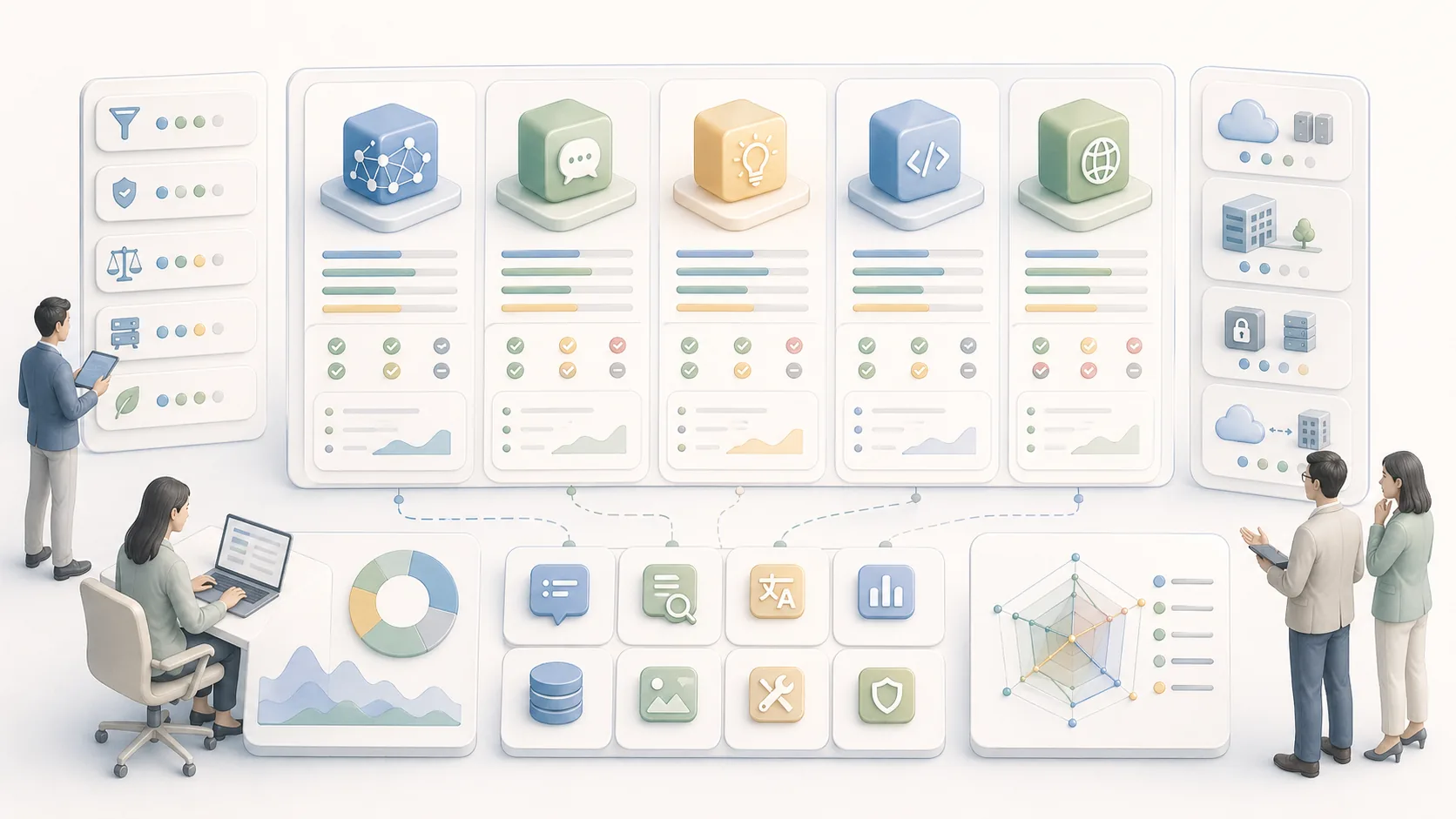
Core dimensions for enterprise LLM evaluation
When evaluating enterprise-grade LLMs, you can't rely solely on academic benchmark scores (such as MMLU or HumanEval) — the scenarios these benchmarks are designed around differ significantly from real enterprise use cases. What truly matters is how a model performs on typical enterprise tasks, and whether it has the reliability and safety a production environment requires.
We chose the following eight dimensions as the core framework for enterprise LLM evaluation: 1) complex reasoning ability (multi-step problem solving, logical deduction); 2) Traditional Chinese processing quality (comprehension and generation); 3) code generation and debugging (multi-language support, code quality); 4) long-context understanding (comprehension and summarization of large volumes of context); 5) instruction-following precision (ability to follow complex prompts); 6) enterprise features (fine-tuning, batch processing, enterprise SLA); 7) safety guardrails (harmful content filtering, prompt injection protection); 8) cost-efficiency (pricing per million tokens, real-world usage cost).
Reasoning ability and Traditional Chinese handling compared
Let us first clarify the nature of the table below, to avoid misuse: it reflects the LargitData consulting team's qualitative initial assessments, accumulated across enterprise deployment projects, specifically for Traditional Chinese and Taiwanese business-document contexts. Its purpose is to shorten a shortlist, not to serve as a reproducible benchmark score. We have not published a unified test set, sample size, or rater-agreement data, and we deliberately avoid expressing it as a percentage, because the same model can vary more across different variants, API endpoints, prompts, and temperature settings than it does compared to other models.
The correct way to use it is as a filter for deciding “which candidates are worth evaluating further,” then building your own evaluation set with your company's own data (see the fifth FAQ at the end of this article for the approach). If you need citable public data, consult each vendor's official model cards and independent third-party leaderboards directly, and pay attention to the test dates and model versions.
| Evaluation dimension | GPT-5.6 | Claude Opus 5 | Gemini 3 Pro | Grok 4.5 | Qwen 3.8 Max |
|---|---|---|---|---|---|
| Complex reasoning (multi-step math and science problems) | ★★★★★ | ★★★★★ | ★★★★☆ | ★★★★★ | ★★★★☆ |
| Traditional Chinese comprehension | ★★★★★ | ★★★★★ | ★★★★☆ | ★★★★☆ | ★★★★★ |
| Traditional Chinese generation quality | ★★★★★ | ★★★★★ | ★★★★☆ | ★★★★☆ | ★★★★★ |
| Code generation (Python/JS/SQL) | ★★★★★ | ★★★★★ | ★★★★☆ | ★★★★★ | ★★★★☆ |
| Long-context understanding | ★★★★★ | ★★★★★ | ★★★★★ | ★★★★☆ | ★★★★☆ |
| Instruction-following precision | ★★★★★ | ★★★★★ | ★★★★☆ | ★★★★☆ | ★★★★☆ |
| Safety guardrail strength | ★★★★☆ | ★★★★★ | ★★★★☆ | ★★★★☆ | ★★★☆☆ (requires additional hardening) |
| Tendency to honestly decline when no supporting evidence is found (qualitative) | Clearly inclined to | Clearly inclined to | Moderate | Moderate | Moderate |
This table reflects the consulting team's qualitative initial assessments in Traditional Chinese enterprise contexts; it is not a published benchmark score. No test set, sample size, or rater data is provided, so it should not be used as procurement acceptance criteria. Context window length varies by model variant and API endpoint — refer to each vendor's official documentation.
Regarding context windows, we deliberately avoid listing fixed numbers in the table. Today's leading flagship models generally offer context windows in the range of 200,000 to 1,000,000 tokens, but under the same model name, the length supported by direct API access, managed cloud endpoints (such as Azure or Vertex AI), and different plan tiers isn't consistent, and long context often comes with separate pricing or performance degradation. The right question to ask during evaluation isn't “what's the maximum it can hold,” but “what's the accuracy rate and latency at the actual document length I need to feed in.” In practice, many systems already start losing recall of mid-document information once the context is even half full — this is what's known as the “lost in the middle” phenomenon.
A deep dive into reasoning ability
GPT-5.6 (Sol), Claude Opus 5, and Anthropic's top-tier Claude Fable 5 sit at each vendor's current flagship tier, designed as the go-to option for multi-step reasoning, math problem solving, and tasks requiring deep analysis. The new generation of flagships generally builds “extended thinking / deep reasoning mode” in as a standard capability, and performance on difficult math and science problems has clearly improved over the previous generation. However, “improved over the previous generation” and “reaching expert-level” are two different claims — the latter requires a defined test, a control group, and a scoring methodology to establish, and this article makes no such claim.
The more practical trade-off for enterprises is cost and latency. When deep reasoning is enabled, the model generates a large number of reasoning tokens that don't count toward the final answer, and the cost and wait time for a single response can be several times that of standard mode. We therefore recommend treating deep reasoning as a switchable mode rather than a default: turn it on for asynchronous, high-value single tasks (contract risk comparison, incident root-cause analysis, complex calculations), turn it off for real-time interaction and high-frequency classification tasks, and track the cost and error rate of each mode separately in your monitoring.
The “Extended Thinking” feature introduced by Anthropic's Claude Sonnet 5 lets the model carry out deeper internal reasoning before responding, which can yield a more complete reasoning process when answering questions that require multi-step breakdown (such as the interaction between contract clauses, or multi-variable business decision analysis). Whether it actually improves quality still needs to be verified by comparing on/off results on your own use cases; for tasks where the answer is already short and the decision path is a single straightforward one, it often just means paying more and waiting longer.
Traditional Chinese reasoning is an area Taiwanese enterprises particularly care about. For reasoning tasks that involve Traditional Chinese (such as analyzing a case under Taiwanese regulations, or understanding Taiwanese business documents and giving recommendations), our project experience suggests GPT-5.6 and Claude Opus 5 are relatively well-balanced on both “word choice conventions” and “local context.” Qwen 3.8 Max's Traditional Chinese handling isn't bad, but it more easily shows conversion traces in Taiwan-specific administrative and business terminology. Grok 4.5 performs impressively on reasoning and code tasks, and its Traditional Chinese is usable, but there's still a gap in local language feel. These are all qualitative observations that may change with future version updates — please re-verify with your own test set.
One important caveat here has nothing to do with model capability: models from Chinese vendors such as Qwen and DeepSeek are typically not accepted in procurement and security reviews for Taiwan's public sector and regulated industries, even when deployed on-premise. So if your organization falls into this category, these models are included in this article only for technical comparison; your actual on-premise candidates should primarily be TAIDE (Gemma-3-TAIDE-12B, released by Taiwan's National Science and Technology Council and the preferred choice for the public sector), Gemma 4 31B, GPT-OSS, and Mistral.
Code generation ability compared
Code generation is one of the core use cases for enterprise AI assistants. GPT-5.6 and Claude Sonnet 5 are both production-ready for mainstream languages like Python, JavaScript, SQL, and Java, and both can understand and refactor existing code. In our observation, the Claude series has an edge in cross-file, long-code comprehension and refactoring explanations, which relates to its long-context capability; but this advantage varies with the size of your codebase, your file-splitting strategy, and retrieval quality — it isn't a fixed conclusion.
IDE-integrated assistants like GitHub Copilot are already common in many development teams, but “common” doesn't mean “the only standard” — there are several other integrated coding assistants on the market, and adoption varies widely across teams. Where enterprises genuinely need to integrate an LLM API themselves is in scenarios that must touch a private codebase, such as automatically generating code review comments per internal standards, checking license terms, or scanning for secrets. The quality bottleneck for these systems usually isn't the model — it's whether you can accurately retrieve “the handful of relevant files.” Stuffing the entire repository into the context is expensive and doesn't necessarily improve accuracy.
Enterprise Features and SLA Comparison
| Enterprise Features | OpenAI / Azure OpenAI | Anthropic Claude | Google Gemini | Open Source (On-Premise Deployment) |
|---|---|---|---|---|
| Fine-tuning support | Partial model support (varies by variant) | Enterprise Plan Inquiry | Partial Model Support | Full support (SFT, LoRA, preference alignment) |
| Batch API (asynchronous batching) | Supported (with additional batch discount) | Supported (with additional batch discount) | Supported | Self-implemented |
| Uptime commitment | Depends on plan and contract | Depends on plan and contract | Depends on plan and contract | Depends on self-built infrastructure |
| Rate limits (TPM/RPM) | Depends on account tier and region | Depends on account tier and plan | Depends on project quota | Not bound by API quotas — determined instead by hardware throughput |
| SSO / SAML integration | Supported (enterprise tier) | Supported (enterprise tier) | Supported (enterprise tier) | Depends on deployment platform |
| Model deployment region selection | Multi-region (actual availability varies by subscription and model) | Depends on plan and service endpoint | Multi-region (depends on project configuration) | Enterprise's own environment |
| Dedicated deployment | Supported (Azure PTU) | Supported | Supported (Vertex AI) | Dedicated by default |
| Compliance reports and controls | May provide relevant reports or controls — confirm per service and contract | May provide relevant reports or controls — confirm per service and contract | May provide relevant reports or controls — confirm per service and contract | Depends on the enterprise's own governance for its self-built environment |
This table is a feature-oriented comparison framework, not a spec sheet for any vendor's plans. Uptime commitments, rate quotas, available regions, and the scope of compliance reports all vary by service, plan tier, tenant region, and contract — refer to each vendor's official documentation, trust center, and formal quote.
A further note on the compliance row, since it's the most commonly misread. Certifications like SOC 2 and ISO 27001 attest to “certain controls at a certain organization's certain services during a certain period” — they are not a property of the model itself, and the scope of certification may only cover part of a product line or certain regions. As for compliance with healthcare-related regulations, this typically requires a separately signed data processing addendum, and the customer still has to complete the usage-side controls themselves. The correct approach is to request the vendor's current audit report and scope statement, confirm whether the specific endpoint you plan to use falls within that scope, and write data-processing terms into your contract — rather than assuming compliance just because you see an acronym. The actual applicable scope and operational requirements should still be determined by the latest announcements from the competent authority and your own legal counsel.
The enterprise value of fine-tuning
Fine-tuning lets an enterprise further train an LLM on domain-specific data so the model becomes more familiar with the company's own terminology, formatting requirements, and business logic. For example, an insurance company could fine-tune a mid-to-lower-tier model (a variant positioned like GPT-5.6 Luna) on historical claims cases so it more reliably produces initial summaries in the company's underwriting format. Fine-tuning is especially valuable in scenarios where: the enterprise has unique formatting requirements (such as fixed-format report generation); the enterprise uses a lot of specific terminology or abbreviations (avoiding the need to re-explain them in every prompt); or the task requires large volumes of output that repeat the same style.
That said, fine-tuning has its limits. It primarily improves a model's “style” and “format-following” ability, rather than fundamentally expanding its knowledge. If the goal is to have the model answer questions about enterprise-specific knowledge, RAG is usually a more effective and lower-cost solution than fine-tuning. In practice, many enterprises adopt a combined fine-tuning + RAG strategy: fine-tuning handles format and style, while RAG handles knowledge injection.
Performance differences across real-world use cases
Below, we compare the real-world performance of each LLM across the four most common enterprise use cases:
RAG Knowledge Retrieval
The core challenge in RAG scenarios is: given a large number of document chunks, accurately extract the relevant information and generate a clear answer, while not “hallucinating” an answer when the document doesn't contain one. In our observation from enterprise projects, the Claude series tends to be more consistent about being willing to say “I don't know” when there's no supporting evidence in the documents, whereas GPT-5.6 occasionally produces confidently worded but factually wrong answers. That said, this is a qualitative impression and is highly sensitive to the system prompt: for the same model, simply instructing it in the prompt to “reply that no data was found and list the retrieved chunks when there's no evidence” noticeably changes its refusal behavior.
So when comparing refusal tendencies, be sure to test with the same prompt, the same set of documents, and the same set of questions deliberately designed to be “not findable in the knowledge base,” and record three separate figures: answered wrong when it should have answered right (factual error); answered anyway when it should have declined (hallucination); and declined when it should have answered (over-conservatism). The third case is often abandoned by users faster than the second inside an enterprise, yet it's the one tested least.
For Traditional Chinese RAG queries, both GPT-5.6 and Claude Sonnet 5 can consistently answer in fluent Traditional Chinese. If on-premise deployment is required for data sovereignty reasons, we recommend prioritizing models such as TAIDE, Gemma 4 31B, GPT-OSS, and Mistral; these models generally need more careful prompt design and retrieval tuning to approach the experience of commercial flagship models in Traditional Chinese RAG, but since answers mainly come from retrieved documents, the gap is usually smaller than in pure generation tasks.
Long-document summarization
Enterprise document summarization (contracts, financial reports, research reports) is one of the highest value-density use cases for LLMs. The Gemini series takes a more aggressive product positioning on ultra-long context, making it well-suited to reading an entire long document in one pass; the Claude series's summary output tends to be more consistently structured (heading hierarchy, bullet-pointed highlights, separated risk callouts), which typically saves post-processing effort. As for each model's currently available context length, please check the official documentation directly — this figure isn't consistent across variants and endpoints, and this article avoids listing a fixed number to prevent misleading you.
More importantly: being able to read a document in one pass doesn't mean reading it completely. The most common failure in long-document summarization isn't fabrication — it's missing an exception clause buried in the middle, a cap amount tucked in an appendix, or a key change in the revision history. In practice, a more reliable approach isn't to simply aim for “stuffing it all in at once,” but to first split the document structurally (by chapter, clause number, appendix), generate sourced highlights section by section, and then use a second call to consolidate them into a summary. This not only tends to produce a higher accuracy rate, but also lets every summary sentence point back to its location in the original text, making review by legal and audit teams easier. For acceptance testing, we recommend preparing a few documents known to contain trap clauses as a fixed test set, and checking whether the model catches them every time.
Customer Service Dialogue
Enterprise customer service conversations require an LLM to: accurately answer product and service questions (relying on RAG); maintain a consistent conversational style aligned with the brand; recognize emotion and respond appropriately; and effectively hand off to a human agent when a request exceeds its capabilities. Claude Sonnet 5 excels at maintaining conversational consistency and emotional awareness — its responses tend to be more natural and empathetic, which is a clear advantage in consumer-facing customer service scenarios.
In Traditional Chinese customer service conversations, our observation is that GPT-5.6's default tone is more concise and direct, while Claude Sonnet 5 tends to be more thorough and considerate; but this difference can be adjusted via the system prompt and response-length limits, so it shouldn't be a primary reason for your model selection. What you should really compare are three things: accuracy rate on the same batch of real conversation logs; whether the model makes unauthorized commitments when uncertain (such as approving a refund or extending a warranty on its own); and whether its judgment about when to hand off to a human is consistent. We recommend pulling out a separate test set for Taiwanese-style mixed Chinese-English colloquial expressions (mixed with English abbreviations, product model numbers, Zhuyin, or typos), since this type of input is the one most likely to throw off intent classification.
Code-assisted development
Code-assisted development covers: generating code from natural-language requirements, code review and optimization suggestions, bug diagnosis and fixes, and technical documentation generation. GPT-5.6 and Claude Sonnet 5 are nearly evenly matched in this scenario. GPT-5.6 has a slight edge in generating structured, immediately usable code; Claude Sonnet 5 is clearer at explaining complex code logic and providing detailed review comments.
For enterprise private-codebase assistance scenarios (helping the AI understand your company's code style and architecture), Claude Sonnet 5's long-context capability lets you feed in more code files as reference in a single pass, whereas GPT-5.6 may need more rounds of interaction to build up context. Both vendors' mainstream models offer function calling / tool use, which can be integrated into CI/CD pipelines, but parameter formats, parallel call behavior, and support for strict structured output differ between vendors and can change with API versions — check the official API documentation at the time of integration before connecting.
Overall cost-efficiency rating
| Solution | Input pricing (USD / 1M tokens) | Output pricing (USD / 1M tokens) | Value-for-money rating (enterprise RAG) | Batch API discount | Recommended use cases |
|---|---|---|---|---|---|
| GPT-5.6 Luna | $1 | $6 | ★★★★★ (high value for money) | Yes (per official announcement) | Batch processing, high-frequency queries |
| GPT-5.6 Sol | $5 | $30 | ★★★★☆ | Yes (per official announcement) | Complex reasoning, flagship applications |
| Claude Sonnet 5 | $3 | $15 | ★★★★★ | Yes (per official announcement) | Long-document analysis, complex tasks |
| Claude Opus 5 | $5 | $25 | ★★★★☆ | Yes (per official announcement) | Highest-difficulty reasoning, flagship applications |
| Gemini 3 Flash | $1.50 | $9 | ★★★★★ (low cost) | — | Ultra-high-frequency, low-complexity tasks |
| Gemini 3 Pro | $2 | $12 | ★★★★☆ (ultra-long context advantage) | — | Ultra-Long Document Processing |
| Grok 4.5 | $2 | $6 | ★★★★☆ | — | Reasoning, code, real-time information |
| TAIDE / Gemma 4 31B / GPT-OSS / Mistral (on-premise) | Hardware depreciation + electricity | Hardware depreciation + electricity | ★★★★★ (at high usage volumes) | No API fees | Large-scale use, data-residency requirements |
Pricing reflects each vendor's official published rates as of July 2026 (USD per million tokens). API pricing changes frequently; refer to each vendor's latest official announcement for current rates.
Cost-optimization strategy is an important consideration in enterprise LLM deployment. Common approaches include: 1) “routing strategy” — choosing different model tiers based on task complexity (simple classification routed to a low-cost variant like GPT-5.6 Luna, complex analysis reserved for Sol); 2) “batch processing” — routing non-real-time tasks to a batch endpoint, which most vendors discount; 3) “prompt optimization” — trimming the system prompt and moving long-term stable instructions into a cacheable section; 4) “prompt caching” — repeated prefix content can qualify for a lower input rate.
The actual savings from these strategies shouldn't be copied from someone else's numbers. Discount rates vary by vendor announcement; caching benefits depend on hit rate, what share of total input the cacheable prefix represents, and the ratio of input to output tokens. If your application involves short input and long output, caching will barely help. We recommend first capturing a week of real traffic, tallying the input/output token distribution and repeated-prefix ratio for each endpoint, then calculating each strategy's expected savings using the current official rates, and verifying against your actual bill after going live. Also remember to set guardrails for each strategy: routing needs trigger conditions for downgrading/upgrading plus manual spot checks, and batching needs an upper bound on result latency and a retry mechanism for failures.
2026 LLM market trends
The 2026 LLM market shows several trends worth enterprises keeping an eye on:
- “Reasoning models” have become standard: GPT-5.6's built-in reasoning mode, Claude's Extended Thinking, Google Gemini 3's Thinking mode, and similar features have brought extended thinking capability into the mainstream, achieving unprecedented accuracy on complex math, science, and programming problems. Enterprises need to assess which use cases are worth enabling deep reasoning for (accepting longer latency in exchange for higher quality) and which should continue using standard mode.
- “Multimodality” is gradually becoming widespread: most mainstream flagship models can now accept mixed text-and-image input, and voice input/output continues to mature. However, vendors handle PDFs very differently — some convert to images or text server-side before feeding the model, while others require you to preprocess the file yourself, and recognition quality varies for scanned documents, complex tables, and handwritten content. Before incorporating this into a production workflow, test it with the hardest documents you have (tables spanning multiple pages, stamped scanned documents, chart data) — don't assume “PDF support” means “reads it correctly.”
- “AI agent” frameworks are maturing: LLMs combined with function calling, memory management, and multi-agent collaboration frameworks are making complex automated workflows possible. Enterprise AI is evolving from a “single-turn conversational assistant” into an “AI worker capable of autonomously executing multi-step tasks.”
- “Open-weight models” continue to close the gap: the capabilities of open-weight models like Gemma 4, GPT-OSS, and Mistral keep improving, and for enterprise applications that don't require the most cutting-edge reasoning (FAQ support, document summarization, tag classification), they're already worth serious evaluation as candidates; for Taiwan's public sector and local applications, TAIDE — released by the National Science and Technology Council — is also an option. Whether they're “good enough” can't be judged in general terms; you should still verify against your own acceptance metrics (accuracy rate, refusal behavior, format stability) on real data. One thing to note: models from Chinese vendors such as Qwen and DeepSeek are typically not accepted in reviews by Taiwan's public sector and regulated industries, even when open-weight and deployed on-premise.
- “Small, efficient models” are on the rise: advances in model distillation, quantization, and sparsification are enabling “small models” with billions of parameters to approach or even surpass the performance of large models on specific tasks, while running at a substantially lower cost. Enterprises can fine-tune small models for specific tasks to get a high-performance, low-cost, purpose-built AI assistant.
Further Reading
- Taiwan Enterprise LLM Selection Guide 2026: Complete Comparison of GPT, Claude, Gemini, and Grok
- A complete vector database comparison: Pinecone, Weaviate, Chroma, and Qdrant — an enterprise selection guide
- RAG vs. Fine-Tuning: Complete Comparison of Enterprise AI Knowledge Ingestion Strategies
- What is an AI agent? The next frontier of enterprise AI automation
FAQ
References
- OpenAI.API Pricing(current rates). openai.com
- Anthropic.Pricing(current rates). anthropic.com
- Google.Gemini API Pricing(current rates). ai.google.dev
- LMSYS Chatbot Arena. "Chatbot Arena Leaderboard"(third-party crowd-sourced ranking — check which model versions it covers and when it was last updated). lmsys.org
- OpenAI (2024). "GPT-4o Technical Report." openai.com
- Anthropic (2024). "Claude 3.5 Model Card." anthropic.com
- Google DeepMind (2024). "Gemini 1.5: Unlocking multimodal understanding across millions of tokens of context." arXiv:2403.05530. [arXiv]
- Meta AI (2024). "The Llama 3 Herd of Models." arXiv:2407.21783. [arXiv]
Need LLM evaluation and selection guidance tailored to your enterprise scenario?
Contact LargitData's AI technical consultants — we help enterprises build customized LLM evaluation frameworks and provide end-to-end RAG system design and implementation services.
Contact Us