Complete Vector Database Comparison: Pinecone, Weaviate, Chroma, Qdrant Enterprise Selection Guide 2026
A vector database is the core infrastructure of a modern enterprise RAG system, directly affecting the retrieval performance and accuracy of AI applications. Facing a market full of options—Pinecone, Weaviate, Chroma, Qdrant, and pgvector each have their own distinct positioning—how should engineers and architects make the selection decision best suited to enterprise scenarios? This article provides a comprehensive evaluation across dimensions such as performance metrics, pricing models, deployment flexibility, and multilingual support, along with selection recommendations suited to the Taiwanese enterprise environment.
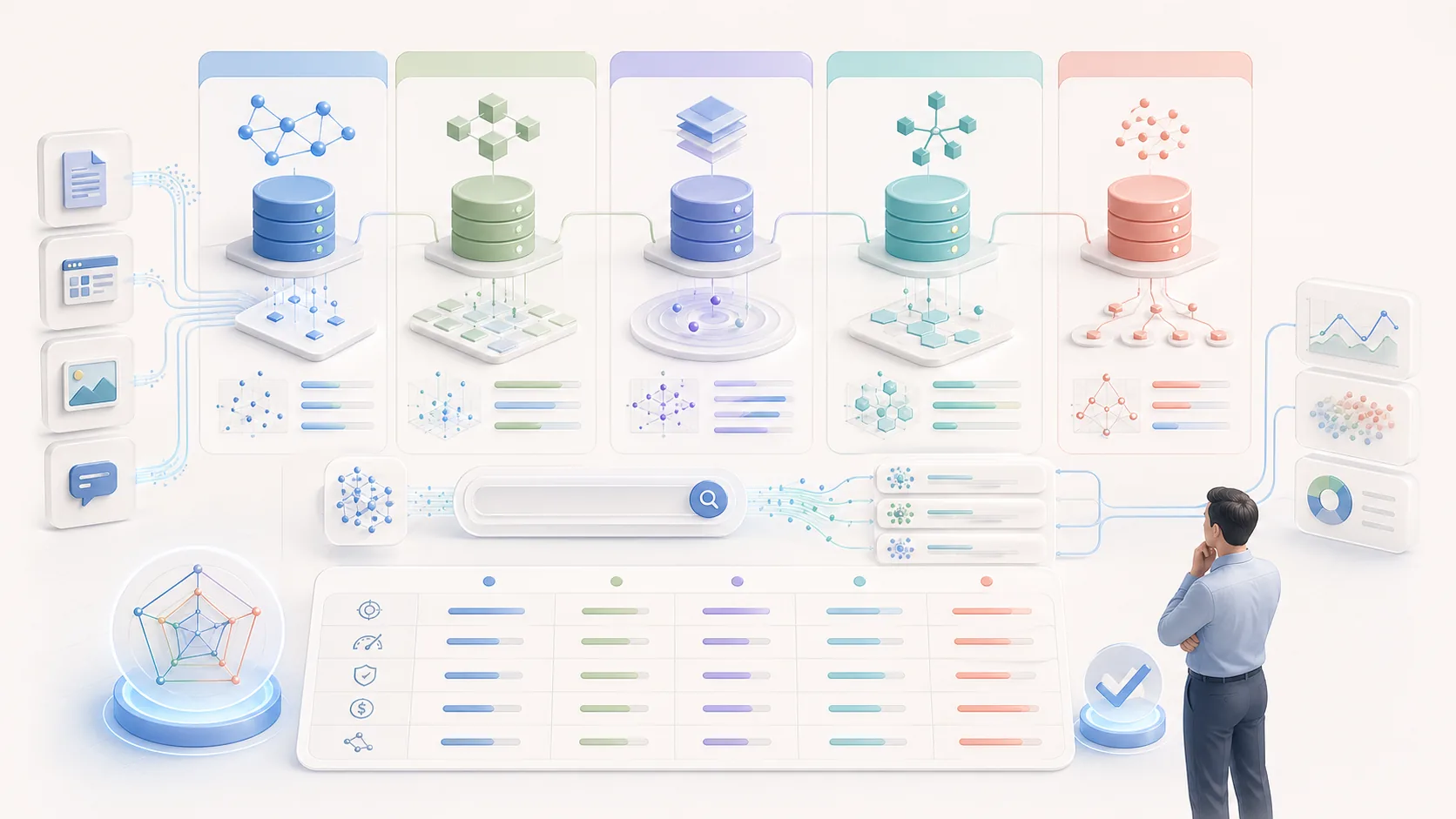
Core capabilities of vector databases
Vector databases are purpose-built to store and query high-dimensional vectors (embeddings)—mathematical representations of unstructured data such as text, images, and audio. Unlike traditional relational databases or search engines, vector databases can perform "semantic similarity search": rather than matching keywords exactly, they find the most relevant results based on semantic closeness. This capability is core to AI applications such as RAG systems, semantic search, recommendation systems, and image search.
The core operating principle of a vector database is "Approximate Nearest Neighbor" search (ANN). When a user submits a query, the system first converts the query text into a vector, then finds the closest set of vectors in the vector space, mapping them to the most relevant document chunks. Mainstream ANN algorithms include HNSW (Hierarchical Navigable Small World), FAISS, and IVF (Inverted File Index), each making different trade-offs among index build speed, query latency, and memory usage.
When evaluating vector databases, several core capabilities deserve particular attention. First is "vector index type": different indexing algorithms have a decisive impact on performance. HNSW offers a good balance of query speed and recall in most enterprise retrieval scenarios and has therefore become the mainstream choice, though its memory footprint is higher than IVF-type indexes, requiring trade-offs in resource-constrained settings. Second is "filtered search capability": filtering by metadata (such as date, department, or document type) alongside semantic search is critical for enterprise RAG systems. Third is "multi-tenancy support": enterprises typically need to isolate data for different departments or customers, so vector databases must provide efficient multi-tenancy mechanisms. Fourth is "embedding update efficiency": when documents are updated, is the system's performance in updating the corresponding vectors sufficient?
In addition, enterprise selection should also consider the data persistence mechanism, backup and restore capabilities, horizontal scaling architecture, and the maturity of integration with mainstream AI frameworks (LangChain, LlamaIndex). Taiwanese enterprises should also pay particular attention to vector search quality in a Traditional Chinese environment, and whether an on-premise deployment option is available to meet data sovereignty requirements.
Mainstream Vector Database Feature Comparison Table
The comparison table below summarizes the five vector database solutions selected for this article. The selection criteria were: solutions commonly considered in enterprise RAG projects, with public documentation verifying their indexing algorithms and deployment methods, and coverage of three distinct positionings—"fully managed SaaS," "open-source self-managed," and "extension of an existing database"—to allow trade-off comparisons. This table does not represent a market-share ranking: market-share data varies by survey methodology across sources, and this article does not draw such inferences.
| Product | Positioning | Deployment Options | Licensing model | Indexing algorithm | Multimodal support | Maximum vector dimensions | Recommended use case |
|---|---|---|---|---|---|---|---|
| Pinecone | Fully managed cloud | Cloud SaaS | Commercial subscription | HNSW | Limited | 20,000 | Rapid prototyping, cloud-first |
| Weaviate | Open-source + multimodal | Cloud / on-premise / Kubernetes | Apache 2.0 (Open Source) | HNSW | Full (text + image + video) | 65,535 | Multimodal RAG, enterprise self-managed |
| Chroma | Lightweight development tool | Local / cloud | Apache 2.0 (Open Source) | HNSW | Limited (primarily text) | 無限制 | Development/testing, small projects |
| Qdrant | High-performance Rust engine | Cloud / on-premise / Docker | Apache 2.0 (Open Source) | HNSW + 量化 | Supported (multi-vector) | 65,535 | High-performance needs, resource-constrained environments |
| pgvector | PostgreSQL extension | Follows PostgreSQL | PostgreSQL License (open-source) | IVFFlat / HNSW | None | 16,000 | Integration with existing PostgreSQL environments |
Pinecone: The fully managed cloud market leader
Pinecone is one of the earliest purpose-built vector databases to enter the market, known for its "zero infrastructure management" cloud SaaS model. Developers don't need to worry about infrastructure configuration, index maintenance, or scaling—Pinecone's backend automatically handles all these details. Pinecone's serverless architecture separates vector storage from compute resources, allowing billions of vectors to be stored at very low cost, with compute charges incurred only at query time.
However, Pinecone's pure-cloud positioning is also its main limitation. For enterprises in Taiwan's finance, government, and healthcare sectors that have strict data sovereignty requirements, transmitting data to Pinecone's US or European data centers may not comply with regulations. In addition, Pinecone's performance on complex metadata filtering queries may fall short of expectations at large scale, and long-term subscription costs can be substantial for high-usage enterprises.
Weaviate: The open-source all-rounder with multimodal capabilities
Weaviate is one of the most feature-complete open-source vector databases available today, leading the market especially in multimodal support: a single database can simultaneously store and search vectors for text, images, video, and audio, and supports cross-modal search (for example, searching for images using a text description). Weaviate has a built-in modular architecture that can directly integrate with various embedding models (including OpenAI, Cohere, and Hugging Face), and it offers both GraphQL and REST API interfaces.
Weaviate supports full on-premise deployment and can run within an enterprise's own environment via Docker or Kubernetes. Its RBAC (role-based access control) and data encryption features make it a viable option for enterprise-grade applications. However, Weaviate's configuration options are complex, its learning curve is steeper, and its memory usage is higher at extremely large scale (billions of vectors).
Chroma: Developer-Friendly Lightweight Tool
Chroma is popular among AI developer communities for its extremely low barrier to entry. A local vector database can be launched with just a few lines of Python code, and integration with LangChain works almost out of the box. Chroma's API is intuitively designed, making it well suited for rapid prototyping and beginners learning RAG.
However, Chroma's production readiness is relatively immature, lacking enterprise-grade features such as comprehensive access control, high-availability configuration, and large-scale horizontal scaling. While Chroma Cloud (the cloud version) is under continuous development, its current functionality and stability are not yet sufficient to meet large-enterprise production demands. Chroma is best suited as a tool for the development and testing phases, and is not recommended for direct use in high-load production environments.
Qdrant: A high-performance engine built with Rust
Qdrant is built in Rust and has notable advantages in performance and memory efficiency. Its quantization technology compresses vectors for storage, significantly reducing memory usage (by 4–32x compared to the original size), making it possible to deploy large vector collections in resource-constrained environments. Qdrant integrates metadata filtering and vector search into a single processing stage (rather than searching first and filtering afterward); in scenarios that require both similarity search and complex conditional filtering, this design helps avoid the problem of too few candidates surviving the filter. Actual performance still needs to be benchmarked against your own data and filter conditions.
Qdrant offers full on-premise deployment support and can be launched quickly via Docker or by running the binary directly. Its REST and gRPC APIs are well designed and support mainstream frameworks such as LangChain and LlamaIndex. Qdrant Cloud also offers a managed cloud option. Its main limitations are the lack of native multimodal support compared to Weaviate, and a relatively smaller community.
pgvector: A vector search extension for the PostgreSQL ecosystem
pgvector is an open-source extension for PostgreSQL that lets enterprises store and query vector data directly within their existing PostgreSQL database, without introducing an entirely new database system. For enterprises that already have PostgreSQL infrastructure, pgvector has the lowest integration cost: existing backup strategies, monitoring tools, and DBA skills can all be reused directly.
However, pgvector cannot match purpose-built vector databases in pure vector search performance, particularly once vector counts exceed one million, where query latency rises noticeably. For production environments with high search accuracy requirements, pgvector's HNSW index (supported only from version 0.96 onward) is the better choice. pgvector is best suited for small-to-medium scale scenarios (under one million vectors) where simplifying the technology stack is a priority.
Performance and scalability analysis
Evaluating vector database performance requires looking across multiple dimensions, and different scenarios weight each metric differently. Below are the main performance evaluation dimensions:
| Performance metric | Pinecone | Weaviate | Chroma | Qdrant | pgvector |
|---|---|---|---|---|---|
| Query latency characteristics | Managed service, includes network round-trip | Self-managed and tunable, varies by index parameters | Single-node oriented, degrades noticeably at larger scale | Rust implementation, designed with resource efficiency in mind | Affected by PostgreSQL query planning and index configuration |
| Throughput scaling method | Read/write units automatically provisioned by the service | Add nodes / horizontal scaling via Kubernetes | Limited scaling options | Distributed mode with sharding and replication support | Depends on PostgreSQL primary-replica and connection pooling setup |
| Memory efficiency | Medium | Low-Medium | Medium | High (via quantization compression) | Medium |
| Filtered search performance | Medium | High | Low-Medium | High | High (native SQL) |
| Horizontal scaling capability | Automatic (fully managed) | Manual / Kubernetes | Limited | Distributed mode supported | Depends on the PostgreSQL setup |
| Recall tunability | Parameters are abstracted away, less room to tune | HNSW parameters can be tuned to trade off recall | Fewer tunable options | HNSW and quantization parameters can be tuned | Adjustable depending on the index type used (HNSW / IVFFlat) |
This table is a qualitative comparison of architectural characteristics, not a benchmark. Each product's actual latency, throughput, and recall will vary substantially with vector dimensions, record count, HNSW's M and ef parameters, whether quantization is enabled, metadata filter conditions, concurrency, hardware specs, and network location—the gap between different configurations of the same product is often larger than the gap between products. Any cross-product numerical comparison is only meaningful if it discloses the above conditions and the test date; we recommend benchmarking directly on your own data, or consulting each product's official documentation and reproducible public benchmark projects.
In large-scale enterprise RAG scenarios, performance evaluation must also account for stability under concurrent queries, the impact on queries during index updates, and the performance degradation curve as the vector collection grows. We recommend that enterprises run stress tests using their own actual data and query patterns before making a selection, rather than relying entirely on third-party benchmarks, since differences in embedding dimensions, metadata filter complexity, and Chinese text tokenization can all significantly affect real-world performance.
Pricing Models and Cost Comparison
Total cost of ownership (TCO) for a vector database needs to be evaluated across multiple dimensions, and different pricing models suit enterprises of different sizes and usage patterns:
| Product | Free tier | Pricing basis | Estimated monthly cost (1 million vectors, moderate query volume) | On-premise licensing fee |
|---|---|---|---|---|
| Pinecone | Yes (2GB storage, limited free QPS) | Read/write units + storage capacity | USD $70–300 | N/A (cloud-only) |
| Weaviate | Yes (Weaviate Cloud Sandbox) | Node count + storage capacity | USD $25–150+ | Free and open-source (enterprise support billed separately) |
| Chroma | Open source completely free | Cloud version priced by usage | Free locally; cloud pricing TBD | Free and open-source |
| Qdrant | Yes (1GB RAM, 1 cluster) | Node specs + RAM capacity | USD $20–100+ | Free and open-source (enterprise edition billed separately) |
| pgvector | Fully free and open-source | Bundled with PostgreSQL infrastructure | Based on PostgreSQL hosting cost | Completely Free |
The monthly costs above are rough order-of-magnitude references, not official quotes. Free tiers, pricing units (read/write units, node specs, storage capacity), and plan structures differ across vendors, and are subject to change by region, read/write volume, and product version; before estimating your own costs, please refer to each vendor's latest official pricing page and confirm how the pricing units translate to your own query volume.
From a long-term TCO perspective, open-source options (Weaviate, Qdrant, pgvector) are generally more cost-effective than commercial SaaS at large scale, but operational labor costs need to be factored in. For small and midsize enterprises with limited technical team resources, fully managed offerings like Pinecone or Weaviate Cloud can save substantial operational effort, and their overall cost in the early stages is not necessarily higher than a self-managed solution. When vector counts exceed 100 million, or daily query volume exceeds several million, we recommend running a detailed three-year TCO calculation before making a final decision.
On-Premise vs. Cloud Deployment Options
For Taiwanese enterprises, the choice of deployment method is often shaped by data sovereignty and regulatory compliance considerations. The financial industry (regulated by the Financial Supervisory Commission), the public sector and critical infrastructure providers (subject to the Cyber Security Management Act framework, under which cyber security responsibility levels are divided into five tiers, A through E, each with different required actions), and healthcare institutions (which handle special categories of personal data as defined under the Personal Data Protection Act) are, in practice, frequently required to deploy on-premise or keep data resident within the country—though this is not universally the case. Whether it's required depends on data classification and sensitivity, the enterprise's role in the processing activity, whether international transfer is involved, the terms of contracts and procurement documents, and other controls already in place. If your organization's regulations or contracts require that data not leave the country or not be hosted externally, then purely cloud-based offerings are ruled out, and self-manageable options such as Weaviate, Qdrant, Chroma (self-managed), and pgvector become common choices. The actual scope of applicability and operational requirements should still be based on the latest announcements from the competent authority and your company's legal determination; the relevant provisions can be found atLaws & Regulations Database of the Republic of China (Taiwan)for reference.
Hardware requirements for on-premise deployment primarily depend on the size, dimensionality, and query throughput of the vector collection. To estimate memory, you can first calculate the raw size of the vectors themselves: the number of vectors multiplied by the dimensions, multiplied by the byte size of each element. For 1 million vectors at 1536 dimensions in float32 (4 bytes), the raw vector data is about 1,000,000 × 1536 × 4 bytes, roughly 6 GB. This is only a lower bound: actual usage must also add the HNSW graph structure (which grows with the connectivity parameter M), metadata and payload, and caching and working memory at query time. Planning therefore typically reserves several times the raw size as a margin—the exact multiplier needs to be confirmed through testing with your chosen index parameters and implementation, and should not be assumed as a fixed number.
Quantization is the primary means of reducing memory requirements: converting each element from float32 to a lower-precision representation (such as scalar quantization to int8, or binary quantization to 1 bit). The theoretical compression ratio can be derived directly from the bit count: int8 is about a quarter of float32, and binary quantization is even smaller. The trade-off is reduced recall, so in practice a two-stage approach is often used—coarse filtering with a quantized index, followed by rescoring with the original vectors to recover accuracy. How much compression is actually achievable and how much recall is lost must be measured on your own data using an evaluation set, since the impact of compression on accuracy varies with data distribution.
A hybrid deployment strategy is also worth considering: deploying vector collections containing confidential data on-premise, while placing non-sensitive public information (such as a company website or product descriptions) in the cloud, routed through a unified application layer. This architecture protects sensitive data while still taking advantage of the cloud's elastic scalability.
Enterprise selection decision guide
Based on differences in enterprise size, technical capability, and requirements, we offer the following selection recommendations:
- Startups / rapid prototyping phase (vector count < 1 million, cloud-first): We recommend Pinecone Serverless or Weaviate Cloud. Low operational burden, fast time-to-launch, and costs stay within a controllable range.
- Technically mature midsize enterprises (moderate data security requirements, self-managed): We recommend on-premise deployment of Weaviate or Qdrant. Both have full community support and enterprise-grade features, with relatively controllable long-term costs.
- Finance / government / healthcare (strict data sovereignty requirements): We recommend on-premise Qdrant (excellent performance, high resource efficiency) or pgvector (if PostgreSQL infrastructure already exists).
- Enterprises with an existing PostgreSQL environment (small to midsize): We recommend starting with pgvector, and evaluating a migration to Qdrant or Weaviate if performance proves insufficient.
- Enterprises that need multimodal search (mixed image + text): Weaviate's built-in vectorization modules for multiple modalities make it a common candidate for evaluating this kind of need; we recommend first confirming the required model integration method and licensing terms.
- Learning and development/test environments: Chroma offers the best developer experience and is well suited for quickly validating RAG concepts. Production environments should use another solution.
Regardless of which vector database you choose, the factors that truly determine the ultimate effectiveness of a RAG system are: the quality and completeness of knowledge base documents, the selection and optimization of the embedding model, the design of the document chunking strategy, and ongoing evaluation and iteration. A vector database is only one component of the overall RAG system, and needs to be evaluated together with the overall architecture design and business requirements.
Further Reading
FAQ
References
- ANN Benchmarks (2024). "Approximate Nearest Neighbor Algorithm Benchmarks." ann-benchmarks.com
- Pinecone (2024). "Vector Database Benchmark Report 2024." pinecone.io
- Weaviate (2024). "Weaviate Documentation: Architecture." weaviate.io
- Qdrant (2024). "Qdrant Documentation: Quantization." qdrant.tech
Looking for the Right RAG Architecture Solution for Your Enterprise?
Contact our technical consultants to evaluate the vector database best suited to your scenario, and to develop a complete RAG system-building strategy.
Contact Us