Understanding television media monitoring to help brands anticipate public opinion
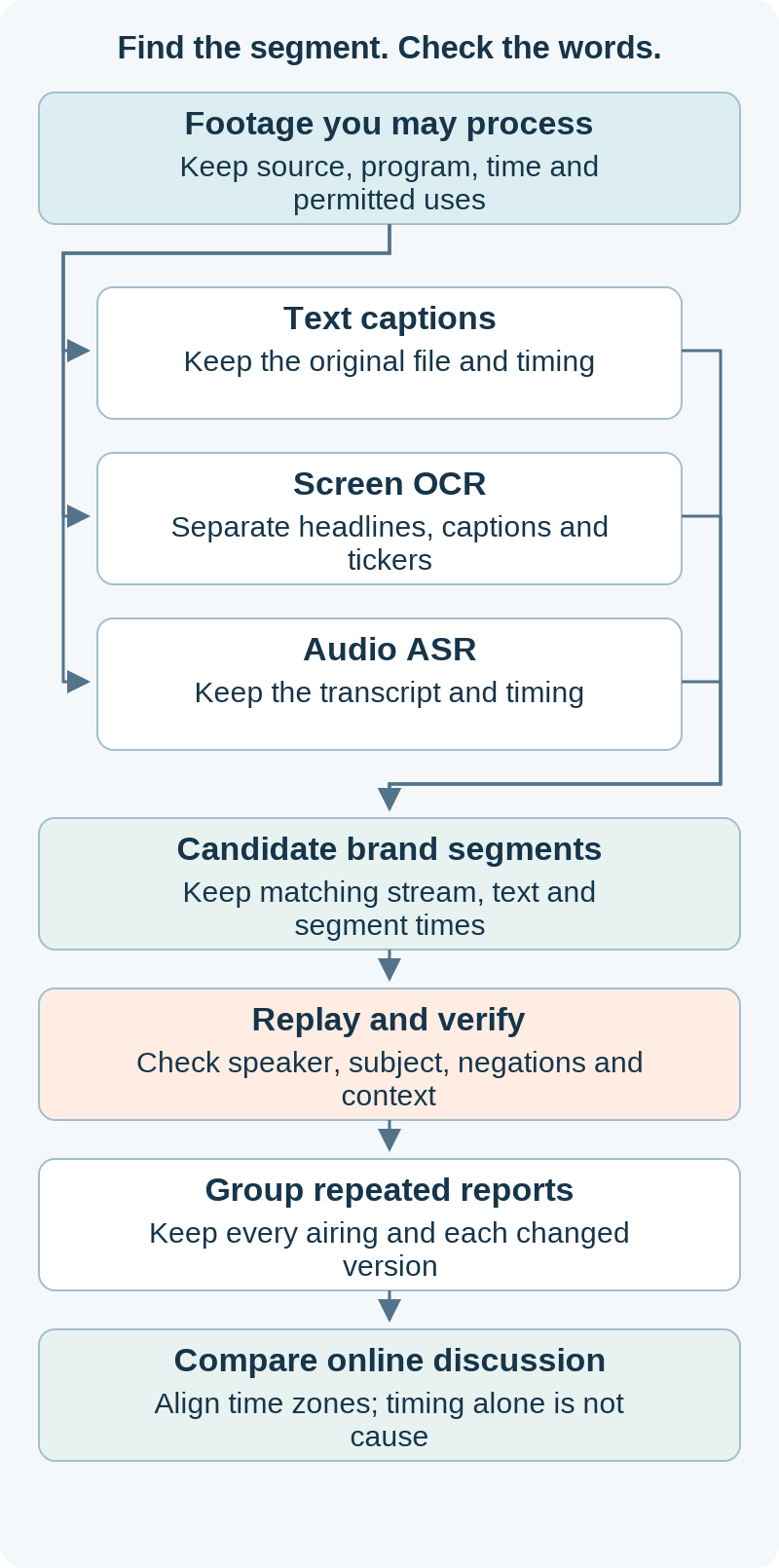
Television monitoring turns lawfully usable footage, on-screen text and broadcast information into searchable, traceable records. OCR detects on-screen text, ASR transcribes spoken mentions and available text captions provide a third timed source. A match in any stream identifies a candidate segment, which must be replayed to establish the speaker, subject, negations and context before a quotation enters a report. Keep airing records alongside distinct-story groups, retaining changed versions whenever a repeat adds information. Compare television coverage with online posts using consistent time zones, brand definitions and observation periods; airings, posts and audience size are different units, and a post-broadcast rise alone does not prove causation. FFmpeg supports media extraction, Whisper provides speech transcription and Cloud Vision handles image text detection. For an integrated service such as InfoMiner, confirm source coverage, usage rights, footage access and review capabilities rather than assuming every step in a general workflow is a supplied product feature.
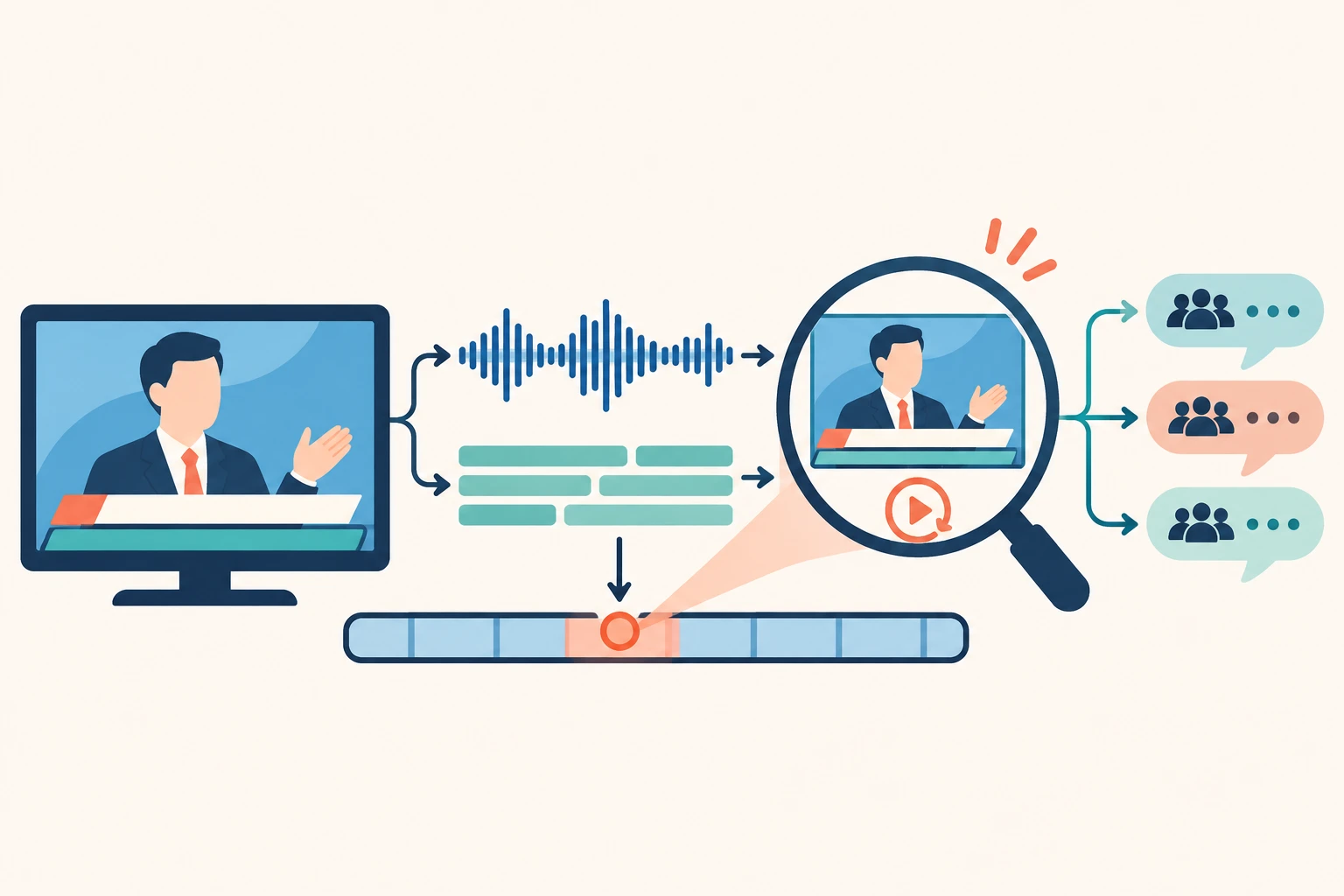
Public opinion can support a brand or undermine the work behind it. When a public relations crisis occurs, adverse discussion may affect what the brand has built, and television coverage can make the consequences difficult to anticipate. How can a team respond early? This article introduces television media monitoring as a way to notice changes in discussion and support verification and response.
In practice, seeing a brand name on screen does not automatically mean the presenter is talking about that brand. The text may come from an unrelated ticker, a sponsor logo on a backdrop, or packaging in an archive clip. Conversely, an interviewee may mention a product aloud with no caption on screen at all. To be useful, television media monitoring has to answer three questions: which segment actually concerns the brand, what was really said, and how that coverage relates to online discussion.
What is television media monitoring, and how do traditional and modern methods differ?
Television media monitoring collects and analyzes text appearing in moving television images to help interpret public discussion. Traditionally, staff watched several channels and recorded content related to a target topic, a process in which human oversight could miss important information. As technology developed, OCR systems using artificial intelligence made it possible to monitor television images through software, broaden the screening process and organize findings into reports.
In practice, modern television monitoring extends well beyond reading words off a screen: it organizes lawfully accessible footage, on-screen text, and broadcast details into records teams can search, replay, and compare. While optical character recognition (OCR)—which converts text in images into searchable characters—helps shoulder the multi-channel screening workload, pairing it with automatic speech recognition (ASR) to transcribe audio and with any available captions closes the blind spots left by visual text alone. Automated recognition surfaces candidate segments, but confirming brand attribution and exact quotations still requires returning to the original recording.
OCR is well suited to locating headlines, tickers, interviewee names, and product labels—on-screen text that often signals what a report is about. By turning large collections of video frames into searchable text, it expands what a team can review. Even so, every detected phrase must keep its screen position: a lower-third ticker may belong to an unrelated story, and qualifiers such as “suspected” must not disappear during reporting. Motion blur, animated graphics, and briefly displayed names can also cause OCR to miss or misread text.
ASR fills in what can only be heard. When a presenter mentions a brand without a title card, or an interviewee describes a product issue aloud, speech transcripts give teams a way to surface that moment. Even then, personal names, Taiwanese speech, regional accents, mixed languages, background music, and overlapping voices still require careful listening. As the official Whisper model card warns, speech recognition can generate text that was never spoken in the audio—so a fluent transcript is never the same as a verified quotation.
Captions fall into two distinct categories as well. Accessible text captions, such as SRT or VTT files, usually include timing and can save a recognition pass, though they may be machine-generated, translated, or condensed. Captions burned directly into the video image still require OCR. Because neither format is guaranteed to be verbatim, store screen appearances, spoken mentions, and caption text in separate fields: pull candidate segments matched by any stream first, then verify whether those streams actually refer to the same story.
Why monitor television news discussion and advertising?
Even with the rise of online media, television remains an important channel. Governments use it to communicate public policy, and companies can present brands and prompt discussion through television exposure. Conversely, the many television channels may carry content about a company that it cannot always control in advance. A major event or adverse public discussion affecting operations may also harm the brand. Monitoring television news and advertising therefore helps teams respond to changes in discussion.
In practice, news and advertising call for different checks. For news coverage, establish who is speaking, what they are saying, and whether the claim is a factual statement or an attributed account. For advertising, define the brand, creative version, core message, and agreed time window up front before verifying actual airing records. Always label a company’s own advertising separately from third-party news; an on-screen brand name alone does not prove viewing, approval, or purchase.
How can television monitoring with OCR help a business?
OCR using artificial intelligence can assist the traditional work of watching television, turning on-screen text into searchable data that supports reports and public-opinion analysis. Recognition errors, omissions and context still require human review. Television monitoring can support the following four brand tasks.
1. Analyze public discussion and prepare a response
Television discussion analysis gathers content related to keywords and helps a team identify information unfavorable to its brand, allowing time to make decisions and supporting its response and communication.
Practice with footage you are allowed to process
How does that work step by step? To walk through the workflow, consider a hypothetical exercise using a team-recorded mock news clip, demo.mp4, covering a packaging issue at the fictional brand “Qinghe Tea.” This is an illustrative drill, not a customer case or an allegation about any real business. In production, use owned footage, licensed material, or sources whose terms explicitly permit the intended processing. Being able to watch a video online does not grant permission to download, transform, or redistribute it, so confirm permitted uses and retention rules before processing begins.
Before running any recognition tool, create a source record containing an asset ID, source URL or file path, channel and program, broadcast date and time zone, recording start time, duration, and permitted uses. Be careful to separate the elapsed position inside a file from the actual broadcast clock: if an uninterrupted recording begins at 18:00:00 Taiwan time, position 00:03:12 corresponds to 18:03:12, whereas an edited upload cannot be mapped by simple addition.
Next, use ffprobe to inspect available subtitle streams. If usable text subtitles exist, preserve the original file along with its language and timing; if none exist, or if captions are burned into the picture, process audio and video frames separately. With FFmpeg installed, technical staff can follow the official documentation and test commands such as:
ffmpeg -i demo.mp4 -vn -ac 1 -ar 16000 demo.wav
ffmpeg -ss 00:03:12 -i demo.mp4 -frames:v 1 frame-0312.png
The first command extracts mono audio for speech recognition, while the second saves a single frame near the target timestamp to inspect a brand label. For ongoing monitoring, the fps filter can sample frames at a fixed interval before OCR processes headlines, captions, and tickers as separate regions. Keep in mind that sparse sampling can miss brief title cards—finding no brand in sampled frames does not prove it never appeared in the video.
Turn recognition output into traceable search results
Once the audio is extracted, Whisper can transcribe it locally. After installing its Python package and FFmpeg according to the official instructions, run this command on the exercise's Mandarin recording:
whisper demo.wav --model turbo --language Chinese --task transcribe --output_format all --output_dir transcriptPreserve the raw transcript and timing, then search for the Chinese brand name, “青禾茶飲,” along with its aliases and product names. The Chinese flag fits this exercise, though it does not guarantee accurate recognition across every language or mixed-language broadcast in Taiwan. Whenever a key name is misheard, replay the audio and enter the correction in a separate reviewed field while keeping the raw machine output intact. Using the transcribe task keeps the text in the source language, reducing the risk of mistaking a translation for the original words.
For video frames, Google Cloud Vision's TEXT_DETECTION offers a managed OCR option. Once you enable the service, configure authentication, and confirm that the material may be sent to the cloud, submit one practice frame and inspect the returned JSON text and bounding boxes. Link every detection back to its asset ID, frame timestamp, and crop region rather than saving only a single merged text block—that way, if a ticker is misread as another brand, a reviewer can jump straight back to that image to verify it.
Once all three text streams are ready, combine their hits into a candidate list with one row per segment, retaining the asset ID, relative start and end times, broadcast details, matching stream, original text, frame reference, and review status. Matching any stream catches audio-only and screen-only mentions, whereas requiring agreement across all three can filter out relevant coverage. Fuzzy matching and similar-sounding names can broaden retrieval, provided they are never counted as confirmed mentions until reviewed.
Check the original words before deciding on a response
If a candidate begins at 00:03:12, replay enough footage before and after that mark to capture the speaker, the question, and the complete answer. Establish who is speaking, whom they are referring to, and whether the statement is a confirmed fact, an allegation, a reported claim, or a rebuttal before recording the quotation. Pay close attention to negations, numbers, dates, and speaker identity: “a suspected product problem” must never be condensed into “a product problem.” When only the ticker matches while the audio covers another story, label it as an on-screen mention and assess its relevance separately.
Every quoted passage should carry its source, channel, program, broadcast time, and retrievable segment position, with verbatim quotations, analyst summaries, and AI summaries kept clearly distinct. Mark unclear audio as awaiting confirmation, then check the original broadcast or ask a second reviewer to listen—a second generated summary cannot validate the first transcript. Where rights allow internal analysis only, external reporting requires its own permitted arrangement.
2. Find emerging topics and explore sales opportunities
Television monitoring can support more than responses to negative discussion. It can also identify emerging topics as a reference for marketing planning and help a team assess whether a trend offers an appropriate opportunity to communicate brand information.
On a packaging topic, for example, first separate recurring questions about recycling, convenience, and quality before comparing them against online discussion. Rising topic interest can inform a demand hypothesis, but a real sales opportunity still requires consumer research or campaign validation.
Next, place verified television clips alongside online news, public posts, and comments on a shared timeline using one time zone, consistent brand definitions, the same observation window, and aligned topic labels. Track distinct television stories, airings, and narratives separately from original posts, reposts, comments, and online source coverage. The two streams inform each other, yet three airings and three posts are different units—combining them does not produce an audience count.
From there, look for content links: does a post link back to the program, quote the same sentence, or reuse its footage? Or was the allegation already circulating online before television picked it up? If discussion rises after a broadcast, describe that sequence strictly as a temporal relationship; without verifying content links, collection coverage, and other factors, timing alone cannot establish that television caused negative reactions. Check who is actually being criticized as well—disapproval of a media headline is not necessarily disapproval of the brand.
3. Understand public opinion and adjust marketing strategy
Collecting television coverage of offline events and feeding findings back into decisions can inform the next marketing activity. Whether it meets its targets must be verified separately against indicators set in advance.
In practice, document the core message the activity was intended to convey, then verify how news and advertising actually presented it, noting any omitted conditions or misunderstandings. Keep broadcast narratives and online responses in separate fields. Assessing changes in sales or brand favorability still requires independent sales, survey, or experimental evidence; airing counts cannot stand in for outcomes.
4. Analyze competitors’ presence on television
Television monitoring can show how media discuss a company’s products and competing products, including favorable and unfavorable assessments. These observations can inform product strategy and generate market or product opportunities for further validation.
When comparing your brand with competitors, apply the same channels, observation period, name definitions, sentiment rules, and repeat-grouping criteria, and separate news, advertising, and sponsorship exposure. That makes it possible to tell whether coverage reflects multiple distinct topics or repeated airings of a single story, rather than mistaking more airings for a stronger product assessment.
Group repeats while retaining every airing
Handling repeats carefully is essential because rebroadcasts can make brand search volume appear to surge overnight. To avoid distortion, maintain both individual airing records and distinct-story groups. Similar transcripts and frame sequences help flag potential repeats, but replay is still required to check for new interviews, updated figures, corrected graphics, or different commentary. Similarity does not prove identity, and a single matching frame or headline is never enough on its own.
As a hypothetical example, three identical repeats of one report can be recorded as three airings within one distinct-story group, while a fourth airing that adds the brand's response should be kept as a changed version linked back to that group. Deduplication is meant to separate new content from repeated distribution without erasing broadcast timestamps. Likewise, airing counts and duration cannot directly establish audience size or brand approval.
Taken together, these verified records support all four monitoring uses: crisis work pinpoints claims that need verification and a response; topic exploration surfaces emerging needs rather than chasing buzz alone; campaign evaluation checks whether intended messages were conveyed accurately; and competitor research compares topics under consistent coverage and repeat-grouping rules. For a complete deliverable, continue with the sentiment analysis report tutorial; for recurring consumer needs, see social listening.
InfoMiner real-time public-opinion analysis with OCR | LargitData
Developed by LargitData, InfoMiner uses OCR and artificial intelligence to analyze television images and condense public-discussion information into summaries. Teams can receive highlights through Email and LINE and then consult the underlying content; summaries and notifications do not replace checking the original material. For crisis response, topic discovery and campaign monitoring, evaluate whether InfoMiner meets the team’s source-coverage and verification needs.
According to its official product overview, InfoMiner covers television and online sources, OCR, speech recognition, and highlight summaries via Email or LINE. Teams looking to reduce custom collection and alert maintenance can configure brand names, aliases, products, and exclusions, select observation sources, and evaluate the platform against a permitted, manually verified segment list—checking which segments are retrieved, which matches are irrelevant, how reliably results trace back to their sources, and how to refine queries when items are missed.
During evaluation, keep a human-reviewed test sheet covering audio-only mentions, ticker-only matches, similar-sounding names, negations, and updated repeats. Check whether the service retrieves relevant segments, filters out unrelated matches, and enables another colleague to trace the evidence back to the original words. Ultimately, the deliverable that matters is a verifiable record with clear limits that supports the next decision.
For another OCR application, see Combining RPA and OCR to reduce repetitive document work.